TL;DR
A newborn does not need body wash at every bath: warm water often handles routine cleaning, and a small amount of mild, fragrance-free baby cleanser can help with visible mess. Check the full ingredient label, use age-appropriate products, rinse well, and ask your pediatrician about premature babies, eczema, or persistent irritation. When comparing alternatives to Baby Dove Sensitive Skin Hydrating Body Wash, treat product claims as label details to verify because formulas can change.
For routine newborn cleaning, warm water is often enough; cleanser is most useful when milk, spit-up, or diaper residue sticks to the skin. That choice matters because a wash can remove grime, but repeated or unnecessary cleansing may also dry or irritate delicate newborn skin. Using less product can be a practical way to keep bathing gentle.

Give the gift of listening to the whole family
- Choose a 1-, 3-, 6- or 12-month membership
- They pick the audiobooks they love
- Easy to send by email
If Baby Dove Sensitive Skin Hydrating Body Wash is hard to find, compare alternatives by their current ingredient lists, fragrance wording, and age guidance rather than assuming a similar name or claim means a similar formula. This guide explains what those label details can tell you, when cleanser may help, and how to bathe safely while keeping one hand on your baby.
Newborn skin is thinner and more easily irritated than adult skin. A label cannot predict how every baby will respond, so stop using a product that appears to cause irritation. For a premature baby, eczema, or ongoing skin trouble, ask your pediatrician for advice tailored to your child. Formulas and labels can change, so check the bottle in your hand and the CPSC recall database before buying child products.
Warm water often handles a routine newborn bath; save cleanser for visible dirt or residue.
Check fragrance wording and the full ingredient list; “hypoallergenic” does not mean allergy-proof.
Use a small amount, rinse thoroughly, and pat skin dry rather than rubbing.
Compare alternatives to Baby Dove by current formula and label details, then verify product claims on the package.
Keep one hand on your baby near water, check CPSC recalls, and ask your pediatrician about premature babies, eczema, or persistent irritation.
Why water alone often works for your newborn
Warm water is often enough for a routine newborn bath; body wash is optional and most useful for visible dirt or residue. A newborn’s skin is thinner and more easily irritated than adult skin, so frequent cleansing can dry it. Think of cleanser as a small tool for a particular mess, not a required step for every bath.
For example, after a quiet morning with a clean diaper and no spit-up, you can wash the face and folds with water and a soft cloth. After a milky feed leaves a sticky patch under the chin, a tiny amount of mild cleanser may help lift the residue. Rinse that spot thoroughly, then pat it dry.
Many babies do not need a daily bath. You can clean the face, neck folds, hands, diaper area, and any messy spots as needed between baths. This lets you keep the routine flexible: a little milk in a neck fold calls for careful cleaning, while a clean, calm baby may need only a quick wipe.
There is no universal start date or schedule that fits every newborn. A baby born early, or one with a skin condition, may need different guidance; ask the clinician who knows your child. For an uncomplicated bath, focus on short sessions, warm water, and gentle handling rather than a strict calendar.
Think of cleanser as a spot tool. If you cannot point to a patch of dirt or residue, water may be all your baby needs that day.
Picture the practical difference: you are changing your baby after a small spit-up. A damp cloth can clean the skin without covering the whole body in lather. That keeps bath time simple and gives you fewer product ingredients to rinse away.
Products Worth Considering

Graco Outpace LX All-Terrain Stroller

Nanit Smart Baby Monitor with 1080p Camera and Floor Stand

Graco Modes Pramette 3-in-1 Travel System with Infant Car Seat, Ellington
As an affiliate, we earn on qualifying purchases.
How to choose a gentle wash without guessing
Choose a baby or sensitive-skin cleanser with a short, clear ingredient label, and look for fragrance-free wording if your baby’s skin is easily irritated. That label is a starting point, not a promise: “hypoallergenic” does not mean allergy-proof, and “natural” or “organic” does not guarantee a gentler result. Check what is actually in the bottle.
Fragrance-free and unscented can mean different things. Fragrance-free generally means no fragrance has been added, while an unscented product may contain ingredients that mask odors. If you are choosing between two bottles for sensitive skin, read the ingredient list rather than relying on the front label alone.
For instance, imagine two washes on a store shelf. One says “natural” in large green letters but has a strong scent; the other has plainer packaging and clearly says fragrance-free. The second may be a better fit for a baby who gets dry patches, though no label can predict how every individual baby will respond.
Strong scents, dyes, and some detergents or preservatives can irritate skin. Product formulas also change, so a past purchase is not a substitute for checking the current package. If a product leaves your baby’s skin red, dry, or uncomfortable, stop using it and rinse the area.
Some brands now highlight sensitive-skin, eczema-prone, or skin-barrier claims. Those terms can help you find relevant products, but they do not replace the ingredient list or medical guidance. If your baby has persistent irritation, cracked skin, or a known skin condition, ask your pediatrician what cleanser and moisturizer to use.
- Look for: baby or sensitive-skin labeling and clear directions.
- Check: the ingredient list, fragrance wording, and age guidance on the bottle.
- Use caution with: “hypoallergenic,” “clean,” and “plant-based” claims, which do not guarantee a match for your baby.
Before buying any child product, check the CPSC recall database and the manufacturer’s current product information. A bottle that looks familiar may have a different formula or package than the one you remember.
How to bathe your newborn safely in a few simple steps
Prepare everything before you start, keep one hand on your baby, and never leave a baby alone in or near water. Safe bathing depends on attention and setup more than on the product you choose. Even a shallow basin requires your full focus; a phone ringing or a towel across the room can create a risky distraction.
- Set out the supplies. Place a towel, clean diaper, clothes, washcloth, and any cleanser within reach before bringing your baby to the bath.
- Use a small amount. Wet a soft cloth and add only a little cleanser if the skin has visible mess. You do not need a big capful to clean a small patch.
- Wash gently. Clean the face and folds carefully, keeping cleanser away from the eyes. Use a soft cloth rather than scrubbing.
- Rinse and dry. Rinse cleanser off fully, then pat the skin dry, especially in folds. Rubbing can irritate tender skin.
- Finish within reach. Keep your baby with you as you move from bath to towel and dressing area.
Imagine a bath after a leaky diaper: the supplies are ready, the cloth is damp, and you use a little wash only where residue remains. The rest of the baby gets a gentle rinse. That scene is easier to manage than trying to open a bottle or find a towel while holding a slippery newborn.
Newborn baths can be short and infrequent. If your family routine includes a bath, keep it calm and simple; you can clean messy spots between baths. If your baby was premature or has a medical condition, follow the bathing advice from your baby’s clinician.
Age-appropriateness matters. Use a product whose label is intended for your baby’s age, and read any directions or warnings. Before purchasing, check for CPSC recalls and review current manufacturer information, especially if a product has been sitting in a cupboard for a while.
How to compare alternatives to Baby Dove Sensitive Skin Hydrating Body Wash
Compare alternatives by formula, skin-type claims, and testing details, not by bottle size alone. Baby Dove Sensitive Skin Hydrating Body Wash has been described as tear-free and hypoallergenic, made without dyes, parabens, sulfates, or phthalates, and intended for sensitive skin; the referenced bottle size is 34 ounces. A product with a smaller bottle can still be a closer match if its label better fits your baby’s needs.
Product listings and packaging can change, and a product that appears unavailable in one place may still show up elsewhere. Treat the options below as candidates to check, not guarantees of current stock or a perfect substitute. Verify the exact variant and current label before choosing.
| Product named in source details | What the listed specs share | What to verify on the current package |
|---|---|---|
| Johnson’s Skin Nourishing Baby Wash, Vanilla & Oat, 20.3 fl oz | Hypoallergenic, pH-balanced, tear-free; listed for delicate skin | Whether the scented variant suits your baby and its current ingredient list |
| Baby Dove Calming Moisture Hypoallergenic Baby Wash, 13 oz | Tear-free and hypoallergenic; listed for sensitive skin | Current formula, directions, and ingredients |
| Baby Dove Sensitive Skin Care Rich Moisture Baby Wash | Tear-free and hypoallergenic; testing listed as pediatrician, dermatologist, and ophthalmologist tested | Current size and whether the formula matches your preferences |
| Johnson’s Baby Comfort Touch Newborn Baby Wash & Shampoo, 13.6 fl oz | Hypoallergenic and pH-balanced; testing listed as pediatrician- and dermatologist-tested | Current age guidance, ingredients, and package claims |
The listed specs are useful for narrowing the shelf, but terms like “tear-free” describe product claims and do not mean you should wash near the eyes. If your baby has sensitive skin, compare fragrance and ingredients directly. For example, a scented vanilla and oat wash may be less appealing to a parent specifically seeking fragrance-free care, even if other listed claims overlap.
Use this comparison as a starting point, then confirm the package in front of you. Ingredient lists, sizes, testing claims, and formulas can shift. A product’s testing statement also does not establish that it is the right choice for a particular skin condition; your pediatrician can advise on that question.
What to do when your baby’s skin gets dry or irritated
Stop a cleanser that seems to irritate your baby’s skin, rinse the area, and ask your pediatrician if symptoms persist or look concerning. Redness after a bath can have several causes, and a product label cannot diagnose the problem. A change in routine may help, but ongoing or worsening symptoms deserve medical advice.
For example, if your baby develops a red patch after you try a new scented wash, rinse the skin with water and stop using that product. Note when the patch appeared and which products touched the area. If the rash spreads, lasts, or becomes severe, contact your pediatrician rather than testing more products one after another.
If your baby has dry skin or eczema, gentle fragrance-free care is often a reasonable topic to discuss with the clinician. Ask whether to use cleanser, how often to bathe, and whether a simple moisturizer fits your baby’s care plan. Cracked, very itchy, worsening, or non-improving skin calls for personalized guidance.
Not every baby needs lotion after a bath. If the skin looks dry, ask your clinician which simple fragrance-free moisturizer to use rather than adding several new products at once. A new lotion plus a new wash makes it harder to tell which product caused a reaction.
Seek urgent care for a severe reaction or symptoms such as swelling or trouble breathing. Those symptoms need prompt medical attention. For a mild patch, keep the routine simple while you contact your child’s clinician for next steps.
Change one product at a time. If a new wash and lotion appear on the same day, you will have a harder time identifying what bothered the skin.
“Hypoallergenic” can be a helpful label to notice, but it is not a guarantee against reactions. Your baby’s skin is the real-world test, and your pediatrician is the right person to guide care when irritation does not settle.
What a newborn bath looks like when you keep it simple
A simple bath uses warm water for routine cleaning and saves a little cleanser for the spots that need it. That approach can shorten bath time and limit unnecessary product exposure. It also gives you a repeatable routine on evenings when you are tired and the room is warm with towel steam.
Suppose your newborn has a small milk spill under the chin and a clean diaper area. You can wipe the chin with a damp cloth, use a trace of mild cleanser if residue clings, rinse it well, and clean the diaper area separately. There is no need to lather the arms, legs, and back just because the bottle is open.
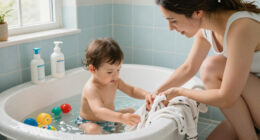
For a bath, gather everything first: a soft cloth, towel, clean diaper, and clothing. Keep one hand on your baby throughout, and never step away while the baby is in or near water. When you finish, pat rather than rub, paying attention to the little folds where moisture can linger.
Some babies enjoy the warm water; others protest the first splash or cry when the air hits their damp shoulders. Move steadily and gently, and keep the bath short. A calm, secure hold matters more than making the routine look like a long spa ritual.
Between baths, clean the face, neck folds, hands, diaper area, and visible mess as needed. If the baby has a rash, unusual dryness, or a medical condition, get guidance from the pediatrician. The goal is clean skin and a safe, comfortable baby, not a perfectly scented bathroom.
Gentle products are only one part of gentle care. A soft cloth, a small amount of cleanser, thorough rinsing, and a steady hand all shape the experience. Your baby’s bath can be a quiet basin, a warm towel, and just enough washing to leave the skin comfortable.
Frequently Asked Questions
Does a newborn need body wash?
No. Warm water is often enough for routine newborn bathing, and you can use a small amount of mild cleanser for visible dirt or residue. Ask your pediatrician if your baby was premature or has a skin condition.
How often should I bathe my newborn?
Newborns usually do not need a bath every day. You can clean the face, neck folds, hands, diaper area, and messy spots as needed between baths. Your baby’s clinician can advise if a medical or skin condition affects the routine.
Is fragrance-free better than unscented?
Fragrance-free generally means no fragrance has been added, while an unscented product may contain ingredients that mask odors. Check the ingredient list, especially if your baby has sensitive skin.
Can I use adult body wash on my baby?
A cleanser made for babies or sensitive skin is usually a better starting point because adult body washes may contain stronger fragrances or detergents. Read the age guidance and ingredient list, and stop using it if it irritates your baby’s skin.
What should I do if a wash causes a rash?
Stop using the product and rinse the skin with water. Contact your pediatrician if the rash is severe, spreading, persistent, or accompanied by swelling or other concerning symptoms; trouble breathing needs urgent care.
Should I use lotion after bathing my newborn?
Not every baby needs lotion. If your baby’s skin looks dry, ask a clinician whether a simple fragrance-free moisturizer fits your child’s care. Introduce one product at a time so you can spot a reaction.
Conclusion
Remember the simplest rule: use water for routine newborn cleaning and a little mild cleanser only when a mess calls for it. Check the label, use an age-appropriate product, and let your pediatrician guide care for a premature baby or persistent skin trouble.
Set the towel within reach, keep your hand on your baby, and let bath time end with soft, clean skin—not a bottle full of foam.