Cooking with children offers a fun way to teach early math skills. You can help them learn measurement by pouring ingredients, practice division by sharing items equally, and boost counting and sequencing as they follow recipe steps. Patterns emerge as they add ingredients, and attention to detail develops through precise measuring. These activities build confidence and make math feel practical and enjoyable. Keep exploring; you’ll discover even more ways to make learning math hands-on and engaging.
Key Takeaways
- Cooking activities help children develop measurement skills through pouring, leveling, and comparing ingredients.
- Dividing ingredients into equal parts introduces early division and sharing concepts practically.
- Following recipes enhances counting, sequencing, and pattern recognition in a real-world context.
- Emphasizing precise measurements teaches attention to detail and the importance of accuracy.
- Collaborative cooking fosters confidence, social skills, and the practical application of early math concepts.
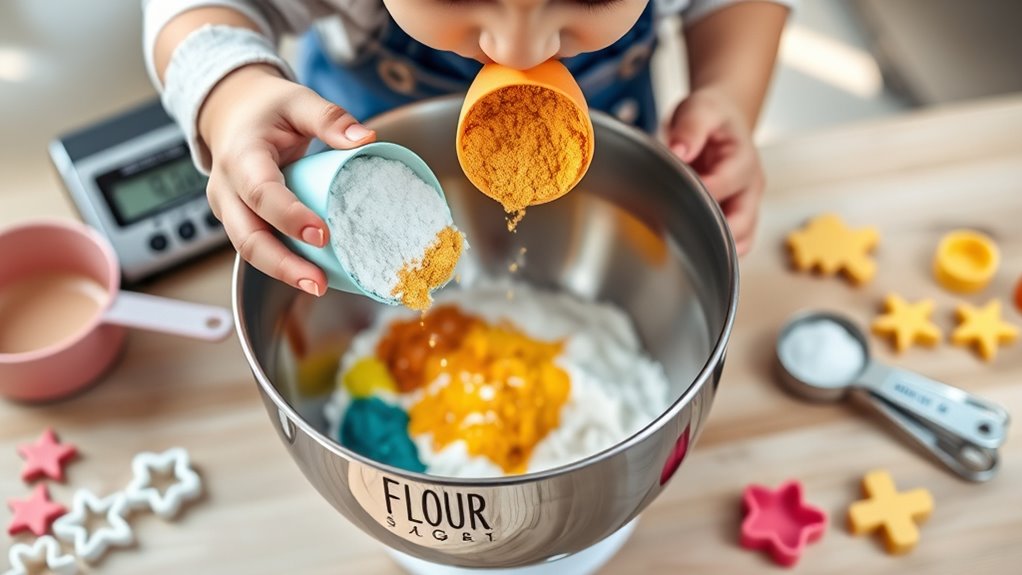
Have you ever thought about how cooking can be a fun and natural way to introduce young children to math? It’s a hands-on activity that makes abstract concepts like measurement and division concrete and engaging. When you involve children in measuring ingredients, you’re helping them grasp the idea of quantity, size, and comparison in a real-world context. Let them pour flour into a measuring cup, level it off, and see how different amounts look. This process not only builds their understanding of measurement but also encourages careful observation and fine motor skills. As they get familiar with cups, spoons, and scales, they start to recognize that measurements have specific values and that different ingredients often require different amounts. It’s a subtle lesson in precision and attention to detail that can be very meaningful for young learners. To deepen their understanding, you can also introduce staying focused techniques to enhance their concentration during cooking activities.
Dividing portions is another excellent way to teach math during cooking. When you prepare recipes together, encourage your child to split ingredients into equal parts, whether it’s dividing dough into smaller pieces or sharing a batch of cookies equally. This activity introduces the concept of division in a practical way, helping children see that breaking something into parts is a way to share and organize. You can turn it into a game by asking, “How many pieces should we make to share equally?” or “If we want everyone to have the same size piece, how big should each one be?” These questions help them understand division as partitioning and equal sharing, laying a foundation for more advanced math skills later on.
Cooking also naturally involves counting, sequencing, and recognizing patterns, all of which are essential early math skills. As you add ingredients one by one, you reinforce counting and the importance of order. Stirring, pouring, and timing require children to follow steps in sequence, boosting their understanding of process and logic. When measuring ingredients and dividing portions, you’re not just teaching about numbers; you’re helping them see how math functions in everyday life. Plus, the collaborative aspect of cooking fosters conversation about these concepts, making learning fun and relevant. By turning cooking into a shared activity, you’re creating opportunities for children to develop confidence with math, see its usefulness, and enjoy the process—all while creating something delicious together.
kids measuring cups and spoons set
As an affiliate, we earn on qualifying purchases.
As an affiliate, we earn on qualifying purchases.
Frequently Asked Questions
How Can Cooking Help Improve Children’s Problem-Solving Skills?
Cooking helps improve your children’s problem-solving skills by encouraging them to understand measurement concepts and recognize patterns. As they measure ingredients, they learn about quantities and fractions, boosting their math abilities. Recognizing patterns in recipes or cooking steps also sharpens their critical thinking. You can involve them in tasks like following directions or adjusting ingredient amounts, making learning fun and practical while developing their analytical skills.
What Safety Precautions Are Necessary When Involving Children in Cooking?
To keep your little chef safe, start by child-proofing hazards like sharp objects and hot surfaces. Always supervise closely and teach safe utensil use, emphasizing careful handling of knives and mixers. Keep spills and clutter to a minimum to prevent slips. Encourage patience and awareness, fostering confidence in safety practices. By creating a secure environment, you help your child explore cooking joyfully while minimizing risks.
How Can Parents Encourage Mathematical Thinking During Cooking Activities?
You can encourage mathematical thinking by involving children in measuring techniques and adjusting ingredient ratios. Let them practice pouring liquids, using measuring cups, and doubling recipes. Ask questions like, “If we need half as much sugar, how much should we add?” or “What happens if we triple the flour?” This hands-on approach helps them understand fractions, ratios, and proportions naturally while making cooking fun and educational.
What Are Age-Appropriate Cooking Tasks to Promote Math Learning?
You can promote math learning by assigning age-appropriate cooking tasks like measuring ingredients and counting items. For younger kids, let them pour liquids or count scoops, helping them develop number sense. As they grow, encourage them to measure ingredients precisely and compare quantities. These activities make math tangible, fun, and practical, boosting their confidence and understanding of basic math concepts while they enjoy cooking with you.
How Does Cooking Foster Collaboration and Social Skills in Children?
Think of cooking as a shared adventure where every ingredient symbolizes teamwork activities. As you work together, you build communication skills and learn to listen and share ideas. You and your children collaborate on tasks like stirring or measuring, fostering cooperation and patience. These social skills grow stronger with each recipe, turning cooking into a meaningful bonding experience that teaches children how to work as a team while having fun.
children's cooking measurement tools
As an affiliate, we earn on qualifying purchases.
As an affiliate, we earn on qualifying purchases.
Conclusion
You might think cooking is just about making tasty meals, but it’s also a fantastic way to introduce early math skills. By measuring, counting ingredients, and timing, you help your child develop essential concepts naturally. Even if you’re not confident in your math skills, don’t worry—your involvement boosts their learning. So, next time you cook together, remember, you’re doing more than feeding—they’re building a strong math foundation without even realizing it.
kids baking and cooking activity kit
As an affiliate, we earn on qualifying purchases.
As an affiliate, we earn on qualifying purchases.
educational cooking game for kids
As an affiliate, we earn on qualifying purchases.
As an affiliate, we earn on qualifying purchases.