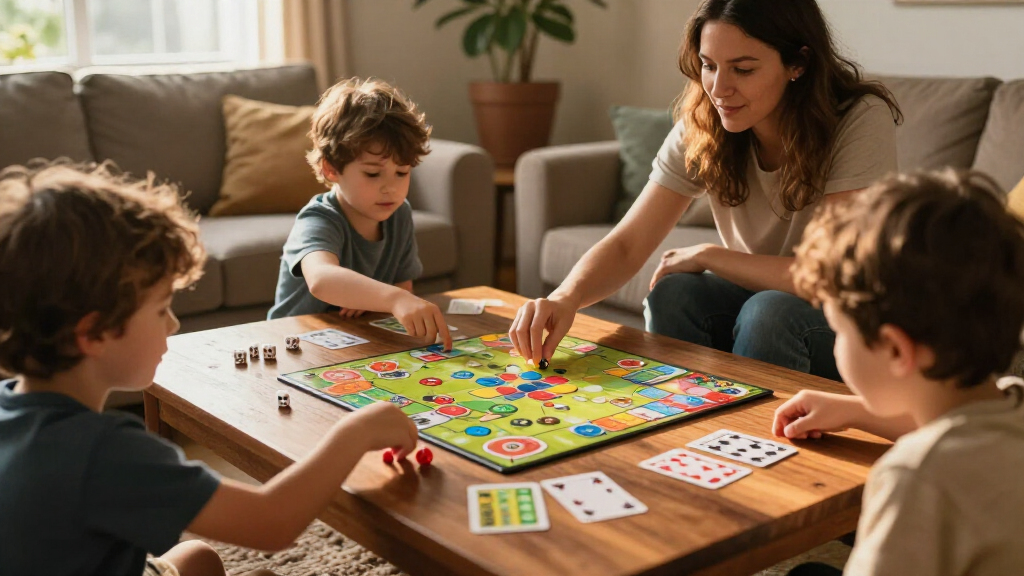
The best family board game for game night is Blank Slate Party Game — it pairs a genuinely clever word-matching mechanic with rules anyone can learn in two minutes, and it plays well across a wide age spread. If your crew skews younger, Trouble and Candy Land are the strongest picks for kids five and under, while Taboo Classic and Herd Mentality deliver the loudest laughs for families with tweens and teens. The main tradeoff in this category is between simplicity and replayability: pure-luck children’s classics fade fast for older players, while smarter party games can leave younger kids stranded. Card games like Do You Really Know Your Family? split the difference but sacrifice the board-and-pieces experience some families want. Read on for the full ranked breakdown of all 14 games.

Turn the school run and nap time into listening time
- Thousands of audiobooks, podcasts and originals
- Listen on your phone, tablet or Echo — also offline
- Cancel anytime
Complete the kit


Key Takeaways
- Word-matching party games (Blank Slate, Herd Mentality) dominated the top of the ranking because they scale across ages and stay funny on the tenth play, unlike roll-and-move classics that rely entirely on luck.
- Every Hasbro classic in the lineup (Trouble, Candy Land, Sorry!, Connect 4, Yahtzee) is durable and cheap to replace, but only Yahtzee and Connect 4 hold adult attention beyond a few rounds.
- The card games in this comparison (Do You Really Know Your Family?, Our Family is So Weird, Guess the Gibberish) win on portability and price but cap out at four to six players, making them weaker anchors for bigger game nights.
- Age labeling matters less than reading level: several ‘family’ games like Taboo and Blank Slate require fluent reading, so households with pre-readers should lean toward Hedbanz, Trouble, or Candy Land instead.
- Only two games in the lineup — Tapple and the Centtechi Hexagon Tower — offer real-time pressure, which turned out to be the single best predictor of whether fidgety kids stayed engaged through a full round.
| Do You Really Know Your Family? Family Card Game |  | Best for Conversation Starters | Age range: 8 and up | Item type: Card game | Components: Cards | VIEW LATEST PRICE | See Our Full Breakdown |
| Hasbro Gaming Trouble Board Game for Kids Ages 5 and Up |  | Best Classic Race Game for Young Kids | Players: 2–4 | Recommended age: 5 and up | Game options: Classic gameplay or Power Up Spaces | VIEW LATEST PRICE | See Our Full Breakdown |
| Hasbro Gaming Taboo Classic Word Guessing Party Game |  | Best for Teens and Adult Family Game Night | Players: 4 or more | Age range: 13 years and up | Cards: 212 | VIEW LATEST PRICE | See Our Full Breakdown |
| Hasbro Gaming Candy Land Board Game for Kids |  | Best First Board Game for Preschoolers | Game type: Board game | Recommended age: 3 years and up | Reading required: No | VIEW LATEST PRICE | See Our Full Breakdown |
| USAopoly TAPPLE Family Word Game |  | Best Fast-Paced Party Pick | Age range: 8 and up | Brand: USAopoly | Components: Portable TAPPLE wheel with built-in timer, 36 cards (144 categories), instructions | VIEW LATEST PRICE | See Our Full Breakdown |
| WHAT DO YOU MEME? Guess the Gibberish Family Card Game |  | Best for Teens and Tweens | Players: 2 or more | Recommended age: 12+ | Cards: 400 | VIEW LATEST PRICE | See Our Full Breakdown |
| Hasbro Gaming Yahtzee Dice Game |  | Best Classic Value | Players: 2 or more | Recommended age: 8 and up | Game type: Dice and strategy game | VIEW LATEST PRICE | See Our Full Breakdown |
| Our Family is So Weird: A Family Card Game to Decide Who’s Most Likely To |  | Best for Family Bonding | Players: 3+ | Ages: 14+ | Number of cards: 150 prompt cards | VIEW LATEST PRICE | See Our Full Breakdown |
| Blank Slate Party Game |  | Best Party Game for Mixed Ages | Players: 3–8 | Age range: 8+ | Playing time: About 30 minutes | VIEW LATEST PRICE | See Our Full Breakdown |
| Hasbro Connect 4 Game, 2025 Edition |  | Best Two-Player Head-to-Head | Players: 2 | Recommended age: 6 years and up | Discs: 42 (21 red, 21 yellow) | VIEW LATEST PRICE | See Our Full Breakdown |
| Centtechi Wooden Hexagon Tower Game for Kids |  | Best for Preschool Skill-Building | Material: Beech wood | Included components: Hexagon tower, 36 sticks, die, 6 balls | Number of players: 2–6 | VIEW LATEST PRICE | See Our Full Breakdown |
| Spin Master Hedbanz Picture Guessing Game, 2nd Edition |  | Best Party Starter for Mixed Ages | Edition: 2nd edition | Players: 2–6 | Recommended age: 6 years and up | VIEW LATEST PRICE | See Our Full Breakdown |
| Herd Mentality Family Party Board Game |  | Best for Big Groups and Extended Family | Brand: Big Potato | Players: 4–20+ | Recommended age: 10 years and up | VIEW LATEST PRICE | See Our Full Breakdown |
| Sorry! Classic Board Game for Kids Ages 6 and Up |  | Best Classic Rivalry Game | Recommended age: 6 years and up | Game type: Family board game | Pawns per player: 4 | VIEW LATEST PRICE | See Our Full Breakdown |
| family board games for game night | Players | Recommended age |
|---|---|---|
| Do You Really Know Your Family | — | — |
| Hasbro Gaming Trouble Board Ga | 2–4 | 5 and up |
| Hasbro Gaming Taboo Classic Wo | 4 or more | — |
| Hasbro Gaming Candy Land Board | Not specified | 3 years and up |
| USAopoly TAPPLE Family Word Ga | Not specified | — |
| WHAT DO YOU MEME? Guess the Gi | 2 or more | 12+ |
| Hasbro Gaming Yahtzee Dice Gam | 2 or more | 8 and up |
| Our Family is So Weird: A Fami | 3+ | — |
| Blank Slate Party Game | 3–8 | — |
| Hasbro Connect 4 Game | 2 | 6 years and up |
| Centtechi Wooden Hexagon Tower | — | 3 years and up |
| Spin Master Hedbanz Picture Gu | 2–6 | 6 years and up |
| Herd Mentality Family Party Bo | 4–20+ | 10 years and up |
| Sorry! Classic Board Game for | — | 6 years and up |
More Details on Our Top Picks
Do You Really Know Your Family? Family Card Game
Most family board games create competition; this one creates actual conversation. The question-and-challenge format gets kids, teens, and adults talking about things that never come up at the dinner table, and the silly challenge cards keep the energy from feeling like a quiz. Compared with Taboo, which rewards quick verbal thinking but says nothing personal, this game makes connection the whole point — there’s no real strategy, and that’s fine. The tradeoff is replay value: unlike TAPPLE’s 144 categories, families may eventually cycle through the deck and hear repeats. It also needs at least a small group of family members to work, so it’s less flexible for mixed-age party crowds than something like Herd Mentality. This pick makes the most sense for households that want laughter and storytelling over winning.
Pros:- Encourages genuine conversation and learning about family members
- Silly challenges add physical comedy and energy
- Rules take under five minutes to learn
- Works across a wide age span, from kids 8+ to grandparents
Cons:- Limited replay value once the deck has been played through
- Requires family members to be meaningful — awkward for mixed groups or parties
Best for: Families with kids 8 and up who want a low-pressure game that sparks real conversations and inside jokes
Not ideal for: Competitive players or adult-only game groups — there’s no strategy, and the content is built around family relationships
- Age range:8 and up
- Item type:Card game
- Components:Cards
- Material:Cardstock
- Manufacturer:ASM Holdings LLC
- Model number:91533
Our verdict“Choose this if your game night goal is closer family bonds rather than a competitive showdown.”
Hasbro Gaming Trouble Board Game for Kids Ages 5 and Up
Trouble earns its spot through simplicity and durability of fun: press the Pop-O-Matic bubble, move your pieces, first one home wins. The iconic bubble isn’t a gimmick — it solves the lost-die problem that plagues games with small children. Unlike Candy Land, which is purely luck-based card drawing, Trouble adds a sliver of decision-making (which piece to move) and includes an optional Power Up Spaces mode for slightly older kids who want more spice. Compared with Sorry!, which shares the send-opponents-back mechanic, Trouble is easier for a five-year-old to grasp and faster to set up. The honest tradeoff: games are almost entirely luck-driven, so adults will get bored after a few rounds, and the two-to-four player cap limits bigger families.
Pros:- Pop-O-Matic bubble keeps the die contained and delights young kids
- Two gameplay modes extend its appeal as kids grow
- Setup and rules take minutes, so play starts almost immediately
- Durable classic design suited to repeated family play
Cons:- Almost entirely luck-based with minimal strategy
- Caps at four players, which excludes bigger families
Best for: Families with children 5–8 who want a classic, no-reading-required race game that plays in under 30 minutes
Not ideal for: Families with teens or strategy-loving adults — luck dominates, and interest fades fast after childhood
- Players:2–4
- Recommended age:5 and up
- Game options:Classic gameplay or Power Up Spaces
- Die roller:Pop-O-Matic bubble
- Game type:Race board game
- Brand:Hasbro Gaming
Our verdict“A dependable first ‘real’ board game for young kids, as long as adults accept they’re there for the bubble, not the tactics.”
Hasbro Gaming Taboo Classic Word Guessing Party Game
When the kids are older and game night gets louder, Taboo delivers the highest energy-per-minute of anything in this lineup. Describing a word without its most obvious clues creates genuine chaos, and with 848 guess words across 212 cards, the deck outlasts most party games — compare that to TAPPLE’s 144 categories and you can see why this pick suits longer-term rotation. The squeaker-and-sand-timer format works without any tech, though the optional online timer and buzzer tools are handy if the physical timer goes missing. The catches are real: it demands at least four players split into teams, and the 13+ age recommendation is honest rather than cautious — younger kids simply can’t keep up with the vocabulary pace.
Pros:- 848 guess words provide long-term replay value
- Team format creates high-energy, social play
- Works fully offline but offers optional online tools
- Compact box travels well to parties and trips
Cons:- Requires a minimum of four players for team play
- Online tools need a web-enabled device, which not every household wants at game night
Best for: Families with teens and adults who want a loud, team-based word game for groups of four or more
Not ideal for: Families with kids under 13 or small households — the team format and word difficulty exclude younger players and duos
- Players:4 or more
- Age range:13 years and up
- Cards:212
- Guess words:848
- Included accessories:Sand timer, squeaker, scorepad
- Online tools:Timer, buzzer, and scorepad
Our verdict“The go-to pick for game night once your crew is 13+ and big enough for teams — skip it for young families.”
Hasbro Gaming Candy Land Board Game for Kids
Candy Land remains the definitive first board game because it asks nothing of a three-year-old except color recognition — no reading, no counting, no strategy. That makes it the youngest-suitable option here by a wide margin: even Trouble, the next most kid-friendly pick, starts at age 5. The gingerbread pawns and candy-themed path give small children something visual to hold onto, and a full game runs short enough to fit a preschooler’s attention span. The tradeoffs are obvious. It’s pure luck with zero decisions, so parents will be mentally elsewhere by round two, and the lack of a specified player count means you’re relying on the four pawns included rather than a stated range. Siblings may also feud over the shortcut and trap cards — a feature, or a bug, depending on your household.
Pros:- No reading required, so true preschoolers can play independently
- Bright, engaging artwork that appeals to very young children
- Extremely short setup and play time
- Teaches turn-taking and color matching as foundational skills
Cons:- Zero strategy or player agency — pure luck of the draw
- Player count not clearly specified by the manufacturer
Best for: Parents of children ages 3–5 who want a no-reading, no-rules-stress introduction to taking turns
Not ideal for: Anyone over about age 7 — there are no decisions to make, so older kids and adults will lose interest quickly
- Game type:Board game
- Recommended age:3 years and up
- Reading required:No
- Game pieces:Gingerbread man pawns
- Players:Not specified
- Brand:Hasbro Gaming
Our verdict“Buy it as a child’s very first board game, then graduate to Trouble or TAPPLE once they turn six or seven.”
USAopoly TAPPLE Family Word Game
TAPPLE occupies a smart middle ground in this lineup: faster than Taboo, more strategic than Candy Land, and more mixed-age friendly than either. The mechanic — name a word in the category that starts with the tapped letter before the ten-second timer sounds — is instantly understood by eight-year-olds and still tense for adults. With 144 categories across 36 cards, the replay value beats most card games here, though it trails Taboo’s 848-word deck. The real differentiator is the self-contained wheel, which stores the cards inside, making this the most travel-ready option in the roundup — toss it in a bag, no box needed. Be aware the timer punishes slower thinkers and younger players, and the 8+ age floor is genuine; there’s no handicap mode for a five-year-old sibling.
Pros:- Rounds play in minutes, keeping game night momentum high
- 144 categories deliver strong replayability
- Wheel stores cards internally, making it genuinely travel-friendly
- Rules take one demonstration to learn
Cons:- Ten-second timer can frustrate younger or slower players
- Age 8+ floor leaves preschool siblings out of the fun
Best for: Families with kids 8 and up who want quick, portable rounds that mix generations without anyone feeling left out
Not ideal for: Families with children under 8 or players who crumble under time pressure — the ten-second timer has no mercy
- Age range:8 and up
- Brand:USAopoly
- Components:Portable TAPPLE wheel with built-in timer, 36 cards (144 categories), instructions
- Categories:144
- Model year:2022
- Edition:Standard Edition
- Players:Not specified
Our verdict“The best pick for families who value speed and portability over deep strategy — just keep a timer-grace rule for younger kids.”
WHAT DO YOU MEME? Guess the Gibberish Family Card Game
This pick stands out as the energetic, laugh-out-loud option for families whose game night skews older. The format — decoding gibberish phrases against a one-minute sand timer — creates urgency that quieter games like Blank Slate can’t match, and the built-in clue system on each card means kids who struggle aren’t left humiliated. With 400 cards, the replay pool is generous compared with the 150 prompts in Our Family is So Weird. The tradeoff is real, though: decoding nonsense phrases demands solid reading and language skills, so players under 12 will mostly watch from the sidelines. Compared with Taboo, it’s more portable and less rule-heavy, but the gameplay is shallower — it’s a sprint, not a strategy contest.
Pros:- 400 cards provide far more content than most party card games in this price category
- Clues on card backs keep weaker players competitive and frustrated less often
- Compact enough for travel, road trips, and vacation play
- Scales to any group size above two players
Cons:- Ages 12 and up means younger siblings can’t meaningfully participate
- Gameplay is one-note — after the novelty of decoding wears off, sessions get repetitive
Best for: Families with kids 12 and up who want a fast, noisy party game that works as well on road trips as at the table
Not ideal for: Families with young children, since the reading-heavy gameplay effectively excludes anyone under 12
- Players:2 or more
- Recommended age:12+
- Cards:400
- Timer:1-minute sand timer
- Format:Word-decoding party game
- Included:400 cards, sand timer, gameplay instructions
Our verdict“Choose this when your game night crowd is tweens and teens who thrive on frantic, timer-driven chaos rather than slow strategy.”
Hasbro Gaming Yahtzee Dice Game
Few games deliver more entertainment per dollar than Yahtzee, and its endurance is earned. Unlike Connect 4, which caps out at two players, Yahtzee happily absorbs any number of players, and unlike Guess the Gibberish, the 8+ age rating lets elementary-school kids play alongside grandparents. The real magic is the push-your-luck decision-making: which combination to score and which to sacrifice gives every roll genuine tension. That said, the dice introduce luck that can frustrate strategic players — a hot-handed child can beat a calculating adult, which is either charming or maddening depending on your temperament. Score pads also run out and need replacing over time, a small ongoing cost that games with boards or dry-erase components, like Blank Slate, avoid entirely.
Pros:- Works for any number of players from two upward
- Age 8+ rating makes it one of the most generation-spanning picks available
- Blends luck with real scoring strategy for meaningful decisions
- Minimal components make it extremely portable and durable
Cons:- Dice luck can decide games regardless of skill
- Paper score pads deplete with use and must be replenished
Best for: Families wanting an affordable, timeless game that spans generations and any group size
Not ideal for: Competitive players who dislike randomness, since dice luck can override smart decisions
- Players:2 or more
- Recommended age:8 and up
- Game type:Dice and strategy game
- Format:Scored dice combinations (straights, full houses, Yahtzee)
- Play style:Luck plus push-your-luck strategy
- Components:5 dice, score pads, cup, instructions
Our verdict“This is the dependable backbone of a family game closet — cheap, compact, and playable by nearly everyone in the house.”
Our Family is So Weird: A Family Card Game to Decide Who’s Most Likely To
Where most games here test speed or tactics, this one tests how well you know each other — and that’s its whole appeal. Voting on which relative is most likely to do the quirky things on 150 prompt cards turns game night into a roast, and the six included dry-erase boards and markers make voting tactile in a way card-flipping games can’t match. Compared with Guess the Gibberish, it’s slower and more conversational; compared with Do You Really Know Your Family?, it leans funnier and slightly spicier, which explains the 14+ age rating. That rating is the main barrier: families with younger kids should look at Blank Slate instead. It also needs at least three players to function, so it’s strictly a group activity, never a couples game.
Pros:- Dry-erase voting boards make gameplay interactive and reusable
- Prompts spark genuine family conversation and inside jokes
- Rules take under five minutes to explain
- Scales well for extended family and large gatherings
Cons:- Requires a minimum of three players to work at all
- 150 cards is a smaller prompt pool that repeat players will cycle through quickly
Best for: Families with teens and adults who want a conversation-sparking game for reunions and holidays
Not ideal for: Households with kids under 14, since prompts and humor are pitched at teens and older
- Players:3+
- Ages:14+
- Number of cards:150 prompt cards
- Dry-erase boards:6
- Dry-erase markers:6
- Format:Voting and family-trivia party game
Our verdict“Pick this when the goal is laughing at your own family’s quirks rather than winning on points.”
Blank Slate Party Game
This pick earns its spot as the best bridge between kids and adults on the list. The mechanic — write a word that completes a cue, then try to match exactly one other player’s answer — rewards thinking alike rather than thinking fast, so an 8-year-old and a parent can genuinely compete. That’s a sharper age range than Our Family is So Weird (14+) and a friendlier one than Guess the Gibberish (12+). With 500 word cues across double-sided cards and a defined 30-minute play time, it fits neatly before bedtime. The catch: it demands writing, so younger or reluctant writers may need help, and with fewer than four players the matching odds get thin fast — it’s a game that genuinely wants a crowd.
Pros:- Age 8+ rating lets the whole family play together, not just the teens
- 500 word cues across double-sided cards give strong replay variety
- Rounds wrap in about 30 minutes for weeknight play
- Dry-erase slates are reusable with no consumables to replace
Cons:- Requires writing, which slows down or excludes very young or hesitant writers
- Below four players, matching another answer becomes too easy or too rare
Best for: Families and mixed-age groups of 4 or more who want a quick, creative word game everyone can win
Not ideal for: Small households of two or three, since the matching mechanic breaks down without enough players
- Players:3–8
- Age range:8+
- Playing time:About 30 minutes
- Word cue cards:250 double-sided (500 cues)
- Components:Scoreboard, 8 dry-erase slates, 250 cards, rules
- Genre:Family, party, word game
Our verdict“This makes the most sense for crowded tables where an easy word game must entertain kids, cousins, and grandparents at once.”
Hasbro Connect 4 Game, 2025 Edition
Sometimes game night is just two people, and nothing fills that niche better than Connect 4. This 2025 edition improves on the version most parents grew up with: the grid folds into a handled carrying case with built-in disc storage, so the 42 pieces stop scattering across the toy bin, and score trackers settle best-of-series rivalries without argument. Where Yahtzee mixes luck into its strategy, Connect 4 is pure tactics — every loss is on you, which makes rematch energy genuinely fierce. Compared with Trouble, it’s faster to learn and harder to master. The obvious limit is the hard two-player cap: at a five-person family night, three people are watching, and unlike Blank Slate there’s no way to stretch it.
Pros:- Pure strategy with no luck element — rewarding for players who want skill to decide outcomes
- Foldable case with disc storage and a handle makes it genuinely travel-ready
- Built-in score trackers support multi-round matches cleanly
- Rounds are fast enough for repeated rematches
Cons:- Strictly limited to two players, useless for group game nights
- Solved-game depth means skilled adults can beat children every time unless they hold back
Best for: Parents and kids, siblings, or couples who want short head-to-head duels with zero setup friction
Not ideal for: Larger families, since it physically can’t include more than two players at a time
- Players:2
- Recommended age:6 years and up
- Discs:42 (21 red, 21 yellow)
- Win condition:Four in a row; first to win 4 rounds is champion
- Storage:Foldable carrying case with built-in disc storage
- Setup:One-motion setup
Our verdict“Grab this for the sibling rivalries and parent-child rematches; skip it if your table seats more than two.”
Centtechi Wooden Hexagon Tower Game for Kids
Most games in this roundup reward vocabulary or luck, but this option stands out for turning counting, focus, and fine motor skills into the actual mechanics. Players pull sticks from a beech wood hexagon tower while trying to keep balls from dropping, which makes it a rare pick that works for children as young as three — unlike Herd Mentality, which waits until age ten. Compared with Candy Land, the physical dexterity element adds a layer that pure card-draw games can’t match. The tradeoff is real, though: the loose sticks and small balls demand supervision around toddlers, and the listed age range is inconsistent across the product page, so buyers should treat the 3+ figure with caution.
Pros:- Blends gameplay with counting and motor skill practice
- Accommodates 2–6 players, so the whole family can join
- Solid beech wood construction with water-based paint
- Compact footprint makes it easy to pack for travel
Cons:- Small sticks and balls are unsafe for very young children without supervision
- Inconsistent age recommendations in the product description create confusion
Best for: Parents of preschoolers who want a screen-free game that quietly builds counting and hand-eye coordination
Not ideal for: Families with children under three still mouthing objects, since the small sticks and balls are a choking hazard
- Material:Beech wood
- Included components:Hexagon tower, 36 sticks, die, 6 balls
- Number of players:2–6
- Recommended age:3 years and up
- Dimensions:7.09 × 4.71 × 0.1 inches
- Batteries:Not required
- Play style:Manual dexterity game
Our verdict“A smart pick for families whose youngest players are too little for word or trivia games but ready to practice skills through play.”
Spin Master Hedbanz Picture Guessing Game, 2nd Edition
When cousins, grandparents, and six-year-olds share one table, Hedbanz is the great equalizer — no reading trivia, no strategy barrier, just yes-or-no questions and a headband. That makes it more accessible than Taboo, which penalizes younger players who lack the vocabulary to describe clues under pressure. The 2nd Edition refreshes things with six themed headbands (dinosaur, narwhal, robot, and more) and a generous deck of 69 picture cards, giving it staying power across repeat plays. The drawbacks: it needs at least two people and truly shines with three or more, and no estimated play time is stated, though rounds are short by design. Question quality, not components, determines how fun each round gets.
Pros:- Yes-or-no format requires no reading skill, so young kids can compete fairly
- Themed headbands add personality and gift appeal
- 69 picture cards keep rounds fresh across many game nights
- First to three correct guesses wins, keeping sessions short
Cons:- Requires a minimum of two players and works best with larger groups
- No stated game duration makes session planning a guessing game itself
Best for: Families and gatherings with a wide age spread who want a zero-learning-curve game everyone can play together
Not ideal for: Solo-prone households or quiet two-person evenings, since the game depends on group energy and at least two participants
- Edition:2nd edition
- Players:2–6
- Recommended age:6 years and up
- Winning condition:First to guess 3 cards correctly
- Headband designs:Dinosaur, narwhal, robot, flower, butterfly, brain
- Card count:69 picture cards, 3 sample question cards
- Included accessories:6 headbands, 6 headplates, 16 scoring badges, 1 timer, instructions
Our verdict“The easiest way to get a mixed-age room laughing within minutes of opening the box.”
Herd Mentality Family Party Board Game
Nearly everything else on this list caps out at six players, but Herd Mentality scales from 4 to 20-plus, which makes it the clear choice when the whole extended family shows up. The hook is simple: write an answer, and if it matches the majority, you collect a cow. It’s the same crowd-pleasing instinct behind Blank Slate, but with a sillier, more kid-friendly tone thanks to the Kids Edition questions. Rounds wrap in about 20 minutes, so nobody sits through a marathon. The tradeoff is emotional, not mechanical — landing the pink cow of doom for an oddball answer can sting for sensitive players, and the matching format means genuinely creative answers get punished. Compared with Guess the Gibberish, it demands no pronunciation tricks, just consensus.
Pros:- Handles 4 to 20+ players, far beyond most family games
- Rules take minutes to learn, so nobody is excluded
- Roughly 20-minute play time fits between dinner and bedtime
- Includes 20 bonus questions for extra replay value
Cons:- Odd-one-out answers earn the pink cow of doom, which can feel punishing
- The majority-wins format discourages genuinely original answers
Best for: Large families, reunions, and party hosts who need one game that scales beyond six players
Not ideal for: Competitive players or easily frustrated kids who hate losing points for thinking differently from the group
- Brand:Big Potato
- Players:4–20+
- Recommended age:10 years and up
- Playing time:20 minutes
- Genre:Family, Party
- Edition:Kids Edition
- Contents:Main game with 20 extra questions
Our verdict“The group-size champion of this roundup — buy it when six seats at the table aren’t enough.”
Sorry! Classic Board Game for Kids Ages 6 and Up
Sorry! earns its slot by delivering something the newer entries here don’t: genuine interpersonal drama. Drawing cards to slide, switch, and send opponents’ pawns back to start creates the kind of teasing, groaning energy that defines family game night. Compared with Trouble, which shares the race-home structure, Sorry! layers in card-driven choices that give kids a taste of strategy rather than pure dice luck. The catch is that same meanness — a pawn sent back to the very beginning can reduce younger or more sensitive players to tears, so it’s a rougher ride than Candy Land‘s consequence-free stroll. The listing also skips play time and player count details, so buyers are relying on general knowledge of the classic format rather than clear specs.
Pros:- Card draws create varied moves and light strategic decisions each turn
- Generations of familiarity make rules explanation nearly instant
- Kids and adults can play together with a real chance to win
- Take-that mechanics generate the laughs and rivalry game night is famous for
Cons:- Pawns can be sent back to start, which feels harsh to younger players
- No stated play time or player count in the product details
Best for: Families with school-age kids who enjoy competitive banter and can handle setbacks without meltdowns
Not ideal for: Households with sore losers or very young children, since losing a pawn’s progress to an opponent is baked into the design
- Recommended age:6 years and up
- Game type:Family board game
- Pawns per player:4
- Movement system:Card draws for moving, sliding, and sending opponents back
- Objective:Race all your pawns home first
- Skill focus:Strategy and adaptability
Our verdict“A time-tested pick for families who want playful competition — as long as everyone can survive a comeback or two.”

How We Picked
I evaluated each game against four family-night criteria: age flexibility (can a 7-year-old and a parent genuinely enjoy the same round?), learning curve (how many minutes from box-open to first turn), replay value (does the game produce different laughs each time, or is it the same luck-driven race?), and group-size fit (whether it works for the typical three-to-six-person household). Component quality and storage also factored in, since family games get packed and unpacked far more often than hobby titles.
The ranking logic favors games that keep the widest slice of a family engaged at once. That’s why party games with a shared-laughter mechanic placed high, roll-and-move classics landed mid-pack despite their nostalgia value, and games requiring fluent reading were ranked for their actual audience rather than their box copy. Where two games serve the same niche, the tiebreaker was replay variety — a game that surprises you on round five beats one that’s fun exactly once.
Factors to Consider When Choosing Family Board Games For Game Night
Before picking a game from the list above, it helps to understand what actually makes or breaks a family game night. These are the factors that separated the top performers from the mid-pack — and the mistakes I saw repeated across this category.
Match the Game to Your Youngest Player, Not Your Oldest
The most common buying mistake is choosing a game for the adults and hoping the kids catch up. A game rated 12+ played with an 8-year-old usually means an adult plays their turns for them, which kills the fun for everyone. Work backward from your youngest regular participant: if they can’t read fluently, picture-based and luck-driven games will include them fully. If your youngest is 8 or older, you can jump straight to word and party games without leaving anyone behind. Also check minimum player counts — several great card games in this category need at least three players to function at all, which matters for smaller households.
Luck Versus Skill: The Balance That Keeps Peace
Games where the outcome is decided purely by dice or card draws (Candy Land, Trouble) prevent sore losers and let young kids win honestly, but older players check out quickly. Skill-heavy games keep adults engaged but can demoralize kids who lose every round. The best family games in this comparison — Blank Slate, Herd Mentality, Tapple — sit in a middle zone where cleverness helps but luck and psychology even the field. If your game nights regularly end in tears or tantrums, tilt toward the luck end. If they end in boredom complaints from the adults, tilt the other way.
Play Time and Attention Spans
Box estimates are optimistic. A game listed at 20 minutes often runs 40 with younger players who deliberate over every move, and setup time is rarely included. For weeknight sessions, look for games that finish in under 20 minutes or can be abandoned without ruining the experience — round-based card games handle early exits gracefully, while long board games do not. Real-time games like Tapple sidestep the problem entirely because turns are forced by a timer. As a rule, one quick game that ends with everyone wanting a rematch beats one long game that ends with everyone tired.
Card Game, Board Game, or Party Game?
Card games are cheap, portable, and easy to bring on trips, but they lack the tactile ritual — pieces, boards, dice poppers — that makes family night feel like an event. Board games deliver that experience and tend to survive rough handling from kids, but they cost more and take longer to set up. Party games generate the biggest laughs but often need bigger groups and a willingness to be silly, which not every family (or every teenager) brings to the table. Most families are best served by owning one of each type rather than three games of the same kind.
Replayability: The Hidden Cost of Cheap Games
A game that costs little but is only fun twice is expensive per hour of enjoyment. Replay value comes from variety-generating mechanics — shuffled prompts, hidden answers, player psychology — not from component count. Games with fixed boards and predetermined paths play out nearly identically every session. Before buying, ask whether the game’s content is generated by the players (which never runs out) or printed in the box (which eventually repeats). Expansion packs can extend content-driven games, but that’s an added cost and a storage burden worth factoring in upfront.
Component Durability and Storage
Family games live a harder life than hobby games: they get dropped, spilled on, and left on the floor. Wooden pieces and sturdy boards outlast cardstock, and games with built-in storage trays save you from a drawer full of loose parts — a real issue with small-piece games like Connect 4 or the Hexagon Tower. Check whether cards are coated (wipeable) or matte (stain-prone around snack-heavy tables). If a game has dozens of tiny components and you have toddlers in the house, either buy a storage bag for it or pick something with fewer, larger pieces.
Frequently Asked Questions
What’s the best family board game if my kids are different ages?
Look for games where age doesn’t determine skill, such as Blank Slate or Herd Mentality, because a 7-year-old matching words with a grandparent is playing the same game, not a handicapped version. Guessing games like Hedbanz also work because the challenge adjusts to whoever is playing. Avoid games where reading speed or trivia knowledge decides the winner, since those systematically favor older players and younger kids notice. A useful test: if the game would still be fun when one player is deliberately playing badly, mixed ages will work. Round-based formats also help, because a younger player can sit out a round without ending the game for everyone.
Are classic games like Candy Land and Trouble worth buying, or are they outdated?
They’re worth it for a specific window: roughly ages 3 to 6, when a child is learning to take turns, count spaces, and lose gracefully. In that window they’re genuinely valuable because the luck-based format means the child can win without anyone letting them. Past that window, though, most adults find them tedious, and the games tend to gather dust. Treat them as developmental stepping stones rather than long-term family staples, and pair them with a more durable party game the family can grow into. If your kids are already 7 or older, I’d skip straight to games like Tapple or Hedbanz.
How many family games do I actually need for a good game night rotation?
Three well-chosen games cover most households: one quick luck or dexterity game for young kids and warm-ups, one word or party game for the whole family, and one longer strategic option for when the adults play after bedtime. Beyond that, diminishing returns set in fast — families tend to gravitate to two or three favorites and ignore the rest, which is why buying one excellent game beats buying three mediocre ones. Rotating rather than accumulating also keeps game night feeling fresh. If a new game doesn’t earn a second play within a month, it probably never will, and that’s a signal not to double down on similar purchases.
Card games or board games — which is better for family game night?
It depends on what your family responds to. Card games like Do You Really Know Your Family? and Guess the Gibberish are faster to start, cheaper, and travel well, making them the practical choice for busy weeknights and vacations. Board games create more of an occasion — the setup, the pieces, the visible progress — which matters if your goal is a screen-free ritual rather than just filling twenty minutes. Kids under 8 also tend to engage more with physical boards and pieces than with cards, which require held hands and sustained attention. The strongest game nights usually mix both, since a quick card game makes a great opener before a longer board game.
What should I do when one kid loses every game and refuses to play anymore?
Shift toward games where losing is diffuse or funny rather than personal. Herd Mentality is excellent for this because the penalty lands on whoever disagrees with the group, which rotates unpredictably and feels like a joke rather than a defeat. Cooperative framing also helps — team-based play splits wins and losses across the table. Avoid games with player elimination, where a losing child has to sit and watch others continue, as that’s the fastest route to a game-night meltdown. And before each session, set the norm that the rematch matters more than the result; quick games that end in ‘again!’ recover from a loss far better than one long game that ends in tears.
Conclusion
Best overall goes to Blank Slate Party Game: it hits the rare balance of easy rules, genuine laughs, and replay value that works from tweens to grandparents. For best value, Tapple delivers the highest fun-per-dollar in the lineup thanks to its self-contained case and infinite word combinations. Herd Mentality earns the best premium slot for households that want a modern party game with the most durable replay loop of anything compared here.
For beginners and young families, start with Hedbanz or Trouble — both teach turn-taking without requiring reading, and both cost little if game night doesn’t stick. For specific needs: choose Yahtzee or Connect 4 for two-player households, Candy Land for pre-readers, Do You Really Know Your Family? or Our Family is So Weird for conversation-driven households that own the party-game niche already, and the Hexagon Tower for kids who need to fidget with something while they play. Whatever you pick, one well-matched game beats a shelf of near-misses — buy for your youngest player, and the rest of the table will follow.
Cold & flu season Picks
humidifiers
As an affiliate, we earn on qualifying purchases.