The best baby balance bikes pair a low, confidence-building seat with stable handling and a fit that suits a child’s current abilities. My best overall pick is the Strider 12 Sport for its broad age range and adjustable fit; the woom WOW stands out for very young beginners, while the Strider Pro 2-in-1 adds a rocking mode for indoor practice. The main tradeoffs are four-wheel stability versus two-wheel balance practice, and simple lightweight designs versus extras that add cost or bulk. A bike that fits your child now may matter more than one with the longest age claim. Read on for the full comparison, buying advice, and picks for different needs.

Turn the school run and nap time into listening time
- Thousands of audiobooks, podcasts and originals
- Listen on your phone, tablet or Echo — also offline
- Cancel anytime
Complete the kit


Key Takeaways
The Strider 12 Sport leads for versatility: its adjustable setup and broad stated age range make it a strong choice for families seeking one bike for several stages.
Very young riders may benefit from added stability: the woom WOW and four-wheel no-pedal option put early confidence ahead of conventional two-wheel balance practice.
A rocking mode changes where practice can happen: the Strider Pro 2-in-1 can support indoor movement before a child is ready to roll outdoors, though it serves a different purpose from a standard bike.
Adjustability matters only when the fit is right: seat and handlebar range can extend usefulness, but a bike that is too tall or heavy now may frustrate a new rider.
Extras are secondary to control: baskets and light-up wheels add appeal, while low reach, stable steering, and a manageable frame matter more for learning.
| KRIDDO Baby Balance Bike for Ages 1–2, Black |  | Best for Stable First Scoots | Brand: KRIDDO | Model: KB004-Black | Age range: 12 months to 2.5 years | VIEW LATEST PRICE | See Our Full Breakdown |
| Strider Pro 2-in-1 Rocking Balance Bike for Children, Black Pearl |  | Best Convertible Rocker-to-Bike | Age range: 6 months–5 years | Frame material: Aluminum | Wheel size: 12 inches | VIEW LATEST PRICE | See Our Full Breakdown |
| Retrospec Cricket Baby Balance Bike for Toddlers, 12–24 Months |  | Best for First-Time Riders | Brand: Retrospec | Model: 4504 | Age range: 12 months–2 years | VIEW LATEST PRICE | See Our Full Breakdown |
| woom GO 1 12-Inch Balance Bike for Toddlers |  | Best for Learning to Brake | Wheel size: 12 inches | Age range: 18 months–3.5 years | Recommended child height: 31–40 inches | VIEW LATEST PRICE | See Our Full Breakdown |
| Radio Flyer Steady Start Balance Bike for Kids Ages 1–3, Red |  | Best Three-Wheel Indoor-Outdoor Pick | Age range: 1–3 years | Wheel design: Wide front wheel and dual rear wheels | Seat: Tool-free adjustable, padded | VIEW LATEST PRICE | See Our Full Breakdown |
| Strider 12 Sport Balance Bike for Kids Ages 1–4, Matte Gray |  | Best for Growing Toddlers | Age range: 1–4 years | Wheel size: 12 inches | Weight: 6.7 pounds | VIEW LATEST PRICE | See Our Full Breakdown |
| SEREED Baby Balance Bike for Toddlers, 12–24 Months |  | Best for First-Time Riders | Age range: 12–24 months | Frame material: Aluminum alloy | Wheel size: 6.7 inches | VIEW LATEST PRICE | See Our Full Breakdown |
| Baby Balance Bike for Toddlers, Ages 12–24 Months, Four Wheels, No Pedals |  | Best for Tool-Free Setup | Age range: 12–24 months | Wheels: 4 high-density EVA wheels | Frame: Carbon steel | VIEW LATEST PRICE | See Our Full Breakdown |
| Bobike Baby Balance Bike for Toddlers, 12–36 Months |  | Best for a Wider Toddler Age Range | Age range: 12–36 months | Frame material: Alloy steel | Wheel material: Alloy steel | VIEW LATEST PRICE | See Our Full Breakdown |
| Strider 12 Classic Balance Bike for Toddlers |  | Best for Paved-Path Practice | Age range: 1–3 years | Wheel size: 12 inches | Weight: 6.5 pounds (2.9 kg) | VIEW LATEST PRICE | See Our Full Breakdown |
| SEREED Toddler Balance Bike with Adjustable Seat and Handlebars |  | Best for Easy Fit Adjustments | Frame material: Carbon steel | Wheel material: EVA | Wheel size: 11 inches | VIEW LATEST PRICE | See Our Full Breakdown |
| Liberry Baby Balance Bike for Ages 1–2, Adjustable Seat, Green |  | Best for Early, Steady Practice | Age range: 12–24 months | Frame material: Steel | Wheel material: EVA | VIEW LATEST PRICE | See Our Full Breakdown |
| KidRoller Toddler Balance Bike with Adjustable Seat and Front Basket, Honeydew Green |  | Best Lightweight Two-Wheel Pick | Age range: 1–3 years | Frame material: Aluminum | Wheel material: EVA | VIEW LATEST PRICE | See Our Full Breakdown |
| Gamfeiny Baby Balance Bike with Colorful Light-Up Wheels |  | Best for Engaging Early Play | Age range: 10–36 months | Frame material: Carbon steel | Wheels: Four enclosed, pedal-free wheels | VIEW LATEST PRICE | See Our Full Breakdown |
| woom WOW Baby & Toddler Balance Bike, No-Pedal, 9 Months–3 Years |  | Best Premium Lightweight Pick | Age range: 9 months–3 years | Recommended rider height: 28–40 inches | Frame material: Aluminum | VIEW LATEST PRICE | See Our Full Breakdown |
| baby balance bike | Age range | Frame material | Weight | Wheel size |
|---|---|---|---|---|
| KRIDDO Baby Balance Bike for A | 12 months to 2.5 years | — | — | — |
| Strider Pro 2-in-1 Rocking Bal | 6 months–5 years | Aluminum | — | 12 inches |
| Retrospec Cricket Baby Balance | 12 months–2 years | — | — | — |
| woom GO 1 12-Inch Balance Bike | 18 months–3.5 years | Aluminum | 6.4 lbs | 12 inches |
| Radio Flyer Steady Start Balan | 1–3 years | — | — | — |
| Strider 12 Sport Balance Bike | 1–4 years | Alloy steel | 6.7 pounds | 12 inches |
| SEREED Baby Balance Bike for T | 12–24 months | Aluminum alloy | 3.5 pounds (1.6 kg) | 6.7 inches |
| Baby Balance Bike for Toddlers | 12–24 months | — | 4.6 pounds | — |
| Bobike Baby Balance Bike for T | 12–36 months | Alloy steel | — | — |
| Strider 12 Classic Balance Bik | 1–3 years | Alloy steel | 6.5 pounds (2.9 kg) | 12 inches |
| SEREED Toddler Balance Bike wi | — | Carbon steel | 7.8 pounds | 11 inches |
| Liberry Baby Balance Bike for | 12–24 months | Steel | Listed as 5 pounds in product details and 6.4 pounds in description | 6 inches |
| KidRoller Toddler Balance Bike | 1–3 years | Aluminum | 4.6 pounds (2.1 kg) | 7 inches |
| Gamfeiny Baby Balance Bike wit | 10–36 months | Carbon steel | 4.6 pounds | — |
| woom WOW Baby & Toddler Balanc | 9 months–3 years | Aluminum | 6 pounds (2.7 kg) | — |
More Details on Our Top Picks
KRIDDO Baby Balance Bike for Ages 1–2, Black
The KRIDDO suits toddlers starting with short, foot-powered rides, where a stable feel and easy-to-grip controls matter more than advanced bike skills. Its 3.6-inch-wide rear wheel is designed to add steadiness, while the adjustable, broad PU seat can accommodate some growth. Soft TPR details and non-slip handlebars also give little hands a more manageable grip. Compared with the Retrospec Cricket, which uses four wheels and a steering limit for especially supported early riding, the KRIDDO has a more bike-like two-wheel layout. That may appeal to families aiming for a balance-bike feel, but it asks the child to push and steer without pedals. Its stated age range is narrow, so it is less suited to families looking for a ride-on that lasts through several toddler years.
Pros:- Wide rear wheel is designed to provide added stability for early scooting.
- Adjustable, wide PU seat can accommodate changes in a young rider’s fit.
- Non-slip handlebars and soft TPR details are shaped for small hands.
- BPA-free materials are specified.
Cons:- Its 12-month to 2.5-year age range limits how long many children may use it.
- No pedals mean children must push the bike along with their feet.
- The product data does not provide a weight or seat-height range for checking fit.
Best for: Caregivers of 12-month to 2.5-year-olds who want a simple, foot-powered starter bike with a wide rear wheel and adjustable seat.
Not ideal for: Families seeking a ride-on that stays useful well beyond toddlerhood, or children who need the extra support of a four-wheel design like the Retrospec Cricket.
- Brand:KRIDDO
- Model:KB004-Black
- Age range:12 months to 2.5 years
- Seat:Adjustable, wide PU seat
- Rear wheel:3.6-inch-wide TPU
- Materials:BPA-free materials; TPR details
- Included component:Tool kit
Our verdict“Choose the KRIDDO for a toddler ready to scoot on a bike-style frame with a stability-focused rear wheel, but choose the Retrospec Cricket for more four-wheel support.”
Strider Pro 2-in-1 Rocking Balance Bike for Children, Black Pearl
The Strider Pro 2-in-1 is the most flexible choice here for households that want one product to serve as a rocker and later as a balance bike. Its detachable rocking base supports use from 6 months, and tool-free conversion makes the change between modes straightforward. Once configured as a bike, adjustable seat and handlebars plus footrests give growing riders more room to learn. The woom GO 1 is lighter at 6.4 pounds and adds a rear hand brake, so it is a stronger pick for children ready to practice bike-specific control. The Strider, at 11.6 pounds, trades that lighter handling and braking feature for rocker functionality and a broader stated age range. It has no braking system and a 40-pound maximum recommendation, which may limit its appeal as a longer-term riding option.
Pros:- Detachable rocking base adds a use mode for younger children.
- Tool-free conversion changes the rocker into a balance bike.
- Adjustable seat and handlebars support fit changes as a child grows.
- Aluminum frame is specified, with a 9–17-inch seat-height range.
Cons:- At 11.6 pounds, it is heavier than the 6.4-pound woom GO 1.
- No braking system is listed.
- The 40-pound maximum weight recommendation may shorten its useful riding period for some children.
Best for: Families with a baby and older toddler who want a rocking mode first, then a convertible balance bike with adjustable fit.
Not ideal for: Buyers prioritizing a light bike or a child-sized hand brake; the woom GO 1 weighs less and includes a rear brake.
- Age range:6 months–5 years
- Frame material:Aluminum
- Wheel size:12 inches
- Item weight:11.6 pounds
- Seat height range:9–17 inches
- Handlebar height range:18–22 inches
- Maximum weight recommendation:40 pounds
- Tires:EVA foam
- Conversion:Detachable rocking base; tool-free conversion
Our verdict“Pick the Strider Pro if rocker-to-bike versatility matters more than low weight or a hand brake.”
Retrospec Cricket Baby Balance Bike for Toddlers, 12–24 Months
For a toddler still learning to scoot and steer, the Retrospec Cricket puts support ahead of a conventional two-wheel balance-bike feel. Its four wheels and low feet-to-floor layout let new riders practice movement with a stable base, while the steering limit helps restrict sharp turns. Non-slip, no-scratch wheels make it a practical option for indoor practice as well as outdoor use. Compared with the two-wheel KRIDDO, the Cricket offers more built-in stability, but less of the balancing challenge that prepares a child for a standard balance bike. It also has a defined 9–13-inch inseam range and a 12–24-month age range, so fit can become a constraint as a toddler grows. Arriving 95% assembled keeps setup relatively light.
Pros:- Four-wheel layout gives beginners a stable base while they practice scooting.
- Low feet-to-floor design lets toddlers propel themselves with their feet.
- Non-slip, no-scratch wheels suit indoor use as well as outdoor riding.
- Arrives 95% assembled.
Cons:- The 12–24-month age range and 9–13-inch inseam recommendation limit fit over time.
- Four wheels provide less of a two-wheel balancing challenge than the KRIDDO.
- It is a ride-on without pedals, rather than a pedaled bike.
Best for: Caregivers of 12–24-month-olds who are new to scooting and want a low, four-wheel ride-on for indoor or outdoor practice.
Not ideal for: Families seeking a two-wheel balance-bike experience or a model with a wider age and inseam range; the KRIDDO is a more bike-like alternative.
- Brand:Retrospec
- Model:4504
- Age range:12 months–2 years
- Recommended inseam:9–13 inches
- Weight capacity:44 lb (20 kg)
- Wheels:Four, non-slip and no-scratch
- Assembly:95% assembled
Our verdict“Choose the Cricket for a very young beginner who needs four-wheel support and easy floor-level scooting, not for a child ready to practice two-wheel balance.”
woom GO 1 12-Inch Balance Bike for Toddlers
The woom GO 1 is the most skill-focused pick in this group: it pairs a light 6.4-pound aluminum frame with a child-sized rear hand brake, giving a ready rider a chance to practice slowing down as well as balancing. Its steering limiter is designed to reduce the risk of the front wheel turning sharply, and the 10.4–14.4-inch adjustable saddle range helps families match the bike to a growing child. By contrast, the Strider Pro 2-in-1 can serve as a rocker before becoming a bike, but it weighs more and has no braking system. The woom’s narrower 18-month–3.5-year age range and specified height and inseam limits make fit checks more important. It also ships about 90% assembled, so some setup remains.
Pros:- At 6.4 pounds, the aluminum bike is comparatively light for a toddler to control.
- Rear V brake introduces hand-braking practice absent from the Strider Pro 2-in-1.
- Steering limiter helps guard against sharp front-wheel turns.
- Adjustable saddle accommodates the specified 10.4–14.4-inch height range.
Cons:- Fit is limited to the listed height and inseam ranges.
- Ships about 90% assembled, so setup is still required.
- Unlike the Strider Pro 2-in-1, it does not convert into a rocking toy.
Best for: Families with a child who fits the listed height and inseam ranges and is ready to learn steering, balance, and hand braking on a lightweight bike.
Not ideal for: Caregivers wanting a rocker as well as a bike, or a model for a child outside the 31–40-inch height and 10.0–14.4-inch inseam ranges.
- Wheel size:12 inches
- Age range:18 months–3.5 years
- Recommended child height:31–40 inches
- Recommended inseam:10.0–14.4 inches
- Adjustable saddle height:10.4–14.4 inches
- Weight:6.4 lbs
- Frame material:Aluminum
- Brake style:V brake
- Assembly:Ships about 90% assembled
Our verdict“Choose the woom GO 1 for a well-fitting toddler ready to learn braking on a light two-wheel bike, rather than for rocker versatility.”
Radio Flyer Steady Start Balance Bike for Kids Ages 1–3, Red
The Radio Flyer Steady Start favors easy, steady scooting over the two-wheel balance practice offered by the woom GO 1. Its three-wheel layout stands on its own, while wide, treaded wheels are intended for quiet rides on paved surfaces indoors or outdoors. A padded seat adjusts without tools, which makes fit changes simpler than on bikes requiring a more involved adjustment. The listed foot brake gives riders a stopping feature, though it differs from the woom’s rear hand brake and does not teach the same hand-control skill. At 7 pounds and with a 42-pound maximum recommendation, it sits between the lighter woom and the heavier Strider Pro 2-in-1 in weight. Its age range is still limited to 1–3 years, and rough terrain is outside its stated intended use.
Pros:- Three-wheel design lets the bike stand on its own between rides.
- Wide, treaded wheels are intended for quiet indoor and outdoor use on paved surfaces.
- Padded seat adjusts without tools as a child grows.
- Foot brake and 42-pound maximum recommendation are specified.
Cons:- The 1–3-year age range limits its useful period as a child grows.
- Three wheels offer less two-wheel balance practice than the woom GO 1.
- Intended for paved surfaces rather than rough terrain.
Best for: Families with 1–3-year-olds who want a self-standing, three-wheel scoot bike for quiet rides on paved indoor or outdoor surfaces.
Not ideal for: Parents focused on two-wheel balance and hand-braking skills, or families who need a bike for rough terrain; the woom GO 1 is better suited to the former.
- Age range:1–3 years
- Wheel design:Wide front wheel and dual rear wheels
- Seat:Tool-free adjustable, padded
- Brake style:Foot brake
- Item weight:7 pounds
- Maximum weight recommendation:42 pounds
- Intended use:Learning to ride, indoor and outdoor
- Riding terrain:Paved roads
Our verdict“Choose the Steady Start for stable, low-fuss scooting on paved surfaces; pick the woom GO 1 if your priority is two-wheel balance and hand-brake practice.”
Strider 12 Sport Balance Bike for Kids Ages 1–4, Matte Gray
The Strider 12 Sport is the strongest fit here for families who want one balance bike to cover more than a brief early-toddler stage. Its 11–17-inch seat range and adjustable handlebars allow a broader fit as a child grows, unlike the SEREED Baby Balance Bike, which is aimed specifically at ages 12–24 months. At 6.7 pounds, it is light enough for many young riders to manage, though it weighs more than that four-wheel option. Flat-free foam tires reduce upkeep and avoid punctures, while the steel frame adds durability at the cost of being heavier than an alloy alternative. There is no braking system, so children stop with their feet; that keeps operation simple but may not suit families seeking a hand-operated brake. I’d choose it for a longer fit window, not for the lightest possible carry.
Pros:- Seat and handlebar adjustments accommodate a growing rider
- Flat-free foam tires need little maintenance
- 6.7-pound weight is manageable for many toddlers
- 60-pound maximum weight recommendation allows extended use
Cons:- No braking system; the rider must stop with their feet
- Alloy steel frame is heavier than some aluminum options
Best for: Families seeking a 12-inch balance bike with a wide seat adjustment range for a child who may ride across several toddler years.
Not ideal for: Caregivers who prioritize the lightest frame or want a dedicated brake for a beginner rider.
- Age range:1–4 years
- Wheel size:12 inches
- Weight:6.7 pounds
- Seat height range:11–17 inches
- Handlebar height range:18–22 inches
- Frame material:Alloy steel
- Tires:Flat-free foam rubber
- Maximum weight recommendation:60 pounds
- Warranty:2-year manufacturer warranty
Our verdict“Choose the Strider 12 Sport if a broad fit range matters more than having a brake or the lowest possible weight.”
SEREED Baby Balance Bike for Toddlers, 12–24 Months
For a toddler just beginning to steer and push along, the SEREED Baby Balance Bike puts stability ahead of speed. Its four-wheel layout, enclosed wheels, and 135° turning limit are aimed at early practice, while its 3.5-pound weight makes it easier for an adult to carry than the 6.7-pound Strider 12 Sport. That lighter, more contained design also comes with a shorter use window: it is specified for ages 12–24 months, rather than the wider range of the Strider. Non-slip handles and a supportive seat add practical touches for a child still learning to coordinate movement. There is no brake, so it is best treated as a supervised starter ride rather than a bike for faster independent travel. I’d skip it if you want a model that can grow into later toddler years.
Pros:- 3.5-pound weight is easy to carry and reposition
- Four-wheel design and 135° turning limit support early steering practice
- Enclosed wheels help keep little feet away from the wheels
- Non-slip handles and supportive seat suit beginner riders
Cons:- Specified for a narrow 12–24-month age range
- No brake; adult supervision remains important
Best for: Parents of 12–24-month-olds who want a very light, four-wheel starter bike for supervised indoor or outdoor practice.
Not ideal for: Families seeking a bike that fits beyond age two or a model with a braking system.
- Age range:12–24 months
- Frame material:Aluminum alloy
- Wheel size:6.7 inches
- Weight:3.5 pounds (1.6 kg)
- Maximum weight capacity:55 pounds
- Turning limit:135°
- Brake:No brake
- Warranty:2-year manufacturer warranty
Our verdict“Pick the SEREED for a lightweight, stability-focused first ride, but choose the Strider 12 Sport for a longer fit range.”
Baby Balance Bike for Toddlers, Ages 12–24 Months, Four Wheels, No Pedals
This four-wheel model is a practical pick when a parent wants a starter ride that can be assembled without tools. The five-step, tool-free assembly is a clear advantage over the Bobike Baby Balance Bike, which includes a tool kit, while the four soft EVA wheels and padded seat make this a beginner-oriented design for short practice sessions. At 4.6 pounds, it is still easy to move around, though it is heavier than the SEREED Baby Balance Bike. The carbon steel frame and non-slip EVA grips provide a straightforward setup, but the stated 12–24-month age range limits its usefulness as a child grows. The listing includes a U brake, unlike the SEREED’s no-brake setup, though the supplied details do not explain its operation. This is a sensible early-learning choice, not a long-term replacement for a larger balance bike.
Pros:- Five-step assembly requires no tools
- Four high-density EVA wheels provide a stable base for beginners
- Padded PU seat and soft non-slip grips add comfort and control
- U brake is listed, unlike the SEREED model
Cons:- Age range is limited to 12–24 months
- At 4.6 pounds, it is heavier than the SEREED Baby Balance Bike
- Product details do not specify the U brake’s operation or adjustment
Best for: Caregivers who want a no-tools assembly and a four-wheel practice bike for a toddler aged 12–24 months.
Not ideal for: Families looking for a bike that will serve beyond the early toddler years or a lightweight carry option like the SEREED.
- Age range:12–24 months
- Wheels:4 high-density EVA wheels
- Frame:Carbon steel
- Seat:Padded PU
- Handle grips:Soft, non-slip EVA
- Weight:4.6 pounds
- Brake style:U brake
- Assembly:5 steps; no tools required
Our verdict“Choose this model for straightforward, tool-free setup and four-wheel stability during the early riding stage.”
Bobike Baby Balance Bike for Toddlers, 12–36 Months
The Bobike’s main distinction is its stated 12–36-month age range, which gives it a longer listed window than the SEREED and four-wheel no-pedal models restricted to ages 12–24 months. Its 135° steering limit and enclosed, non-slip wheels are intended to help beginners manage turns, and the supplied tool kit can make assembly more approachable. The product is described as suitable for indoor and outdoor practice, with paved roads, unpaved trails, and urban terrain listed; however, it has rigid suspension, so the setup offers no cushioning over bumps. A disc brake is listed, but the details do not give information about adjustment or braking feel. Compared with the Strider 12 Sport, its age range begins at the same toddler stage but its fit details are less complete: no seat-height range or bike weight is provided. I’d choose it for the wider stated age span, while checking fit carefully.
Pros:- Stated 12–36-month age range extends beyond the SEREED and four-wheel starter bikes
- 135° steering limit is intended to help control turns
- Enclosed non-slip wheels suit supervised beginner practice
- Tool kit is included for assembly
Cons:- Rigid suspension offers no cushioning over uneven surfaces
- Seat-height range and bike weight are not provided
- Adult supervision is required during use
Best for: Families who want a beginner bike with a stated age range through 36 months and expect to use it on varied everyday surfaces.
Not ideal for: Buyers who need clear seat-height and weight specifications or expect cushioned rides on rough ground.
- Age range:12–36 months
- Frame material:Alloy steel
- Wheel material:Alloy steel
- Steering limit:135°
- Suspension:Rigid
- Brake style:Disc
- Minimum user height:70 cm
- Included components:Tool kit
- Warranty:Limited
Our verdict“Consider the Bobike for its broader stated toddler age span, but confirm the child’s fit because adjustment measurements are not supplied.”
Strider 12 Classic Balance Bike for Toddlers
The Strider 12 Classic suits families ready for a conventional two-wheel balance bike on paved paths. Its 12-inch flat-free foam tires avoid puncture repairs, and the adjustable seat and handlebar give it more room to fit a growing rider than the SEREED’s fixed early-toddler format. At 6.5 pounds, it is slightly lighter than the Strider 12 Sport, but its seat adjusts only from 11–16 inches, compared with the Sport’s 11–17-inch range. A built-in footrest gives a child a place to rest their feet while coasting. The Classic is listed for paved roads, so it is less suited to rough or varied terrain than the Bobike, which is described for several surface types. Although a coaster brake is listed, the product description emphasizes foot-powered stopping, so I would not choose it as a dedicated hand-brake option.
Pros:- Flat-free foam tires avoid punctures and routine inflation
- Adjustable seat and handlebar accommodate fit changes
- Built-in footrest provides a place to rest feet while coasting
- 6.5-pound weight is slightly lower than the Strider 12 Sport
Cons:- Listed for paved roads rather than rough or varied terrain
- Seat-height range ends at 16 inches, below the Sport’s 17-inch maximum
- No pedals; children push and stop with their feet according to the description
Best for: Families looking for a low-maintenance 12-inch balance bike for a child aged 1–3 who will ride mostly on paved paths.
Not ideal for: Riders who need a broad seat-height range, rough-terrain use, or a clearly described hand-operated brake.
- Age range:1–3 years
- Wheel size:12 inches
- Weight:6.5 pounds (2.9 kg)
- Frame material:Alloy steel
- Tire type:Flat-free foam rubber
- Seat height range:11–16 inches
- Recommended inseam:12–17 inches
- Maximum rider weight:60 pounds (27 kg)
- Riding terrain:Paved roads
Our verdict“Choose the Strider 12 Classic for paved-path practice and a footrest, or the Strider 12 Sport for a wider seat adjustment range.”
SEREED Toddler Balance Bike with Adjustable Seat and Handlebars
The SEREED stands out for families who want a beginner bike that can be resized quickly: its seat and handlebars adjust without tools, so changing the fit does not require a separate wrench. At 7.8 pounds, it is heavier than the 4.6-pound KidRoller and Gamfeiny, but the carbon steel frame gives this pick a different balance of weight and sturdy construction. Its 11-inch EVA tires are airless, removing flat-tire upkeep, though the listed terrain is paved roads rather than rough paths. There are no brakes, so riders need close supervision and a safe, open practice area. The included plate and stickers add a personal touch, but buyers focused on a more compact ride for very young toddlers may prefer a four-wheel option such as the Liberry.
Pros:- Seat and handlebars adjust without tools
- Airless EVA tires do not go flat
- Light enough for many children to push and carry
- Includes a customizable plate and stickers
Cons:- No brakes, so young riders need close supervision
- Listed for paved roads rather than uneven terrain
- Heavier than the KidRoller and Gamfeiny models in this group
Best for: Families seeking a pedal-free bike with quick, tool-free seat and handlebar fit changes for a growing beginner.
Not ideal for: Caregivers who want a brake-equipped bike or need a model suited to gravel and uneven paths.
- Frame material:Carbon steel
- Wheel material:EVA
- Wheel size:11 inches
- Seat height:12.6–17.1 inches
- Handlebar height:19.6–22.5 inches
- Weight:7.8 pounds
- Maximum weight recommendation:110 pounds
- Brakes:None
- Warranty:2 years
Our verdict“Choose the SEREED if tool-free fit adjustments matter more than having a brake or a particularly lightweight frame.”
Liberry Baby Balance Bike for Ages 1–2, Adjustable Seat, Green
The Liberry is the most stability-focused option in this group: its four-wheel layout and closed wheels are aimed at toddlers 12–24 months old who are just beginning to move under their own power. That makes it a different starting point from the two-wheel SEREED, which asks a young rider to manage more balance. The 9.7–11-inch adjustable seat offers some room for fit changes, while soft EVA tires are intended for quiet play on smooth indoor or outdoor surfaces. Its limits are clear: it is not recommended for gravel or uneven ground, and the listed weight conflicts between 5 and 6.4 pounds. A 90-day warranty is also shorter than the SEREED’s two-year coverage. Choose it for sheltered, smooth-surface practice, not as a bike for varied terrain or extended use as skills advance.
Pros:- Four wheels provide a stable starting layout
- Closed wheels help protect little feet
- Adjustable seat accommodates some growth
- Soft EVA tires are intended to reduce noise and skidding on smooth surfaces
Cons:- Not recommended for uneven surfaces such as gravel
- Product weight is listed inconsistently as 5 and 6.4 pounds
- 90-day warranty is shorter than the SEREED’s listed two-year warranty
Best for: Caregivers of 12–24-month-olds who want a four-wheel starter for smooth floors, patios, or other level surfaces.
Not ideal for: Families planning rides on gravel or bumpy paths, or buyers who want consistent published weight information and longer warranty coverage.
- Age range:12–24 months
- Frame material:Steel
- Wheel material:EVA
- Wheel size:6 inches
- Seat height:9.7–11 inches
- Maximum weight recommendation:55 pounds
- Weight:Listed as 5 pounds in product details and 6.4 pounds in description
- Brake style:Foot brake
- Warranty:90 days
Our verdict“Pick the Liberry for a very young beginner’s smooth-surface practice, but choose a different bike for rough ground or longer-term flexibility.”
KidRoller Toddler Balance Bike with Adjustable Seat and Front Basket, Honeydew Green
At 4.6 pounds, the KidRoller is a compelling option for toddlers who need to maneuver a bike themselves and for adults who will often carry it. Its aluminum frame helps keep weight down, while the steering limiter and enclosed wheel design offer more control and foot protection than a basic open-wheel setup. Compared with the four-wheel Liberry, this is a more bike-like choice for ages 1–3, but it calls for a child ready to practice steering and balance rather than relying on four contact points. EVA wheels are suited to indoor play and paved routes; they are not a substitute for cushioning on rough surfaces. The rigid suspension and paved-road guidance narrow its use. Its front basket is not detailed in the listed specs, so the strongest reasons to choose it are low weight and its enclosed, limited-steering design.
Pros:- 4.6-pound weight is easy for toddlers to maneuver
- Aluminum frame keeps the bike light
- Steering limiter helps restrict sharp turns
- Enclosed EVA wheels are designed for indoor use without leaving marks
Cons:- Designed for paved roads rather than rough surfaces
- Rigid suspension offers less cushioning on uneven ground
- Two-wheel riding may be less suitable for toddlers who need a four-wheel starter like the Liberry
Best for: Families with 1–3-year-olds ready for a lightweight two-wheel balance bike for indoor floors and paved paths.
Not ideal for: Riders who need extra cushioning on bumpy terrain or a bike intended for gravel and off-road use.
- Age range:1–3 years
- Frame material:Aluminum
- Wheel material:EVA
- Wheel size:7 inches
- Weight:4.6 pounds (2.1 kg)
- Drivetrain:Chainless
- Suspension:Rigid
- Riding terrain:Paved roads
- Color:Honeydew green
Our verdict“Choose the KidRoller for a light, controlled two-wheel practice bike on smooth surfaces, not for bumpy routes.”
Gamfeiny Baby Balance Bike with Colorful Light-Up Wheels
The Gamfeiny’s main distinction is the light-up rear wheels, which glow as they spin without batteries; this adds a visual hook to short practice sessions without creating a charging task. Its four enclosed wheels and 135-degree steering limit make it a more contained early-play choice than the two-wheel KidRoller, while its 4.6-pound weight makes it easy to move between rooms or carry outside. Tool-free buckle assembly also suits families who do not want to work through a tool-heavy setup. This remains a starter, not a bike designed to carry a child into pedaling: it has no pedals, and the stated age range ends at 36 months. The product data does not give seat-height or maximum-load figures, which makes fit planning less precise than with the Liberry’s published seat range and load recommendation.
Pros:- Rear wheels light up as they spin without batteries
- Four enclosed wheels and a 135-degree steering limit support controlled early play
- Weighs 4.6 pounds
- Tool-free buckle assembly
Cons:- Intended for early balance practice, not pedaling
- Listed age range ends at 36 months
- Seat-height and maximum-load specifications are not provided
Best for: Caregivers of 10–36-month-olds who want a lightweight, four-wheel starter with a playful visual feature and simple assembly.
Not ideal for: Families seeking a bike with detailed fit and load limits, or a two-wheel model for continued balance practice as a child grows.
- Age range:10–36 months
- Frame material:Carbon steel
- Wheels:Four enclosed, pedal-free wheels
- Weight:4.6 pounds
- Dimensions:21.2 × 9.2 × 15.3 inches
- Steering limit:135 degrees
- Assembly:Tool-free buckle design
- Handle material:EVA
- Seat material:PU
Our verdict“Choose the Gamfeiny for lightweight, engaging starter play; pick the Liberry instead if published seat and load limits matter more.”
woom WOW Baby & Toddler Balance Bike, No-Pedal, 9 Months–3 Years
The woom WOW is the most refined fit for families who want one lightweight bike to cover a broad early-rider age range: it is listed for 9 months to 3 years, with a low 10.5-inch saddle and a recommended rider height of 28–40 inches. At 6 pounds, it is heavier than the 4.6-pound KidRoller and Gamfeiny, yet the aluminum frame and turnable handlebars make it easier to carry and store than its weight alone suggests. Self-centering steering supports steadier practice for new riders, while quiet, maintenance-free wheels suit indoor use as well as paved outdoor routes. Unlike the Liberry, this is not a four-wheel starter; it has no brake or drivetrain and needs a child ready for a balance-bike format. It is a polished early-learning option, but not a choice for rough terrain or pedal practice.
Pros:- Self-centering steering supports new riders
- Low 10.5-inch saddle suits small riders
- Quiet, maintenance-free wheels work indoors and outdoors
- Handlebars turn for easier carrying and storage
Cons:- No brake
- No pedals, gearing, or drivetrain
- Listed for paved roads, and its rigid suspension does not add cushioning on rough surfaces
Best for: Families wanting a lightweight aluminum balance bike for a 9-month-to-3-year-old who can use its low saddle and recommended height range.
Not ideal for: Caregivers who want a four-wheel starter, a brake, or a bike for rough terrain and pedal practice.
- Age range:9 months–3 years
- Recommended rider height:28–40 inches
- Frame material:Aluminum
- Weight:6 pounds (2.7 kg)
- Saddle height:10.5 inches
- Handlebar height:15.75 inches
- Brakes:No brake
- Suspension:Rigid
- Intended terrain:Paved roads
Our verdict“Choose the woom WOW for a thoughtfully designed, low-saddle early balance bike, but skip it if your child needs four-wheel stability or a brake.”
How We Picked
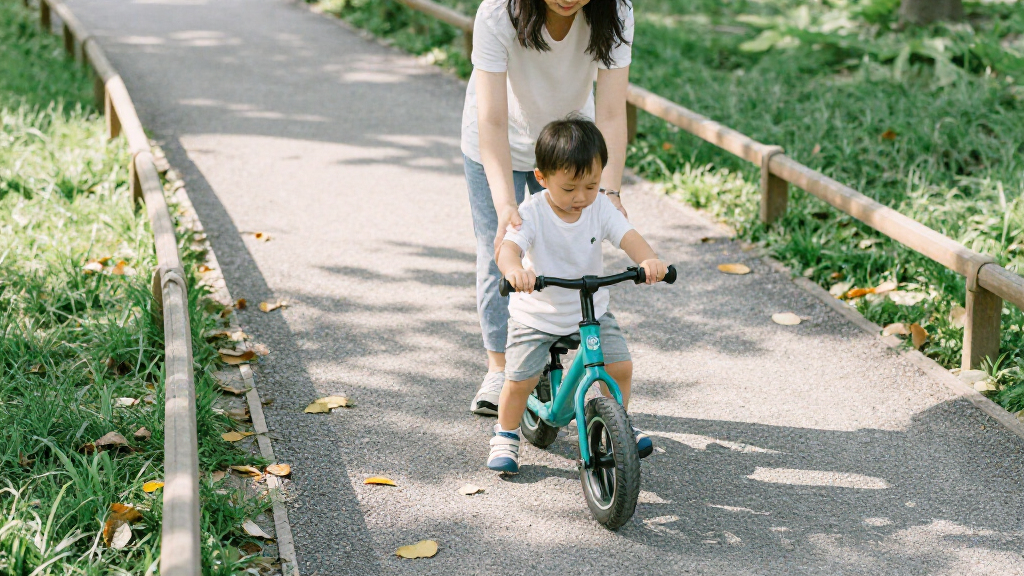
I ranked these bikes around the needs that shape a first riding experience: fit for young riders, stability, control, adjustability, and ease of handling. I also compared each design’s stated age range and intended use, distinguishing conventional two-wheel balance bikes from rocking models and four-wheel beginner styles. Where product details were limited, I avoided treating a feature as proof of superior performance.
The order favors bikes that appear to balance immediate usability with room to grow, while still recognizing that no single design suits every child. A stable, simple starter can rank ahead of a more feature-rich model if its form better matches a cautious beginner; a premium or specialized pick ranks lower overall when its extra function narrows its audience. I weighed maintenance and practical ownership too: fewer complicated parts and a clear fit range can be more useful than accessories that do not help a child learn to steer and glide.
| baby balance bike | Frame material |
|---|---|
| KRIDDO Baby Balance Bike for A | — |
| Strider Pro 2-in-1 Rocking Bal | Aluminum |
| Retrospec Cricket Baby Balance | — |
| woom GO 1 12-Inch Balance Bike | Aluminum |
| Radio Flyer Steady Start Balan | — |
| Strider 12 Sport Balance Bike | Alloy steel |
| SEREED Baby Balance Bike for T | Aluminum alloy |
| Baby Balance Bike for Toddlers | — |
| Bobike Baby Balance Bike for T | Alloy steel |
| Strider 12 Classic Balance Bik | Alloy steel |
| SEREED Toddler Balance Bike wi | Carbon steel |
| Liberry Baby Balance Bike for | Steel |
| KidRoller Toddler Balance Bike | Aluminum |
| Gamfeiny Baby Balance Bike wit | Carbon steel |
| woom WOW Baby & Toddler Balanc | Aluminum |
Factors to Consider When Choosing Best Baby Balance Bikes
Before choosing from this lineup, I would start with your child’s fit and confidence rather than the longest age range or most eye-catching feature. These broader checks can help you decide whether a stable starter, adjustable two-wheeler, or specialized indoor option makes sense.
Match the seat height to your child, not the age label
Age ranges are rough guidance; children the same age can have very different leg lengths and confidence. A beginner should be able to sit with both feet planted and knees slightly bent, then push off without reaching for the ground. Check the maker’s minimum seat height against your child’s inseam, wearing the shoes they will ride in. A wide adjustment range helps only if the bike can be set low enough today. One common mistake is buying for a future growth spurt and leaving a new rider unable to stabilize the bike. If the specifications do not give a clear seat-height range, ask the seller or manufacturer before choosing.
Choose stability based on the learning goal
Four-wheel designs can offer a more supported introduction to movement, particularly for a child who is hesitant to sit and push on two wheels. A conventional two-wheel balance bike asks for more active steering and balance, which can make it a better fit once the child is ready to move beyond supported scooting. Rocking models occupy a separate niche: they can invite movement indoors, but rocking practice is not the same as steering and gliding on a rolling bike. Avoid assuming that more wheels always mean an easier path to riding; the right design depends on your child’s comfort and the skills you want to practice. If you are unsure, prioritize a low seat, controlled movement, and a setting where an adult can stay close.
Check weight and reach before valuing adjustability
A bike can be adjustable yet still feel hard for a small child to handle if its frame is heavy or the controls sit too far away. Look at the child’s ability to grip the bars, turn them, and walk the bike while seated. A lighter frame can make it easier for a caregiver to carry as well, especially when rides include stairs or a walk home. Do not pay extra for a long adjustment range if the lowest setting does not fit now. For growing toddlers, a useful range is one that preserves a comfortable position at both ends, rather than a large number on a specification sheet.
Think about where the bike will be used
Indoor floors, smooth paths, and uneven sidewalks place different demands on a first bike. A rocking option may suit indoor movement, while outdoor riding calls for a stable frame and wheels suited to the surfaces your family actually uses. Consider storage, transport, and whether the bike must be carried regularly; compactness can matter more than accessories when space is tight. Check the product instructions for suitable surfaces and any assembly or inspection steps. A basket or decorative wheel feature can appeal to a child, but neither replaces a safe, clear riding area. Match the bike to your routine instead of assuming one model will work equally well everywhere.
Spend on fit and construction before extras
When deciding whether to pay more, I would look first for a dependable frame, secure fittings, a comfortable reach, and an adjustment system that is easy to use. Extras can be fun, but lights, baskets, or multiple modes do not automatically improve balance skills. A simpler model may be a better value if it fits well and will mostly be used for short rides. A premium option makes more sense when its design solves a real need, such as indoor rocking or a wider usable fit range. Check care instructions and inspect wheels, fasteners, and moving parts periodically. The best purchase is not the one with the longest feature list; it is the one your child can use comfortably and safely.
Frequently Asked Questions
Should I choose a four-wheel bike or a two-wheel balance bike for a first-time rider?
A four-wheel design can feel more supported for a child who is still getting used to sitting, pushing, and steering. A two-wheel balance bike gives more direct practice with balance and gliding, but may ask more of a cautious beginner at first. Your child’s ability to plant both feet and control the handlebars matters more than choosing a style by age alone. If possible, let your child try the riding position before buying. Choose the setup that encourages repeated, comfortable practice rather than the one that seems most advanced.
Is a rocking balance bike a replacement for an outdoor balance bike?
A rocking model can provide indoor movement and help a young child get comfortable sitting on a ride-on toy. It does not offer the same practice with forward steering, rolling, and gliding as a conventional balance bike. It may be a useful first step for families with limited outdoor space or a child who is not ready to ride outside. If your main goal is learning to coast and steer outdoors, a standard balance bike is the more direct choice. Some families may value both uses, but they are not interchangeable skills.
How can I tell whether my child has outgrown a balance bike?
Check whether the seat can still be set so your child sits comfortably with feet flat and knees slightly bent. If the seat is already at its maximum and the riding position feels cramped, the bike may no longer fit well. Also watch whether your child can steer and move the bike without knees or arms feeling crowded. Age by itself is not a reliable signal, since growth and comfort vary. Before replacing the bike, review the manufacturer’s fit guidance and compare it with your child’s current measurements.
Are adjustable handlebars worth prioritizing along with an adjustable seat?
They can help preserve a comfortable reach as a child grows, especially if the handlebar position otherwise feels too low, too high, or too far away. Seat adjustment is often the first fit check because it affects whether a beginner can put both feet down. Handlebar range should support relaxed arms and easy steering, not just add a growth claim. If a bike fits well at the seat but forces an awkward reach, the extra adjustment may matter. Compare the actual adjustment ranges and check how easy they are to change.
What should I check before letting my toddler ride a new balance bike?
Follow the manufacturer’s assembly and use instructions, then check that all fasteners are secure and the wheels and steering move as intended. Confirm that the seat height suits your child and that they can grip and turn the handlebars comfortably. Choose a clear, flat practice area away from traffic, steps, and other hazards, and supervise closely. Use protective gear recommended for your child and the riding setting. Recheck fittings and moving parts periodically, particularly after assembly or transport.
Conclusion
For most families seeking one conventional bike with room to adjust, I would start with the Strider 12 Sport as my best overall pick. The Retrospec Cricket is my best value-style choice for families who want a straightforward toddler option, while the woom WOW is my premium pick for very young riders and families drawn to its baby-focused design. Beginners who need an indoor confidence step may prefer the Strider Pro 2-in-1; families prioritizing supported, early scooting can compare it with the four-wheel no-pedal model. For extra visual appeal, the Gamfeiny’s light-up wheels offer a distinct feature, but I would put fit and control ahead of decoration. Choose based on your child’s current reach, confidence, and riding space—not the longest age claim.