

As your child grows, their cognitive development moves from recognizing objects and understanding object permanence to engaging in pretend play. During infancy, they start to realize objects exist out of sight, while toddlers build language skills, solve problems, and imagine scenarios through play. This progression supports their social awareness and emotional understanding. If you want to learn how to nurture these skills effectively, discover how early experiences shape their learning journey.

Turn the school run and nap time into listening time
- Thousands of audiobooks, podcasts and originals
- Listen on your phone, tablet or Echo — also offline
- Cancel anytime
Key Takeaways
- Object permanence develops during the sensorimotor stage, enabling infants to understand that hidden objects still exist.
- Early cognitive milestones include tracking objects, following sounds, and recognizing familiar faces, supporting mental representation.
- As language and play skills emerge, children begin engaging in pretend play, imagining scenarios and role-playing.
- Imaginative play builds on object permanence, allowing children to manipulate mental images and understand symbolic representations.
- Play-based experiences foster cognitive growth, creativity, and social understanding, transitioning from simple awareness to complex thinking.
object permanence toys for infants
As an affiliate, we earn on qualifying purchases.
As an affiliate, we earn on qualifying purchases.
Early Signs of Awareness in Infants

Understanding early signs of awareness in infants is essential because it helps caregivers recognize when a baby is beginning to engage with their environment. One key indicator is reaching sensorimotor milestones, like tracking moving objects or turning toward sounds. You’ll notice your baby starting to follow objects with their eyes or respond to familiar voices. Facial recognition is another important sign; they may smile when they see a caregiver’s face or show interest in faces they recognize. These behaviors demonstrate that your infant is beginning to process visual and social cues, signaling growing awareness. Recognizing these early signs allows you to support your baby’s development and encourage their curiosity. Keep observing their responses, as they reveal important steps in their cognitive growth. Additionally, the development of object permanence indicates that your baby is understanding that objects continue to exist even when out of sight, which is a critical milestone in cognitive development. Developing neural pathways through interaction and exploration further enhances their ability to learn and adapt.
The Development of Object Permanence

As infants grow, they begin to grasp the concept that objects continue to exist even when out of sight, a milestone known as the development of object permanence. During the sensorimotor stage, which lasts until about age two, your baby learns to understand that things don’t just disappear when hidden. Early on, they might search for partially hidden objects, but fully developed object permanence requires forming mental representations. This means your infant starts to hold in their mind the idea that an object still exists, even if they can’t see or touch it at the moment. Recognizing the importance of cognitive development at this stage helps caregivers support their child’s learning process. This cognitive leap marks a critical step in their understanding of the world and lays the foundation for more complex thought processes later on. Additionally, research suggests that the development of object permanence is closely linked to emerging prophetic dreams, as both involve mental visualization and understanding that unseen realities still exist.
Cognitive Growth During Toddler Years

During the toddler years, children experience rapid cognitive growth that builds upon their earlier understanding of object permanence. You’ll notice their language milestones accelerate, as they begin to say more words and form simple sentences, helping them express their needs and thoughts more clearly. Sensory exploration becomes a key part of their learning, as they actively touch, taste, and manipulate objects to understand the world around them. This exploration enhances their problem-solving skills and deepens their curiosity. As they experiment with new sounds and words, their vocabulary expands, fueling further cognitive development. Additionally, exposure to diverse play activities, such as interactive toys, supports their development by encouraging exploration and learning. Recognizing the importance of attention in their activities can significantly boost their creative and learning capabilities. Furthermore, understanding relationship dynamics can help caregivers foster a supportive environment for healthy social and emotional growth. This period marks a vital transition from basic awareness to more complex thinking, laying the foundation for future learning and social interactions.
The Role of Play in Learning
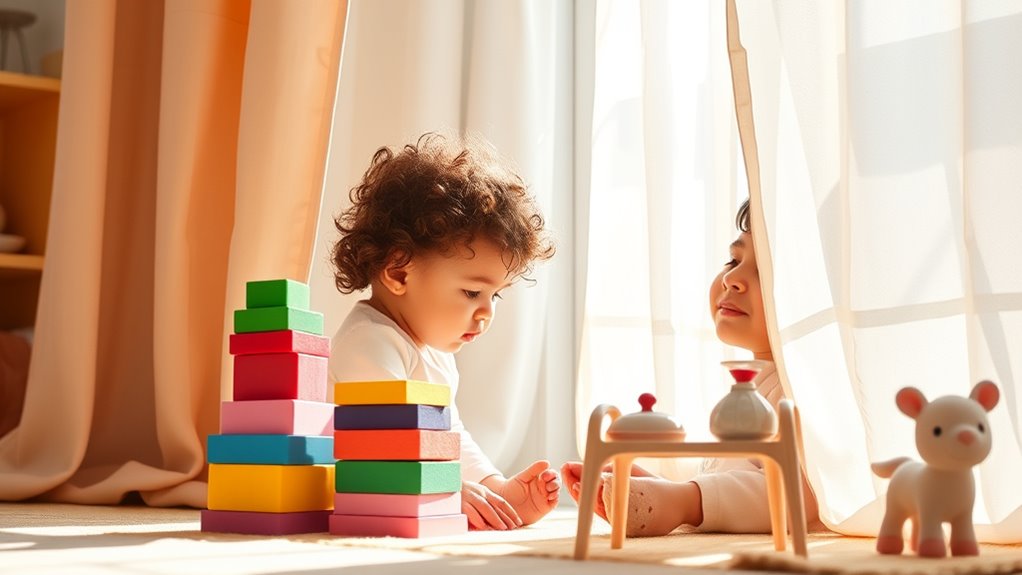
Play helps you see how children develop important cognitive skills and solve problems. It also encourages them to interact with others and build social skills naturally. Plus, play sparks creativity, inspiring kids to imagine and explore new ideas. Engaging in sensory activities during play can further enhance cognitive development and stimulate curiosity. Incorporating diversified play methods can optimize learning outcomes and foster well-rounded development. Additionally, integrating organic farming techniques into play scenarios can teach children about sustainability and environmental responsibility from an early age.
Enhances Cognitive Skills
Have you ever wondered how engaging activities boost a child’s thinking skills? Play stimulates their brain, helping develop key cognitive abilities. When children manipulate toys or solve puzzles, they practice problem solving skills, strengthening their reasoning and adaptability. Play also encourages language development as they describe actions, ask questions, and share ideas, expanding their vocabulary and communication abilities. These activities challenge children to think critically and creatively, fostering mental flexibility. As they navigate different scenarios and make decisions during play, their cognitive resilience grows. Regular, engaging play pushes children to process information more effectively, laying a foundation for future learning. Additionally, play can enhance emotional support by helping children express their feelings and cope with new situations. Incorporating play-based learning tools such as interactive toys or educational games can further amplify cognitive development. Ultimately, playful experiences serve as an essential tool in enhancing cognitive skills, making learning both enjoyable and impactful.
Fosters Social Interaction
Engaging in social play helps children build meaningful connections and develop essential social skills. Through peer interactions, children learn how to communicate, share, and understand others’ perspectives. Cooperative games encourage teamwork and patience, fostering a sense of trust and collaboration. As children navigate these activities, they practice negotiating roles, resolving conflicts, and expressing emotions appropriately. These experiences lay the groundwork for empathy and social awareness. Play that involves peers also helps children recognize social cues and develop a sense of belonging within their group. By participating in shared activities, children gain confidence in social settings and learn the importance of cooperation, respect, and reciprocity. Incorporating structured play elements like eye patches can help children feel more comfortable and confident during social interactions, especially if they have sensitive skin or need extra comfort. Understanding the importance of social skills can further enhance their development and prepare them for diverse social environments. Additionally, engaging in diverse types of play can support the development of object permanence, helping children understand that objects continue to exist even when out of sight. Overall, play acts as a crucial tool for nurturing the social skills necessary for healthy development and positive relationships.
Encourages Creativity
Because play naturally sparks curiosity and exploration, it serves as an essential catalyst for fostering creativity in children. When you encourage playful activities, you help develop their imaginative thinking, allowing them to envision new worlds and ideas. Through pretend play and open-ended tasks, children learn to approach problems creatively, honing their ability for creative problem solving. Play provides a safe space for experimentation, where children can test out different solutions and ideas without fear of failure. This process nurtures their capacity to think outside the box and develop original concepts. By supporting playful learning, you empower children to build their creative skills, which are crucial for innovation and adapting to new challenges throughout their lives.
How Imagination Emerges in Children

How does imagination first take shape in a child’s mind? It begins through the interplay of imagination and language, as children start to assign meaning to their thoughts and experiences. When they hear stories or describe their play, they practice creating mental images and scenarios, fueling their imaginative skills. Simultaneously, imagination and emotional intelligence work together, helping children understand and express feelings through pretend play. As they imitate actions or invent characters, they develop empathy and self-awareness. This process strengthens their ability to see the world from different perspectives. Over time, these early imaginative experiences lay the foundation for more complex creative thinking, problem-solving, and social understanding, all vital to their overall cognitive development.
Supporting Cognitive Advancement at Home

What practical steps can you take at home to boost your child’s cognitive growth? Encourage language acquisition by talking with your child regularly, describing activities, and reading together. Use open-ended questions to stimulate thinking and help them express ideas. Incorporate problem solving strategies by providing puzzles, building blocks, or simple challenges that require critical thinking. Create a rich learning environment with diverse toys and materials that promote exploration. Allow your child to make choices and experiment, fostering independence and confidence. Engage in activities that promote memory, attention, and reasoning skills. Consistent interaction and encouragement help build neural connections essential for cognitive development. Additionally, incorporating top ceiling fans options into your home can create a comfortable environment that supports focused learning and relaxation. Surrounding your child with a stimulating environment encourages curiosity and exploration, which are vital for cognitive advancement. By nurturing curiosity and supporting their problem solving and language skills, you lay a strong foundation for your child’s lifelong learning.
Frequently Asked Questions
How Do Cultural Differences Influence Cognitive Development Stages?
You’ll find that cross-cultural perceptions and educational influences shape your cognitive development stages profoundly. Different cultures prioritize various skills, like independence or social harmony, which affect how you develop object permanence or engage in pretend play. Educational practices across cultures also impact your learning pace and problem-solving abilities. By understanding these influences, you see how your environment molds your cognitive growth, highlighting that development isn’t the same everywhere but varies with cultural context.
What Are Signs of Delayed Cognitive Development in Children?
Think of your child’s brain as a garden—delayed cognitive development signs are weeds that hinder growth. If they struggle with brain plasticity, like difficulty adapting to new tasks, or show poor sensory processing, such as overreacting to sounds or textures, it’s a red flag. Watch for delays in language, problem-solving, or social skills, which indicate their cognitive pathways might need extra nurturing.
How Can Parents Encourage Creativity Beyond Pretend Play?
You can encourage creativity by providing open-ended materials like art supplies, building blocks, or costumes that fuel imaginative exploration. Ask questions that spark creative thinking, such as “What could this be?” or “What story can you tell?” and give your child plenty of time for unstructured play. Your active involvement and encouragement foster their ability to think creatively, helping them develop essential problem-solving skills and a love for imaginative exploration.
What Role Does Language Development Play in Cognitive Growth?
Think of language development as building a bridge that connects thoughts and understanding. When you help your child with language acquisition and vocabulary expansion, you give them tools to explore their world more deeply. For example, a child learning new words can better express their ideas and emotions, fueling cognitive growth. This active process strengthens their problem-solving skills and sparks curiosity, making learning an exciting journey.
Are There Specific Activities That Accelerate Cognitive Milestones?
You can accelerate cognitive milestones by engaging in sensory activities and problem-solving games. Sensory activities stimulate your child’s senses, enhancing perception and understanding, while problem-solving games boost critical thinking and reasoning skills. These activities encourage exploration and curiosity, helping your child develop important cognitive abilities like object permanence and pretend play. Incorporate these fun, interactive experiences regularly to support your child’s ongoing growth and learning.
Conclusion
As you watch your child grow, you’ll see their understanding deepen—from recognizing that objects still exist to creating imaginary worlds. For example, a toddler who hides a toy and then searches for it demonstrates object permanence. Supporting their curiosity through play not only boosts their cognitive skills but also nurtures their imagination. Remember, your involvement helps shape their learning journey—so encourage exploration and pretend play to foster their developing mind.
Evergreen bestsellers Picks
bestsellers
As an affiliate, we earn on qualifying purchases.