
📊 Full opportunity report: Understanding Consent Management For Youth-Service Software on IdeaNavigator AI — validation score, market gap, and execution plan.

Turn the school run and nap time into listening time
- Thousands of audiobooks, podcasts and originals
- Listen on your phone, tablet or Echo — also offline
- Cancel anytime
TL;DR
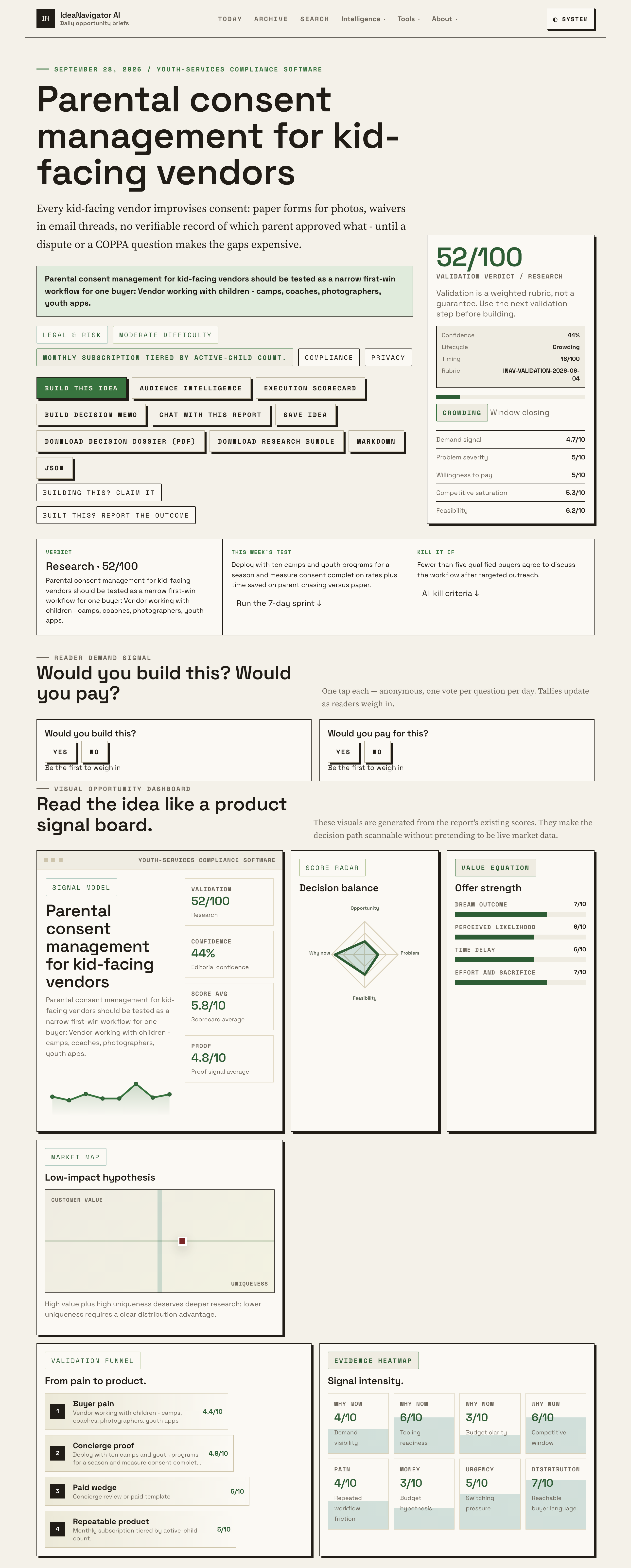
IdeaNavigator AI proposes testing a parental consent management workflow with 10 camps and youth programs over one season. The proposal describes phone-based forms, per-child records and audit exports, but reports no pilot, product launch or measured results.
IdeaNavigator AI has proposed testing a parental consent management workflow with 10 camps and youth programs, targeting vendors that collect permissions for children’s photos, data use, medical information or liability waivers. The proposal describes a possible product and validation plan; it does not report that a service has launched or that any pilot has begun.
The proposed service would let a youth-service vendor send parents a vendor-branded consent flow they can complete on a phone. The suggested forms cover separate permission areas, including photo use, data collection, medical information and liability. The proposal says the system could keep a consent ledger for each child, track when permissions expire and produce an audit export.
Identity checks would be selected according to the risk tier of the consent request, but the proposal does not specify the verification methods or how a vendor would set those tiers. It also suggests charging vendors a monthly subscription based on the number of active children. No price, technical design, named provider or customer commitment is given.
For validation, the proposal recommends a season-long trial with 10 camps and youth programs. It identifies two measures: how often parents complete consent requests and how much staff time is saved chasing permissions compared with paper forms. Those are proposed measures; no completion rates, time savings or other findings are reported.
Consent Records for Youth Programs
Small organizations that work with children may need to manage several permissions for each participant, across enrollment, events and changing activities. When approvals sit in paper files or email threads, staff may have difficulty locating which parent approved which use, or whether an approval is still current. A child-level record and exportable history could make that information easier to retrieve, if the proposed workflow works as intended.
The proposal points to children’s privacy rules and parent concerns as reasons vendors may want more defensible records. It does not document a particular enforcement action, legal requirement for this product, or finding that existing practices are unlawful. Whether a digital record satisfies any specific legal obligation would depend on the applicable rules and how the system is implemented.
parental consent management software
As an affiliate, we earn on qualifying purchases.
As an affiliate, we earn on qualifying purchases.
From Paper Forms to a Pilot
The proposal frames the opportunity around vendors serving children, including camps, coaches, photographers and youth-focused apps. It says these organizations often improvise consent collection, using paper forms for photos and email threads for waivers, and may lack a verifiable record linking an approval to a parent and a particular use. That description is the proposal’s account of the problem, rather than a survey finding or independently measured market assessment.
Its suggested first step is deliberately limited: test one workflow with a small group of camps and youth programs for a season before drawing conclusions about demand or performance. The proposed market category is youth-services compliance software. The material does not provide market sizing, customer interviews, legal analysis or evidence that vendors have agreed to participate.
Pilot Results Are Not Yet Available
No product or pilot results are reported. It remains unclear whether any camps have agreed to take part, when a trial might begin, who would build or operate the service, and what the subscription would cost. The proposal also does not define how identity verification would work, how sensitive medical information would be protected, or how records would be corrected or retained.
There is no reported comparison of digital consent with paper processes, and no evidence yet that parents would complete requests at higher rates or that staff would save time. The proposal cites changing privacy rules and parent challenges as drivers, but does not specify jurisdictions or explain which requirements a product would address. Its legal fit and commercial demand therefore remain unestablished.
A Season-Long Test Would Measure Use
The next step described is a season-long test with 10 programs. If carried out, it would track consent completion and staff time spent following up, comparing those measures with paper-based collection. No schedule or launch announcement is provided.
Further reporting would be needed to establish whether vendors participate, what consent categories are included, how parent identity and child records are handled, and whether the test produces measurable results. Until those details emerge, the software remains a proposed opportunity rather than a proven service.
Key Questions
Has parental consent software for youth vendors launched?
The proposal does not announce a launch or name a product. It outlines a possible service and recommends testing it with camps and youth programs.
What would the proposed system do?
It would let vendors send phone-based consent forms to parents and maintain per-child records, expiry tracking and audit exports. Suggested permissions include photo use, data collection, medical information and liability.
Are camps already participating in a pilot?
No participants or pilot start date are reported. The proposal recommends recruiting 10 camps and youth programs for a season-long test.
What results would the pilot measure?
The suggested measures are parent consent completion rates and staff time spent following up compared with paper forms. No results are available in the proposal.
How would the service make money?
The proposal suggests a monthly subscription priced by active-child count, but gives no price or evidence of customer demand.
Source: IdeaNavigator AI
Halloween Picks
halloween
As an affiliate, we earn on qualifying purchases.






![Every Parent Dreads That Call From School… 📞😱 [Litterbox Comics]](https://motherbabykids.com/wp-content/uploads/2026/10/every-parent-dreads-that-call-from-school-litterbox-comics-featured-260x140.jpg)