
📊 Full opportunity report: Daily Postpartum Check-ins For The First Two Weeks Home on IdeaNavigator AI — validation score, market gap, and execution plan.

Turn the school run and nap time into listening time
- Thousands of audiobooks, podcasts and originals
- Listen on your phone, tablet or Echo — also offline
- Cancel anytime
TL;DR
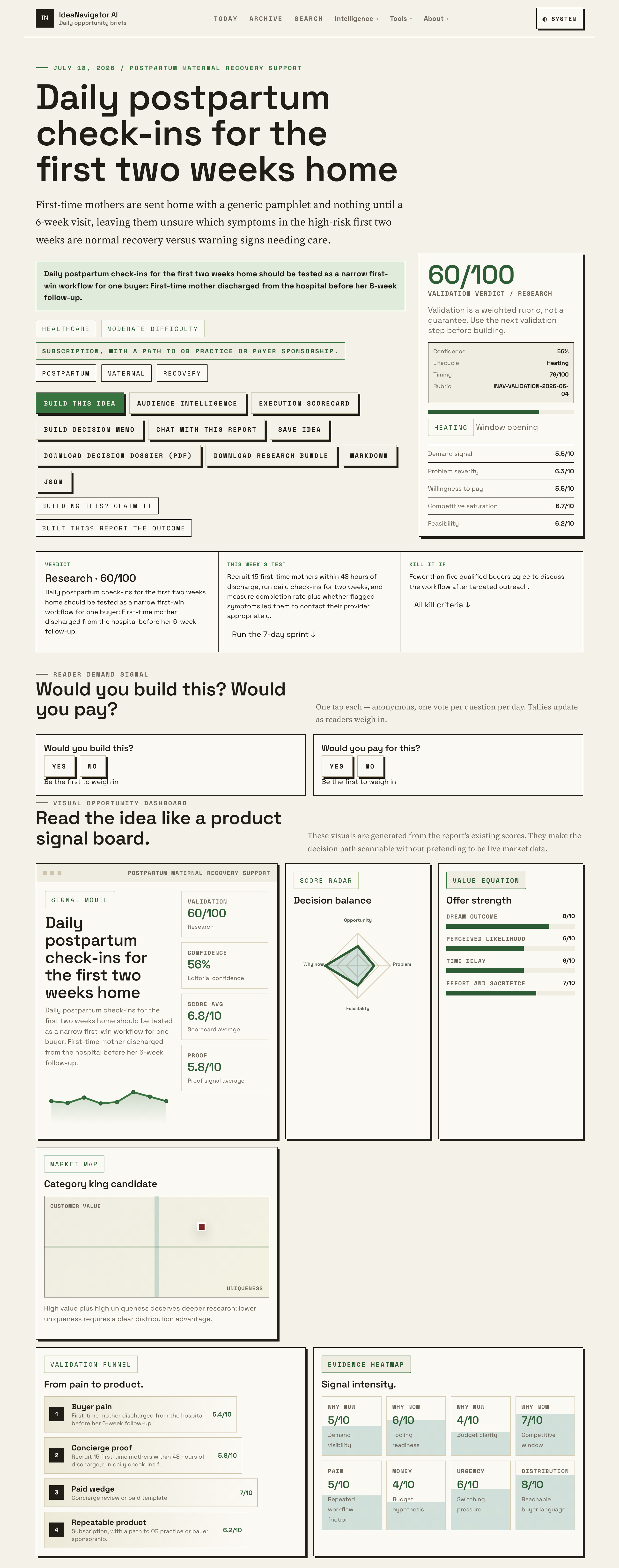
An IdeaNavigator AI proposal describes testing daily postpartum check-ins for first-time mothers during the first two weeks at home after hospital discharge. The concept has not been reported as a launched or clinically validated service; its proposed pilot would assess completion and whether symptom alerts prompt appropriate contact with providers.
IdeaNavigator AI has proposed testing daily postpartum check-ins for first-time mothers during the first two weeks at home after hospital discharge, a period the proposal says may pass without planned follow-up before a six-week visit. The plan describes a possible service and a small validation test, not a launched program or proven clinical intervention.
According to the IdeaNavigator AI proposal, the service would begin with an onboarding process that records delivery details, feeding method and a mental-health baseline. It would then send daily, personalized check-ins for two weeks, offer recovery information and prompt a mother to contact her provider if she reports a flagged symptom. The proposal does not list specific symptoms, explain how alerts would be reviewed or identify any clinical team responsible for them.
To test the idea, IdeaNavigator AI proposes recruiting 15 first-time mothers within 48 hours of discharge and running the check-ins for two weeks. The proposal names two suggested measures: whether participants complete the daily check-ins and whether flagged symptoms lead them to contact a provider appropriately. It reports no recruitment, trial results, participant feedback or comparison group.
The concept identifies a subscription as a possible revenue model, with potential sponsorship by obstetric practices or health insurers. These are business routes proposed by IdeaNavigator AI, not confirmed partnerships or evidence of demand. The material provides no price, product launch date, clinical review plan or details about how personal health information would be protected.
Support During the Early Weeks
The proposal focuses on a gap between discharge and a scheduled postpartum appointment. It suggests that a daily prompt could give a new mother recovering at home a structured way to notice changes and seek advice, rather than relying only on a general pamphlet. That is the intended benefit; the proposal provides no evidence that the service improves health outcomes or prevents complications.
The distinction matters because a symptom-checking tool can affect decisions about when to seek care. Any guidance would need to be clinically appropriate, clear about urgent warning signs and explicit that it does not replace a clinician. The pilot measures suggested in the proposal—check-in completion and provider contact after a flagged symptom—would not by themselves establish that a prompt was timely, care was appropriate or users who received no flag were safe.
If developed, the service would also handle sensitive information about delivery, feeding and mental health. Mothers and providers would need to know how those details are stored, who can see them and what happens if a user reports a concerning symptom. The IdeaNavigator AI proposal does not answer these operational and safety questions.
As an affiliate, we earn on qualifying purchases.
The Discharge-to-Follow-Up Gap
IdeaNavigator AI frames the concept around first-time mothers who leave hospital before a six-week follow-up. The proposal characterizes the time at home as a period when generic written information may not answer individual recovery questions. It points to maternal-health awareness and smartphone access as reasons a daily digital service could be tested, but provides no data on how often mothers lack interim support or how many might use an app.
The proposed workflow is limited to the first two weeks after discharge: create a recovery profile, send daily prompts, provide tailored information and encourage provider contact when a response raises concern. The proposal says a 15-person test would assess use and response behavior, not establish clinical effectiveness across postpartum populations. It specifies no study protocol, institution, clinician partner or ethics review.
Clinical and Trial Details Missing
IdeaNavigator AI’s material does not establish whether the proposal has moved beyond planning, when a pilot might begin or who would build and oversee the service. It identifies no clinician, hospital, insurer or participant as a partner. No results are reported showing whether daily check-ins are feasible, users find the advice useful or alerts lead to timely care.
The proposal leaves symptom criteria and the escalation process unspecified. It does not say whether responses would be automated, reviewed by a person or sent to a provider, or how urgent answers outside office hours would be handled. It also provides no details on privacy safeguards, accessibility, language options or inclusion of mothers without reliable smartphone access. These questions would need answers before readers could assess the tool’s safety or reach.
A Small Pilot Is Proposed
In the plan described by IdeaNavigator AI, the next step would be to recruit 15 first-time mothers within 48 hours of hospital discharge and collect check-in completion data over two weeks. The proposal also calls for examining whether flagged symptoms result in appropriate provider contact. It gives no start date or method for assessing appropriateness.
Any reported pilot findings would need to clarify who participated, how symptom flags were defined, how provider contact was verified and what happened when a participant reported an urgent concern. Until those details and results are available, daily postpartum check-ins remain a proposed support workflow rather than an established care service.
Source: IdeaNavigator AI proposal
Key Questions
Is a daily postpartum check-in service available now?
IdeaNavigator AI describes a proposed concept and pilot. Its material does not report that a service has launched or participants have been recruited.
Who is the proposed service for?
The IdeaNavigator AI proposal targets first-time mothers discharged from hospital before a six-week follow-up, with check-ins planned for the first two weeks at home.
What would the check-ins include?
According to the proposal, delivery details, feeding method and a mental-health baseline would be used to tailor daily recovery information and prompt provider contact when a response flags a symptom. Specific symptoms and alert procedures are not provided.
Has the idea been shown to improve postpartum care?
No results or clinical evidence are reported in the proposal. Its suggested 15-person pilot would measure completion and provider contact after flagged symptoms; those measures would not, on their own, establish improved health outcomes.
Source: IdeaNavigator AI
Cold & flu season Picks
humidifiers
As an affiliate, we earn on qualifying purchases.