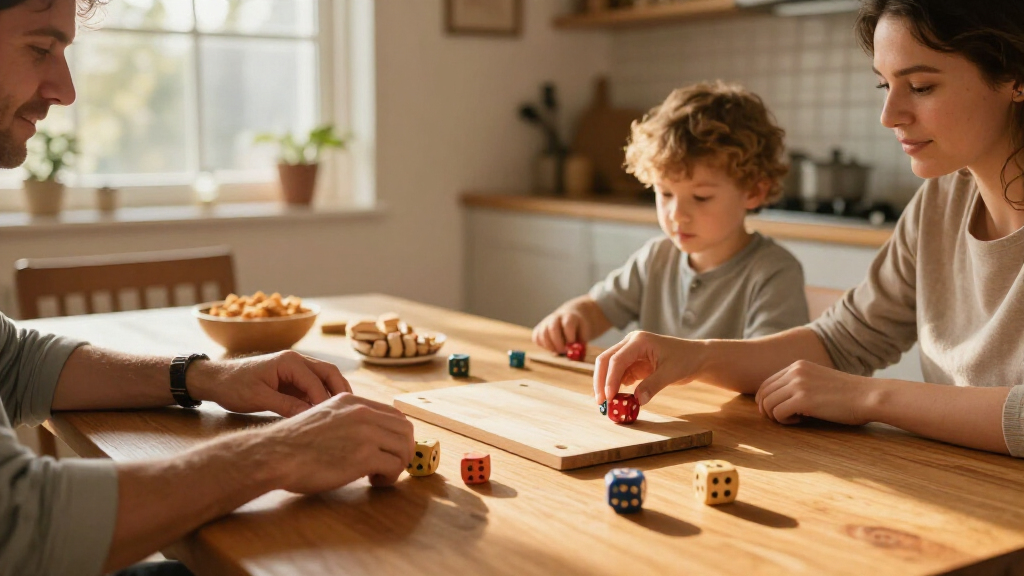
The best dice games for families are easy to teach, quick to set up, and engaging for a mix of ages. I’d put Gamewright Qwixx first for its lively decisions and brief turns, while TENZI Party Pack suits groups that want fast, energetic rounds and Farkle Classic offers familiar push-your-luck play. The main tradeoff is between games built for noisy group fun and those that reward quieter planning; player count, reading demands, and small-piece handling also affect the fit. Keep reading for the full breakdown of all 15 options and guidance on choosing one for your family.

Turn the school run and nap time into listening time
- Thousands of audiobooks, podcasts and originals
- Listen on your phone, tablet or Echo — also offline
- Cancel anytime
Complete the kit


Key Takeaways
- Qwixx stands out for family play that balances quick turns with meaningful choices, while more luck-driven options ask less of players strategically.
- TENZI Party Pack is the liveliest pick for simultaneous play, but its pace and excitement may suit active groups better than families seeking a calm table game.
- Shut the Box options bring a tactile wooden-board format that differs from cup-and-dice games; check the stated player range before choosing between the Nicecho and AMEROUS sets.
- Yahtzee offers a familiar score-sheet structure, while Yahtzee Frenzy adds cards and a faster party format, so the two serve different moods rather than being interchangeable.
- LCR, Farkle, and Pass the Pigs lean heavily on chance and easy turns, making them approachable choices, but families wanting more planning may prefer Qwixx or Shut the Box.
| Farkle Classic Dice Game Set |  | Best for Push-Your-Luck Strategy | Brand: PlayMonster | Recommended age: 8 years and up | Players: 2 or more | VIEW LATEST PRICE | See Our Full Breakdown |
| LCR Left Center Right Dice Game in Blue Tin |  | Best for Larger Groups and Simple Turns | Players: 3 or more | Recommended age: 5 years and up | Playing time: 30 minutes | VIEW LATEST PRICE | See Our Full Breakdown |
| Nicecho Shut the Box Wooden Dice Game for 2–4 Players |  | Best for Early Math Practice | Brand: Nicecho | Material: Pinewood | Players: 2–4 | VIEW LATEST PRICE | See Our Full Breakdown |
| TENZI Party Pack Dice Game with Storage Case |  | Best for Fast Family Rounds | Players: 2–6 | Dice: 60 total; 6 sets of 10 | Ways to play: 9 | VIEW LATEST PRICE | See Our Full Breakdown |
| Bamboozled – Bluffing Dice & Card Game |  | Best for Bluffing and Short Sessions | Brand: Blue Wasatch Games | Model: BWG-1016 | Players: 2–8 | VIEW LATEST PRICE | See Our Full Breakdown |
| LCR Left Center Right Dice Game |  | Best for Large, Lively Groups | Edition: 2010 | Manufacturer: Brybelly | Players: 3 or more | VIEW LATEST PRICE | See Our Full Breakdown |
| Pass the Pigs Dice Game |  | Best Compact Travel Pick | Brand: Winning Moves Games USA | Model number: 1046 | Recommended age: 7 years and up | VIEW LATEST PRICE | See Our Full Breakdown |
| Farkle Dice Game with Cup |  | Best for Push-Your-Luck Decisions | Brand: PlayMonster | Players: 2 or more | Recommended age: 8 years and up | VIEW LATEST PRICE | See Our Full Breakdown |
| Hasbro Gaming Yahtzee Dice Game with Collapsible Cup and Storage Case |  | Best for Structured Scorecard Play | Brand: Hasbro Gaming | Players: 2 or more | Recommended age: 8 years and up | VIEW LATEST PRICE | See Our Full Breakdown |
| AMEROUS Upgraded Shut The Box Dice Game for 1-6 Players |  | Best for Family Math Practice | Brand: AMEROUS | Material: Natural solid wood and plastic | Players: 1–6 | VIEW LATEST PRICE | See Our Full Breakdown |
| Hasbro Gaming Yahtzee Frenzy Dice & Card Game |  | Best for High-Energy Family Play | Players: 2–4 | Age range: 8 years and up | Combo cards: 66 | VIEW LATEST PRICE | See Our Full Breakdown |
| Gamewright Qwixx Dice Game |  | Best for Keeping Everyone Involved | Players: 2–5 | Recommended age: 8 years and up | Playing time: About 15 minutes | VIEW LATEST PRICE | See Our Full Breakdown |
| Hasbro Gaming Yahtzee Classic Dice Game |  | Best for Traditional Dice Strategy | Players: 2 or more | Recommended age: 8 years and up | Dice: 5 | VIEW LATEST PRICE | See Our Full Breakdown |
| Big Discoveries Dumpster Dice Family Game |  | Best for Younger Kids and Variety | Players: 2–4 | Recommended age: 6 years and up | Playing time: 5–10 minutes | VIEW LATEST PRICE | See Our Full Breakdown |
| University Games Pizza Party Dice Game |  | Best for Two-Player Family Matches | Players: 2 | Recommended age: 6 years and up | Game type: Dice game and matching game | VIEW LATEST PRICE | See Our Full Breakdown |
| dice games for familie | Players | Recommended age | Material | Brand |
|---|---|---|---|---|
| Farkle Classic Dice Game Set | 2 or more | 8 years and up | Paper, plastic | PlayMonster |
| LCR Left Center Right Dice Gam | 3 or more | 5 years and up | Plastic | — |
| Nicecho Shut the Box Wooden Di | 2–4 | 5–10 years | Pinewood | Nicecho |
| TENZI Party Pack Dice Game wit | 2–6 | 7 years and up | Plastic | — |
| Bamboozled | 2–8 | 8 years and up | Paper | Blue Wasatch Games |
| LCR Left Center Right Dice Gam | 3 or more | — | Plastic | — |
| Pass the Pigs Dice Game | 2 or more | 7 years and up | — | Winning Moves Games USA |
| Farkle Dice Game with Cup | 2 or more | 8 years and up | Plastic | PlayMonster |
| Hasbro Gaming Yahtzee Dice Gam | 2 or more | 8 years and up | — | Hasbro Gaming |
| AMEROUS Upgraded Shut The Box | 1–6 | — | Natural solid wood and plastic | AMEROUS |
| Hasbro Gaming Yahtzee Frenzy D | 2–4 | — | — | — |
| Gamewright Qwixx Dice Game | 2–5 | 8 years and up | Cardboard | — |
| Hasbro Gaming Yahtzee Classic | 2 or more | 8 years and up | Plastic | — |
| Big Discoveries Dumpster Dice | 2–4 | 6 years and up | ABS | — |
| University Games Pizza Party D | 2 | 6 years and up | Plastic | University Games |
More Details on Our Top Picks
Farkle Classic Dice Game Set
Farkle Classic suits families who want dice rolling to involve more than taking turns and hoping for a lucky result. On each turn, players decide whether to bank points or keep rolling for a larger score, so the game creates simple risk-reward choices that children and adults can discuss together. The cup, six dice, and score pads are included, which makes it ready to play and easier to pack than a game that needs a separate score sheet. Compared with LCR Left Center Right, Farkle gives players more influence over their decisions, though luck still plays a large part. Its roughly 30-minute play time can suit a family game night, but may feel long beside the quicker rounds of Bamboozled. Paper score pads can wear out or go missing, and the game needs at least two players.
Pros:- Includes a cup, six dice, and score pads for play without extra components.
- Push-your-luck choices give players more agency than a purely luck-based game.
- Simple rules make it accessible across ages eight and up.
- Compact dimensions make it practical to bring on trips.
Cons:- Luck can outweigh careful decisions, which may frustrate players seeking tighter strategy.
- Paper score pads can wear out or be misplaced.
- Requires at least two players and does not offer a solo mode.
Best for: Families with children around eight and older who enjoy simple scorekeeping and choosing when to take a risk.
Not ideal for: Solo players or strategy-focused families who want outcomes to depend less on luck.
- Brand:PlayMonster
- Recommended age:8 years and up
- Players:2 or more
- Estimated playing time:30 minutes
- Included components:Dice cup, 6 dice, score pads
- Material:Paper, plastic
- Dimensions:8.13 × 5.38 inches
- Model number:6910
Our verdict“Choose Farkle if your family wants a portable dice game with easy rules and recurring risk-reward decisions.”
LCR Left Center Right Dice Game in Blue Tin
LCR Left Center Right is the straightforward group pick here: players roll, follow the dice directions, and pass game pieces around. Its three-or-more-player format makes it a better fit for a full family table than Shut the Box, which is listed for two to four players. The rules are aimed at ages five and up, so younger children can join without learning a scoring system like the one in Farkle Classic. A small blue tin keeps the dice and pieces together, making storage and travel easy. The tradeoff is that this is a luck-first game; players have little control over what happens after a roll, and there is no listed solo option. Its roughly 30-minute playing time may also be longer than families expect from such simple turns, and the description positions it for indoor play.
Pros:- Rules and recommended age suit family groups with children from age five.
- Designed for three or more players, making it a fit for larger tables.
- Tin keeps the dice and game pieces together in a compact package.
- No score pads or complex scoring system are listed.
Cons:- Luck drives play, leaving little room for strategic decisions.
- Not suited to two players or solo play based on the listed player count.
- The product is described for indoor play, limiting its stated use cases.
Best for: Families with at least three players, including younger children, who want a simple game with minimal strategy or scorekeeping.
Not ideal for: Two-player households or groups looking for meaningful tactical choices and a strong sense of control.
- Players:3 or more
- Recommended age:5 years and up
- Playing time:30 minutes
- Included components:Dice, game pieces
- Container:Blue tin
- Material:Plastic
- Dimensions:4.5 × 3.5 × 1.5 inches
- Weight:3.2 ounces
Our verdict“Pick LCR for an easy, group-friendly game where young children can join in without learning complicated rules.”
Nicecho Shut the Box Wooden Dice Game for 2–4 Players
Nicecho Shut the Box is the educational-leaning choice for families who want dice play to reinforce addition and logical thinking. Its wooden board gives players a hands-on surface for the game, while the felt lining is designed to reduce noise—a useful difference from the more rapid clatter of TENZI. It supports two to four players, so it can work for a small family but not for a larger group as comfortably as LCR, which is designed for three or more. The listed age range of 5–10 years points toward younger players; older children and adults may want a game with more varied challenges. The board measures about 8.74 inches square, which keeps it portable but may feel cramped when several players gather around. Only dice are listed as included components.
Pros:- Dice play can support arithmetic and logical-thinking practice.
- Pinewood board with a felt surface is designed to reduce rolling noise.
- Portable board size suits small tables and travel.
- Supports two to four players.
Cons:- The recommended age range is listed as five to ten, which may limit its appeal for older players.
- The compact board may feel small for groups gathering around it.
- Only dice are listed as included components, so buyers should check what else the game requires.
Best for: Families with children aged five to ten who want a compact dice game that can support arithmetic practice.
Not ideal for: Larger families or households seeking a game with a broad listed age range and a more expansive play surface.
- Brand:Nicecho
- Material:Pinewood
- Players:2–4
- Included components:Dice
- Board dimensions:8.74 × 8.74 × 1.1 inches
- Weight:368 g
- Recommended age:5–10 years
- Color:Multicolor
Our verdict“Choose Nicecho Shut the Box for a small family with younger children who value math practice and quieter dice rolls.”
TENZI Party Pack Dice Game with Storage Case
TENZI Party Pack is the pace-setter in this group: six sets of ten dice let up to six players roll at once, rather than waiting through turns as they do in Farkle Classic. That simultaneous play makes it a strong fit for families who want quick, energetic rounds, and the instructions offer nine ways to play when one format starts to feel familiar. The recommended age is seven and up, making it accessible to many school-age children, though the speed may be less appealing to players who prefer calmer, more deliberate choices like those in Nicecho Shut the Box. A storage case keeps the 60 dice together, but the case is narrow and the dice colors may vary. The available details do not give an exact playing time, so families wanting a predictable round length may prefer Bamboozled, which lists 10–15 minutes.
Pros:- Sixty dice provide ten for each of up to six players.
- Nine listed ways to play add variety within one set.
- Simultaneous rolling keeps players involved rather than waiting through turns.
- Includes a storage case for keeping the dice together.
Cons:- Fast rolling may not suit families who prefer slower, more thoughtful turns.
- Dice colors may vary.
- No exact playing time is provided in the product details.
Best for: Families with two to six players, especially those with school-age children who enjoy quick simultaneous play and game variations.
Not ideal for: Players who prefer a quiet, turn-based game or want a specifically listed play time before choosing.
- Players:2–6
- Dice:60 total; 6 sets of 10
- Ways to play:9
- Material:Plastic
- Storage case dimensions:1 × 3.5 × 10 inches
- Recommended age:7 years and up
Our verdict“Choose TENZI if your family wants energetic, simultaneous dice play for up to six players and values having several ways to play.”
Bamboozled – Bluffing Dice & Card Game
Bamboozled adds social bluffing to dice play: players secretly roll, try to beat the previous score, and choose whether to play honestly or risk a lie. That gives it a different family appeal from LCR, where outcomes mostly follow the roll, and from TENZI, which centers on speed and simultaneous rolling. With 10–15 minute rounds and support for two to eight players, it can fit a short game break or a larger group. The recommended age is eight and up, so it is less suited to families with younger children than LCR or Shut the Box. Its compact box travels easily, but the paper-based set includes cards and strike cards that players must track manually. Families wanting a substantial board or a calmer pace may prefer another option.
Pros:- Bluffing choices add interaction beyond simple dice luck.
- Listed rounds of 10–15 minutes suit short game sessions.
- Supports two to eight players, covering small and larger groups.
- Compact dimensions and weight make it easy to pack for travel.
Cons:- Recommended for ages eight and up, excluding younger children from the listed age range.
- Players must manually track strikes and lives.
- Paper components may feel less substantial than a wooden board or larger dice set.
Best for: Families with children aged eight and older who enjoy bluffing, reading other players, and keeping game sessions short.
Not ideal for: Households with children under eight or players who want a quieter game with less social pressure and manual tracking.
- Brand:Blue Wasatch Games
- Model:BWG-1016
- Players:2–8
- Recommended age:8 years and up
- Playing time:10–15 minutes
- Components:2 dice, 1 dice cup, 36 action cards, 16 strike cards, rules
- Dimensions:7 × 4.63 inches
- Weight:7.36 ounces
- Material:Paper
Our verdict“Pick Bamboozled for short family sessions where players aged eight and older enjoy bluffing and playful risk-taking.”
LCR Left Center Right Dice Game
LCR’s marked dice keep play simple and quick: roll, follow the symbols, and pass chips or tokens around the group. Its three-or-more-player format gives it a different family role from Pass the Pigs, which can start with two players and asks each player to weigh a riskier scoring choice. LCR is a better fit when several relatives are gathered and nobody wants a long explanation before the first turn.
The tradeoff is that the specialty cubes do most of the work; there is little strategic control compared with Farkle, where players choose whether to keep rolling. The small plastic set is easy to put away, but it is intended for indoor play, and the supplied description does not specify chips or tokens among the included components. I’d pick it for a relaxed group game, not for families seeking meaningful decisions or a complete accessory list.
Pros:- Specialty-marked cubes make turns straightforward to follow.
- Designed for three or more players, making it suitable for group gatherings.
- Includes a rulebook to help families get started.
- Small, lightweight box is easy to store between game nights.
Cons:- Relies heavily on chance, with less player decision-making than Farkle.
- The listed components specify dice but do not confirm inclusion of chips or tokens.
- Plastic construction and indoor-use design may not suit families seeking a more durable outdoor game.
Best for: Families with at least three players who want a fast, easy-to-explain group game for indoor gatherings.
Not ideal for: Two-player households and families looking for strategic choices or confirmed inclusion of the chips or tokens used during play.
- Edition:2010
- Manufacturer:Brybelly
- Players:3 or more
- Material:Plastic
- Included components:Dice
- Special feature:Specialty-marked cubes
- Usage:Indoor
- Item weight:2.4 ounces
Our verdict“Choose LCR for a simple indoor game with three or more players, but pick Farkle if your family wants more control over each turn.”
Pass the Pigs Dice Game
Pass the Pigs replaces numbered dice with two pig-shaped dice, and the scoring depends on how they land. That gives it a playful, tactile hook that distinguishes it from Farkle Dice Game with Cup, which uses six conventional dice and asks players to decide whether to risk another roll. With a carrying case, score pad, pencils, and instructions listed, this set is suited to family trips where a small game needs to pack up neatly.
The rules are recommended for ages seven and up, and the two-player minimum makes it more flexible for smaller households than LCR. Its main limitation is also clear: chance drives the outcome, so it offers less strategic depth than Farkle. The small pieces can go missing if they are not returned to the case, and scoring requires tracking points. I’d choose it for portable, lighthearted play rather than a family seeking substantial tactical choices.
Pros:- Carrying case keeps the pig dice and scoring accessories together for travel.
- Can be played by two or more players, unlike LCR’s three-player minimum.
- Distinct pig-shaped dice make outcomes easy to see and add a playful physical element.
- Scoring can prompt casual discussion of probability and chance.
Cons:- Outcomes depend heavily on luck, with less strategic choice than Farkle.
- Small dice and accessories can be lost if they are not stored in the case.
- Players need to track scores to determine who reaches 100 points.
Best for: Families with children aged seven and older who want a compact game for trips and can keep small pieces together in a case.
Not ideal for: Players seeking a strategy-focused game, or households that often misplace small game pieces.
- Brand:Winning Moves Games USA
- Model number:1046
- Recommended age:7 years and up
- Players:2 or more
- Included components:2 pig dice, score pad, 2 pencils, carrying case, and instructions
- Target audience:Tweens, teens, and adults
- Manufacturer warranty:1 year from purchase
Our verdict“Pick Pass the Pigs for portable, chance-driven fun with children seven and older, not for a game built around strategy.”
Farkle Dice Game with Cup
Farkle makes each turn a choice between banking points and rolling again, so family members have more influence over their fortunes than they do in LCR or Pass the Pigs. That push-your-luck tension gives it a stronger fit for players who enjoy weighing risk, while the rules list an age recommendation of eight and up and support for two or more players. The set includes six dice, a lidded cup, and rules, making it a compact option for a table at home or on a trip.
That extra decision-making comes with a catch: one more roll can wipe out the turn’s points, which may frustrate cautious players or younger children. Chance still shapes the results, and players need to follow scoring rules rather than simply rolling and passing as in LCR. Compared with Yahtzee, Farkle’s central choice is whether to keep pushing, not how to fill a fixed scorecard. I’d choose it for families who enjoy lively risk management.
Pros:- Push-your-luck turns give players meaningful choices about when to stop.
- Six dice and a lidded cup provide the core play components in one compact set.
- Supports two or more players, including smaller family groups.
- Combines chance with planning, giving players more agency than LCR.
Cons:- A risky roll can cost players the points they built during that turn.
- Dice luck still affects results, limiting how much planning can control outcomes.
- Players need to learn and apply the scoring rules, unlike simpler pass-and-roll games.
Best for: Families with players aged eight and older who enjoy making risk-versus-reward choices and want a portable game for two or more.
Not ideal for: Younger children or players who dislike losing a turn’s accumulated points after choosing to roll again.
- Brand:PlayMonster
- Players:2 or more
- Recommended age:8 years and up
- Included components:6 dice, lidded dice cup, and rules
- Material:Plastic
- Educational objective:Critical thinking and strategic planning
- Operation mode:Manual
Our verdict“Choose Farkle if your family likes deciding when to bank points and when to risk another roll.”
Hasbro Gaming Yahtzee Dice Game with Collapsible Cup and Storage Case
Yahtzee gives every player a shared scorecard framework: roll five dice up to three times, then record a combination across 13 rounds. That structure makes it a more deliberate family game than LCR, where the action mainly follows the symbols rolled, and it offers a different decision pattern from Farkle’s choice to continue or stop. The collapsible cup and fold-and-go case with a dice tray help keep the dice contained and make the set easier to pack for a family trip.
The listed age recommendation is eight and up, and the estimated playing time is 30 minutes. Score sheets are central to play, not an optional extra, so the included 80 sheets are useful, but they will eventually run out. Families that prefer games without written tracking may find the process fussy compared with Pass the Pigs. I’d choose this version when portability and organized scoring matter more than the quick, loose pace of simpler dice games.
Pros:- Five-dice, 13-round format gives play a clear structure and endpoint.
- Fold-and-go case includes a dice-rolling tray to help contain rolls.
- Collapsible cup packs more conveniently than a rigid cup.
- Includes 80 score sheets for repeated games.
Cons:- Players must track results on score sheets throughout the game.
- The included sheets are a finite supply and may need replacing when used up.
- At about 30 minutes, it is a longer commitment than quick games such as LCR.
Best for: Families with players aged eight and older who enjoy tracking combinations over a structured game and want a portable storage case.
Not ideal for: Families seeking a very short, score-free game or a set that does not rely on paper score sheets.
- Brand:Hasbro Gaming
- Players:2 or more
- Recommended age:8 years and up
- Playing time:30 minutes
- Included components:Game unit with dice tray, collapsible cup, 5 dice, 80 score sheets, and game rules
- Model number:G2662
- Model year:2025
Our verdict“Choose this Yahtzee set for families who want structured scorecard play in a packable case and do not mind keeping written scores.”
AMEROUS Upgraded Shut The Box Dice Game for 1-6 Players
AMEROUS Shut The Box combines dice rolls with number choices, making it the clearest pick here for families who want play to exercise arithmetic and logical thinking. It supports one to six players and lists an age range of six and up, so it can accommodate a broader group than two-player-minimum Farkle. The natural-wood board and noise-reducing felt pad also give it a more substantial table presence than the small plastic sets such as LCR.
This is not the most grab-and-go option: a board takes more space than a dice cup and carrying case, and the number cards need setup before play. The listed components include 12 colored dice and four wooden dice, so the mixed materials may feel less consistent than an all-wood set. Compared with Yahtzee, Shut The Box emphasizes number combinations rather than filling a 13-round scorecard. I’d choose it for family game nights where shared math practice matters more than compact storage.
Pros:- Supports one to six players, including solo play and larger family groups.
- Number combinations create opportunities to practice arithmetic and logical thinking.
- Wooden board and felt pad offer a quieter, more substantial play surface than compact plastic dice sets.
- Listed age range starts at six years.
Cons:- The board is less portable than compact sets such as Farkle with its cup.
- Number cards require setup before play.
- The mix of plastic and wooden dice may not feel consistent to buyers seeking all-wood components.
Best for: Families with children aged six and older who want a tabletop dice game for up to six players that practices number combinations.
Not ideal for: Travel-focused families or buyers who want an all-wood set and minimal setup before play.
- Brand:AMEROUS
- Material:Natural solid wood and plastic
- Players:1–6
- Included components:1 wooden board, 12 colored dice, 4 wooden dice, and instruction manual
- Age range:6 years and up
- Genre:Strategy, party, and educational
- Warranty:1 year
Our verdict“Choose AMEROUS Shut The Box for a larger family group that wants hands-on number practice and has room for a board.”
Hasbro Gaming Yahtzee Frenzy Dice & Card Game
Yahtzee Frenzy turns dice matching into a simultaneous race: players roll to complete combo cards, then claim them before someone else does. That keeps the whole group involved instead of leaving everyone else waiting through one player’s turn, as can happen in Yahtzee Classic. Power Up cards add ways to interfere with opponents, giving the quick rounds more interaction than a simple speed challenge. The tradeoff is that speed and luck matter more than careful planning, and slapping cards can get loud. With a limit of 2–4 players, it also suits smaller households better than games such as Qwixx, which accommodates five. I’d choose this for families who enjoy lively competition, but not for quieter game nights or players seeking a more thoughtful pace.
Pros:- Simultaneous rolling keeps players active rather than waiting through turns.
- Combo cards and Power Ups add variety and direct interaction.
- Quick-start materials support an accessible introduction for ages 8 and up.
- Compact components are practical for travel and small game-night setups.
Cons:- Card slapping and shouted calls can be disruptive in quiet settings.
- Speed and luck may matter more than strategic decision-making.
- The 2–4 player limit excludes larger groups.
Best for: Families with children aged 8 and up who want short, energetic rounds and enjoy racing to claim cards.
Not ideal for: Larger families, quiet settings, or players who prefer turn-based strategy over speed and luck.
- Players:2–4
- Age range:8 years and up
- Combo cards:66
- Dice:20 total, in 4 sets
- Power Up cards:8
- Dice Tracker cards:4
- Other components:2 Quick Start cards, round keeper, round keeper token, game rules
- Model number:F5516
Our verdict“Choose Yahtzee Frenzy for a small family that wants noisy, fast-paced competition rather than a quiet strategy game.”
Gamewright Qwixx Dice Game
Qwixx makes a strong family pick for groups that dislike waiting: every roll gives everyone a chance to mark numbers on their scorecards, even when it is not their turn. Its roughly 15-minute playtime is also easier to fit into a busy evening than the 13 scoring rounds of Yahtzee Classic. The rules are simple, but choosing which numbers to cross off gives players more decision-making than the speed-focused Yahtzee Frenzy. It supports up to five players, a useful middle ground for families, though it still falls short of open-ended group games. The main ongoing drawback is the score pad: repeated sessions use up sheets, so it is less self-contained over time than a game with reusable components. I’d pick it for compact, low-downtime play, not for families wanting a large pile of dice to share.
Pros:- Everyone can participate on each roll, reducing downtime.
- About 15 minutes of play suits short family sessions.
- Simple rules make it approachable for ages 8 and up.
- Compact box is easy to pack for travel.
Cons:- The included score pad is consumable and may need replenishing.
- The player limit of five may not suit larger family gatherings.
Best for: Families of two to five who want a short game where players stay engaged on every roll.
Not ideal for: Groups larger than five or households seeking a reusable, score-pad-free game.
- Players:2–5
- Recommended age:8 years and up
- Playing time:About 15 minutes
- Dice:6
- Included scoring:1 score pad
- Material:Cardboard
- Dimensions:5.25 × 3.75 inches
- Batteries:Not required
Our verdict“Choose Qwixx for short family sessions where everyone should have a decision on nearly every roll.”
Hasbro Gaming Yahtzee Classic Dice Game
Yahtzee Classic is the traditional, turn-based choice in this lineup: players can roll up to three times to build combinations and fill 13 scoring categories. That makes it a better fit for families who enjoy weighing risk and keeping score than Yahtzee Frenzy, where speed and simultaneous play take the lead. Its straightforward dice-and-scorecard format also provides a familiar starting point for ages 8 and up, while the shaker lid helps keep the five dice together between turns. The tradeoff is pacing: with players taking turns across 13 rounds, a family session requires more attention and patience than a quick game of Qwixx. It also relies on scorecards, so tracking results is part of every game. I’d choose it for classic push-your-luck play, not for groups that want everyone acting at once.
Pros:- Up to three rolls per turn create choices about risk and scoring.
- Thirteen scoring rounds give a game a clear structure.
- Shaker lid doubles as a place to contain the dice.
- Includes 100 score cards for repeated play.
Cons:- Turn-taking across 13 rounds can feel slow for impatient players.
- Players must track scores throughout the game.
- The set requires at least two players.
Best for: Families with children aged 8 and up who want a familiar, turn-based game with choices about when to stop rolling.
Not ideal for: Families seeking very short rounds or simultaneous play, or players who dislike tracking scores over multiple turns.
- Players:2 or more
- Recommended age:8 years and up
- Dice:5
- Rolls per turn:Up to 3
- Turns per player:13
- Score cards:100
- Included shaker:Shaker with lid
- Material:Plastic
Our verdict“Choose Yahtzee Classic if your family wants the familiar rhythm of taking turns, rolling for combinations, and recording scores.”
Big Discoveries Dumpster Dice Family Game
Dumpster Dice stands out for families with younger children: it is designed for ages 6 and up, while Yahtzee Classic and Qwixx start at 8. Players roll to complete a set of numbers from 1 to 6 while avoiding duplicates, and the short 5–10-minute rounds can make it easier to bring children into a game night. Its 80 colorful dice and five gameplay variations offer more component variety than the small, scorecard-focused Qwixx. The removable lid also serves as the board, so there is less separate equipment to manage. Still, the standalone game only supports 2–4 players; larger groups need the Trash Dice combination. The many dice may also be less appealing to families who prefer a simple, low-clutter setup. I’d favor it for young kids and varied short sessions, rather than for larger groups playing from one box.
Pros:- Age recommendation of 6 and up makes it accessible to younger players than Qwixx or Yahtzee Classic.
- Five gameplay variations offer options beyond one ruleset.
- The removable lid doubles as the game board.
- Short rounds fit into brief family play sessions.
Cons:- Standalone play is limited to 2–4 players.
- The 80 dice may create more pieces to handle and put away.
- Groups larger than four need to combine it with Trash Dice.
Best for: Families with children aged 6 and up who want short rounds, colorful components, and several ways to play.
Not ideal for: Families needing a standalone game for more than four players or those who prefer minimal components.
- Players:2–4
- Recommended age:6 years and up
- Playing time:5–10 minutes
- Dice:80
- Gameplay variations:5
- Components:Dumpster, removable game-board lid, graffiti sticker sheet, instruction sheet
- Material:ABS
- Dimensions:6 × 5 inches
- Expansion:Can combine with Trash Dice for up to 6 players
Our verdict“Choose Dumpster Dice for younger families who want varied, quick games and do not need more than four players in a standalone set.”
University Games Pizza Party Dice Game
Pizza Party is the clearest choice here for a parent and child, siblings, or another pair: players race to match topping dice with order cards and build a complete pizza. Its age recommendation of 6 and up makes it accessible to younger players than Yahtzee Classic, while the head-to-head format gives each round a direct opponent rather than a shared score sheet. Unlike Qwixx, though, the box is strictly for two players; it will not include the rest of the family in the same game. The matching objective is easy to grasp, and the storage case supports travel, but the play centers on quick recognition and racing rather than the longer-term scoring choices in Yahtzee. I’d choose it for compact two-person contests, not as the main game for a family group.
Pros:- Simple topping-and-order matching is accessible to younger players.
- Head-to-head races give two players a clear shared objective.
- Compact storage case suits road trips and travel.
- Quick rounds work well for short play sessions.
Cons:- Limited to two players per box.
- Families need additional copies to accommodate more than two players.
- Plastic components may not suit buyers looking for a more substantial tabletop feel.
Best for: A parent-child pair or two siblings looking for a portable, quick matching game suitable for ages 6 and up.
Not ideal for: Families wanting one game that can include three or more players at the same time.
- Players:2
- Recommended age:6 years and up
- Game type:Dice game and matching game
- Dice:10 pizza topping dice
- Cards:40 pizza slice cards
- Included storage:Storage case
- Material:Plastic
- Brand:University Games
Our verdict“Choose Pizza Party for a portable game between two players, but pick Qwixx or Yahtzee Classic if the whole family needs to play together.”
How We Picked
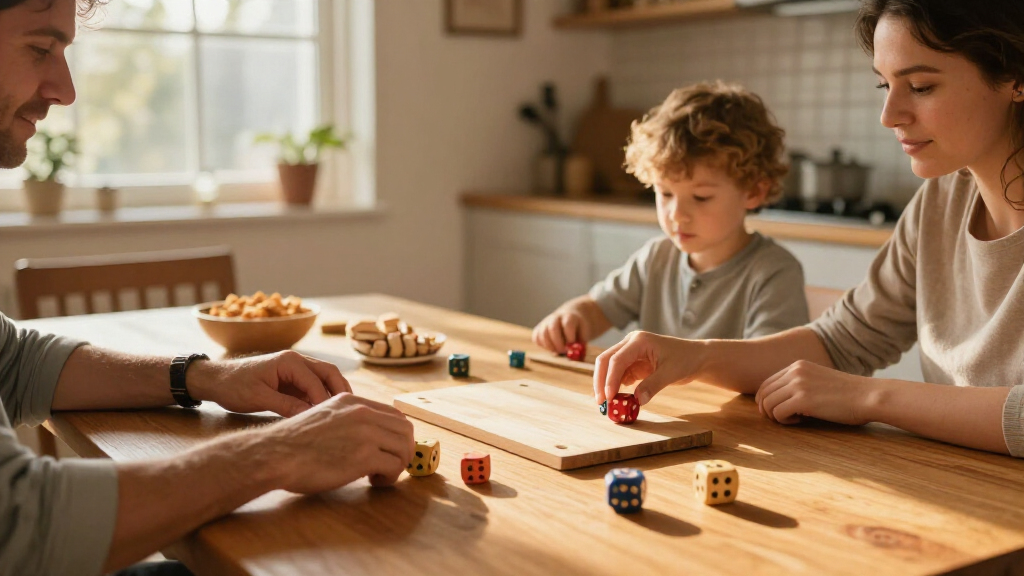
I compared the 15 games by how readily a family can learn the rules, how well their play styles suit mixed ages, and whether the format works for a quick round or a longer game night. I also weighed player-count fit, the role of reading or scorekeeping, setup and storage features, and whether the game encourages individual decisions, group energy, or mostly luck. Those factors matter because a game can be simple yet still disappoint if it leaves some players waiting or asks young players to manage more than they can comfortably handle.
The ranking gives priority to versatility across family groups and clear, repeatable play, then distinguishes games by their best use. A broad-appeal choice ranks ahead of a more specialized party or tactile option, even when the latter may be a stronger fit for a particular household. Similar products are compared by format and play experience, not treated as duplicates: for example, the two LCR editions and the several Farkle and Yahtzee sets may differ in packaging or included components, while their core game style remains the main basis for family fit.
Factors to Consider When Choosing Best Dice Games For Families
Before choosing a family dice game, I’d match the game’s rhythm and demands to the people who will actually play. The right pick is not always the one with the most components: a short, simple game can get more use than a longer option that feels like homework for younger players.
Match the rules to the youngest regular player
Choose based on the youngest person who will play often, not the oldest person who may join occasionally. A game with score sheets, symbols, or several rule steps can slow down a group even when the dice themselves are easy to handle. If younger players are still learning numbers or reading, look for turns that can be explained aloud and decisions that do not depend on reading cards. Older children may enjoy more choice, but a game that leaves younger siblings waiting can undermine family play. A useful check is whether an adult can teach the first round without repeatedly pausing to clarify rules. Keep age guidance in mind, then judge the actual demands of the game rather than relying on the label alone.
Decide whether you want strategy, luck, or both
Dice games vary widely in how much control players have over the outcome. Purely luck-led games are easy to join and can keep a mixed-age group on equal footing, but some families may find repeated rolls less engaging over time. Games with choices or score planning give players more ways to affect their results, though those decisions can create a learning curve. Push-your-luck play adds suspense, but a risky decision can also erase progress or frustrate a cautious player. Think about whether your group enjoys playful surprises or prefers to feel that planning matters. A balanced game can work well when tastes differ, while a very luck-heavy or strategy-focused option is better for a family that already knows its preferences.
Check player count and how much downtime each turn creates
The printed player range tells only part of the story; the pace of each person’s turn matters just as much. In a simultaneous game, everyone may stay involved at once, while a turn-based format can create waiting as the group grows. That difference can matter more than the nominal player limit for families with energetic children or frequent interruptions. If you often play with relatives or friends, choose a format that remains clear when the table is full. For a smaller household, a game designed for a few players may offer more focused decisions. Avoid assuming that a game suitable for many players will automatically feel lively with them all seated together.
Think about setup, scorekeeping, and cleanup
A quick game night often depends on how easily the pieces come out and go away again. Cups and storage cases can help keep dice together, while boards, score sheets, cards, or several small pieces add steps before and after play. Those extras may be worthwhile if they support the game’s central activity, but they can be a nuisance when the family wants a spontaneous round. Check whether scorekeeping requires a pencil and whether the table has enough room for the components. For travel or visits, a compact container can matter more than a large set of accessories. Choose the format your household will realistically set up, not the one that merely looks most complete.
Choose the right level of noise and competition
Family game night can mean a quiet challenge at the kitchen table or a loud party with everyone calling out at once. Fast, simultaneous play may be ideal for a lively group, but it can be hard to follow in a small room or for players who prefer time to think. A turn-based game creates more breathing room, although it may feel slow when everyone wants constant action. Competition also varies: some games make each person’s score the focus, while others involve shared outcomes or playful bluffing. Consider whether losing a round is likely to lead to laughter or disappointment in your household. Matching the social tone to the group helps a game stay welcome after the novelty wears off.
Pay for useful durability, not just a fuller box
When comparing versions of a familiar game, look at what the added components change during play. A sturdy board, well-contained dice, or a storage case may earn its place if the game will travel or see frequent use. Extra cards or accessories matter less if they complicate the rules or are likely to stay unused. For a household that plays occasionally, a straightforward set may be the more sensible choice; for frequent family gatherings, durable pieces can make setup and storage easier. Also check whether replacement or organization of small pieces will be manageable at home. The best fit is the version whose extras solve a real problem for your family.
Frequently Asked Questions
Which kind of dice game works best when children and adults have very different skill levels?
Look for a game where everyone can take a turn without needing the same level of reading, arithmetic, or long-term planning. Luck-led play can reduce the skill gap, while simple choices can keep adults engaged without making children feel outmatched. If the group includes very young players, try a sample round before committing to a longer game. Adults can help explain a rule, but avoid making them responsible for every child’s decisions. A game that lets players participate independently is usually easier to bring back to the table.
Should I choose a game that everyone plays at once or one with turns?
Simultaneous play keeps the whole group active and can make a game feel brisk, especially with several players. Turn-based games give each person more space to think, which may suit quieter families or players who dislike rushing. The tradeoff is that waiting can become more noticeable as the group grows. Consider the attention span and style of your regular players, not just the number of people listed on the box. If your family has mixed preferences, a short game can make either format easier to enjoy.
Are score sheets and arithmetic a problem for younger children?
They can be, depending on the child’s confidence with numbers and how much help the game requires. A score sheet may be part of the fun for school-age players, but repeated calculations can slow a group when younger children need an adult to manage each turn. Check whether the scoring can be handled by one person without taking over the game. If you want children to play more independently, favor rules that keep counting brief and visible. A little assistance is reasonable, but constant scorekeeping can make a supposedly simple game feel like a task.
Is a storage case or tin worth prioritizing?
It is useful when your family tends to play away from home, store games on open shelves, or lose small pieces between sessions. A tin or case can make a compact game easier to pack and keep together. It will not improve a game whose pace or rules do not suit your group, so treat storage as a practical tie-breaker rather than the main reason to choose. Check whether all components fit securely and whether the container is easy for children to open and close. For a game kept in one place, a simple box may be enough.
How do I choose between similar versions of Farkle, LCR, or Yahtzee?
Start with the game format you want, then compare what each edition actually includes. Packaging, cups, cases, cards, or other components may change storage and setup, but they do not necessarily change the core rules or family fit. For Yahtzee, distinguish the classic score-focused format from the separate Frenzy dice-and-card style rather than choosing by name alone. For Farkle and LCR, check the contents and presentation if portability or organization matters to your household. If those details do not solve a specific need, choose based on the play style and player range that best match your group.
Conclusion
For the best overall family fit, I’d start with Gamewright Qwixx for quick play that still gives players decisions to make. Farkle Classic is my value-minded pick for families who want familiar push-your-luck turns, while Yahtzee Classic is the more polished choice for households that prefer a traditional scoring game and appreciate its included storage format. For beginners or mixed-age groups that need very simple rules, LCR or Pass the Pigs makes a friendlier starting point. Choose TENZI for energetic, simultaneous play, Shut the Box for a tactile board-game feel, or Bamboozled when bluffing is the specific draw; skip those specialized formats if your family prefers quieter, more predictable rounds.