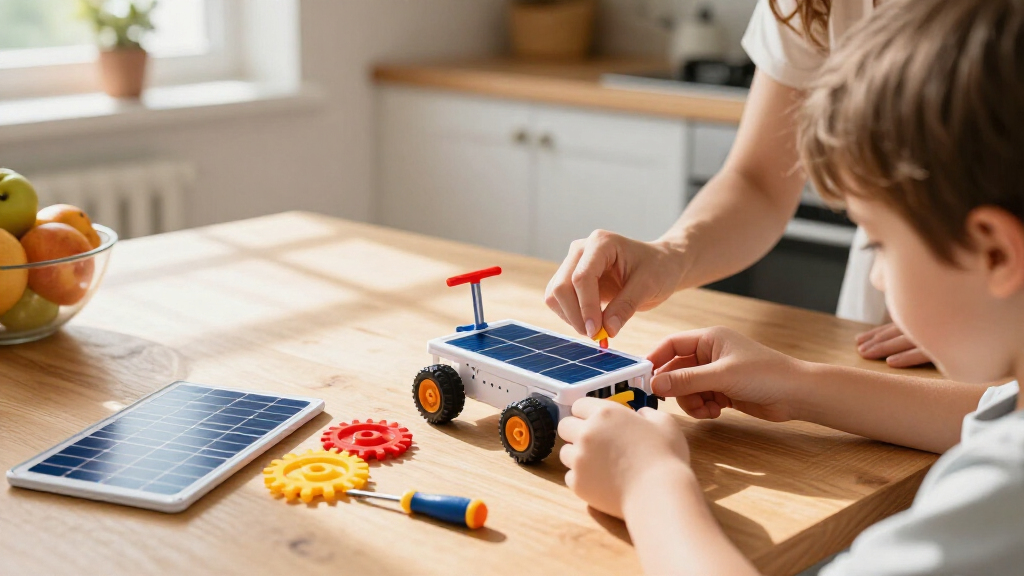

Looking for the best solar science kits for kids to spark curiosity about renewable energy? The Sillbird 12-in-1 Solar Robot Building Kit takes the top spot for its 190-piece versatility and ability to build a dozen different moving models. For families on a budget, the Yutin 6-Pack Solar Car Kit offers the best value with multiple projects to share, while the BeAndge 4-Pack is the easiest entry point for younger children. The real tradeoff in this category is between depth (one complex kit) and breadth (many simple kits), plus how much adult supervision you’re willing to provide. Read on for the full breakdown of all seven contenders.

Turn the school run and nap time into listening time
- Thousands of audiobooks, podcasts and originals
- Listen on your phone, tablet or Echo — also offline
- Cancel anytime
Complete the kit


Key Takeaways
- The Sillbird 12-in-1 stands apart with 190 pieces and 12 buildable models, making it the only kit that grows with a child from simple to complex builds.
- Multi-pack kits like Yutin and WESAYEE deliver far better per-project value and are the clear choice for siblings, classrooms, or birthday parties.
- Age ratings are misleading — several kits labeled for 8+ require adult help with small parts and motor wiring, while the BeAndge is genuinely beginner-friendly.
- Solar panel quality varies widely: the CYOEST and SCAEMO kits work indoors under bright light, but the Sillbird needs direct sunlight to move reliably.
- If you want a kit that teaches actual physics concepts rather than just assembly, the Delinx kit includes experiments that go beyond simple solar cars.
- Storage and organization matter — the Sillbird’s loose pieces are easy to lose, while the Yutin and WESAYEE kits come with clear storage boxes.
- No single kit is perfect for every child; the best choice depends on whether you prioritize build variety, number of projects, or depth of learning.
| Yutin Solar Car STEM Science Kits for Kids, 6-Pack |  | Best for Classroom & Group Activities | Brand: Yutin | Model: YT1022 | Quantity: 6 kits | VIEW LATEST PRICE | See Our Full Breakdown |
| Delinx Fun Physics Science Experiment Kit |  | Best for Advanced Physics Learning | Brand: Delinx | Age range: 12 years and up | Educational topics: Physics, circuits, problem solving, critical thinking, hands-on experimentation | VIEW LATEST PRICE | See Our Full Breakdown |
| BeAndge Solar Robot Car STEM Kit, 4-Pack |  | Best for Young Builders (Ages 8–12) | Brand: BeAndge | Model: BA1024 | Age range: 8–12 years | VIEW LATEST PRICE | See Our Full Breakdown |
| SCAEMO 4-Piece STEM Science Kit for Kids |  | Best for Project Variety | Brand: SCAEMO | Age Range: 8–16 years | Number of Kits: 4 | VIEW LATEST PRICE | See Our Full Breakdown |
| CYOEST Solar Power STEM Kit for Kids, 4 Models |  | Best for Quick and Easy Assembly | Brand: CYOEST | Age range: 8 years and up | Models included: Solar-powered car, solar-powered fan, wind-powered car, wooden plane | VIEW LATEST PRICE | See Our Full Breakdown |
| WESAYEE 8-Pack Solar Powered Fan STEM Kits for Kids |  | Best for Classrooms & Group Activities | Brand: WESAYEE | Age Range: 8 years and up | Number of Packs: 8 | VIEW LATEST PRICE | See Our Full Breakdown |
| Sillbird 12-in-1 Solar Robot Building Kit, 190 Pieces |  | Best for Versatile Builders | Brand: Sillbird | Models: 12 | Piece Count: 190 | VIEW LATEST PRICE | See Our Full Breakdown |
| solar science kits for kid | Brand | Material | Age range |
|---|---|---|---|
| Yutin Solar Car STEM Science K | Yutin | Plywood | — |
| Delinx Fun Physics Science Exp | Delinx | Plastic | 12 years and up |
| BeAndge Solar Robot Car STEM K | BeAndge | — | 8–12 years |
| SCAEMO 4-Piece STEM Science Ki | SCAEMO | — | 8–16 years |
| CYOEST Solar Power STEM Kit fo | CYOEST | Wood | 8 years and up |
| WESAYEE 8-Pack Solar Powered F | WESAYEE | Non-toxic plastic | 8 years and up |
| Sillbird 12-in-1 Solar Robot B | Sillbird | ABS | — |
More Details on Our Top Picks
Yutin Solar Car STEM Science Kits for Kids, 6-Pack
When you need to keep an entire classroom or club busy, this six-pack is the practical pick. Each kit builds a solar-powered car with plug-in connections, so there’s no soldering or special tools to manage — just snap pieces together and head outside. Compared with the BeAndge 4-pack, which suits smaller groups, the Yutin set gives you twice as many builds for the same supervision effort. The illustrated instructions are clear enough for most 8-year-olds, though younger kids will likely need an adult to help with the trickier gear assembly. The plywood pieces are smooth and rounded, which makes this a safer choice for group settings. The main tradeoff is that the cars only move in direct sunlight, so you’ll need to plan around weather or a bright window.
Pros:- Six identical kits allow simultaneous building in groups
- Tool-free plug-in assembly keeps setup simple and safe
- Non-toxic plywood with rounded corners is kid-friendly
- Covers solar energy, circuits, and gear transmission in one project
Cons:- Requires strong sunlight to demonstrate movement, limiting indoor use
- Gear assembly can be fiddly for younger children without adult help
Best for: Teachers, homeschool co-ops, or parents running STEM parties who need multiple kits for several kids at once
Not ideal for: Families with just one or two children — the six-pack is overkill and takes up storage space
- Brand:Yutin
- Model:YT1022
- Quantity:6 kits
- Recommended age:8 years and up
- Material:Plywood
- Power source:Solar
- Assembly:Plug-in connections; no soldering or special tools required
- Included components:Building toys, circuit kit, DIY kits, STEM science kit, wooden puzzle
Our verdict“If you’re equipping a classroom or group activity, this six-pack offers the best value in scale and ease of supervision.”
Delinx Fun Physics Science Experiment Kit
This kit takes a different approach from the others in the lineup by focusing on energy conversion rather than just building a single vehicle. With 23 pieces, you can generate electricity three ways — solar, hand-crank, and wind — and use that power to light an LED or spin a fan. That makes it a stronger fit for older kids (12 and up) who are ready to grasp abstract concepts like circuits and energy transfer. Compared with the Yutin 6-pack, which is purely solar-powered and assembly-driven, the Delinx kit encourages more open-ended experimentation. The catch is that paper instructions aren’t included; you’ll need to download them, which may be inconvenient if you want a screen-free activity. The plastic components are durable but feel less premium than the wooden kits, and the small size (3 x 3 x 2 inches) means it’s best for individual or pair work rather than a large group.
Pros:- Three power generation methods (solar, hand-crank, wind) teach multiple concepts
- Hands-on circuit building with a real LED and fan output
- Compact and portable for desk or travel use
- Encourages critical thinking and problem solving beyond simple assembly
Cons:- No paper instructions included — must download and print them
- Plastic parts feel less durable than wooden alternatives
- Recommended for ages 12+, limiting use for younger siblings
Best for: Tweens and teens who want to understand how electricity is generated and converted, not just how to assemble a toy
Not ideal for: Younger kids or those who prefer step-by-step visual guides — the lack of paper instructions is a hurdle
- Brand:Delinx
- Age range:12 years and up
- Educational topics:Physics, circuits, problem solving, critical thinking, hands-on experimentation
- Power generation modes:Solar, hand-cranked, wind
- Number of items:23
- Unit count:16
- Material:Plastic
- Item dimensions:3 x 3 x 2 inches
- Item weight:0.18 kg
Our verdict“For a curious middle-schooler who wants to experiment with energy sources rather than just build a model, this kit offers the most educational depth.”
BeAndge Solar Robot Car STEM Kit, 4-Pack
This kit hits a sweet spot for younger elementary kids who are just getting into STEM. Each of the four cars is a simple solar-powered build that uses a mini screwdriver instead of complex wiring — perfect for developing fine motor skills without frustration. Compared with the SCAEMO 4-piece set, which includes a plane and a fan, the BeAndge kit keeps things focused on cars, which tend to be more intuitive for this age group. The included manuals are straightforward, and the four screwdrivers mean siblings or friends can each work on their own car simultaneously. The main drawback is that the cars only run in direct sunlight, so you’ll need a sunny day to see them in action. Adult guidance is recommended for 8-year-olds, especially when tightening screws, but most 10-12 year olds can handle it independently. This is a solid choice for a birthday party activity or a weekend project with one or two kids.
Pros:- Four identical cars allow parallel building for siblings or friends
- Screwdriver-based assembly builds fine motor skills
- Clear manuals included for each car
- No batteries required — pure solar power
Cons:- All four projects are the same, limiting variety after the first build
- Sunlight dependency makes indoor demonstrations unreliable
- Younger children (8-9) will likely need adult help with screws
Best for: Parents of 8–12 year olds who want a first building project that teaches solar power without overwhelming complexity
Not ideal for: Older kids or teens who want more varied models — the four identical cars get repetitive
- Brand:BeAndge
- Model:BA1024
- Age range:8–12 years
- Number of cars:4
- Power source:Solar
- Included components:4 car kits, 4 manuals, 4 mini screwdrivers, 1 color box
- Skills:Construction, problem solving, hand-eye coordination, motor skills, exploration
Our verdict“If your child is in the 8-12 range and wants a straightforward, hands-on solar car project, this kit delivers a satisfying first STEM experience.”
SCAEMO 4-Piece STEM Science Kit for Kids
If you want your child to see how solar energy can power different types of machines, this kit delivers the widest range of builds in the lineup. You get a solar car, a solar plane, a wind-powered car, and an electric fan — four distinct projects that teach energy conversion from multiple angles. Compared with the CYOEST kit, which also has four models but with a simpler assembly, the SCAEMO set includes a plane that adds a bit more challenge and a fan that demonstrates a different application. The wooden pieces fit together without welding, and the included instructions are clear, though younger kids (8-10) will likely need an adult to help with the trickier connections. The tradeoff is that none of the models are particularly complex, so older kids might finish all four quickly. For a family that wants to rotate through different projects over a few weekends, this is a strong choice.
Pros:- Four distinct models (car, plane, wind car, fan) teach different energy applications
- No welding required — simple circuit connections
- Instructions included for each project
- Wooden construction feels sturdy and eco-friendly
Cons:- Each model is fairly simple, so older kids may complete them too quickly
- Adult participation is often needed for younger children to finish successfully
- Wind-powered car requires a breeze or a fan to demonstrate movement
Best for: Families who want a variety of solar and wind projects to keep kids engaged over multiple sessions
Not ideal for: Kids who prefer a single, more challenging build — the models are relatively simple and quick to assemble
- Brand:SCAEMO
- Age Range:8–16 years
- Number of Kits:4
- Materials:Wood
- Educational Subject:Energy conversion
- Included Models:Solar-powered car, solar-powered plane, wind-powered car, electric fan
- Assembly:No welding; instructions included
- Item Dimensions:9.1 x 5.9 x 2 inches
- Item Weight:0.31 kg
Our verdict“For a child who enjoys building a little bit of everything, this kit offers the most project diversity without overwhelming complexity.”
CYOEST Solar Power STEM Kit for Kids, 4 Models
This kit earns its place as the most beginner-friendly option in the roundup. The standout feature is the included magnetic screwdriver, which makes tightening screws much easier for small hands — a real advantage over the SCAEMO kit, which requires a standard screwdriver and more patience. The four models (solar car, solar fan, wind car, and wooden plane) are similar in scope to SCAEMO’s, but the assembly steps feel more forgiving, with parts that snap together cleanly and no welding needed. Instructions are included, and the age rating of 8+ is accurate; most kids can tackle these with minimal adult help. The downside is that the models are less sturdy than some wooden alternatives, and the plane is purely decorative (no solar motor). If your child is new to STEM kits and you want a low-frustration introduction, this is the one to start with.
Pros:- Magnetic screwdriver simplifies assembly for small hands
- Four different models offer variety without overwhelming difficulty
- No welding or special tools required
- Instructions are clear and easy to follow
Cons:- The wooden plane is non-functional (no motor), which may disappoint
- Wood quality is lighter and less durable than other kits
- Assembly still requires patience and some adult help for the youngest users
Best for: First-time builders or younger kids who need a gentle introduction to solar power without complex steps
Not ideal for: Kids who want a motorized plane or a more durable build — the plane doesn’t move and the wood is thinner
- Brand:CYOEST
- Age range:8 years and up
- Models included:Solar-powered car, solar-powered fan, wind-powered car, wooden plane
- Number of items:4
- Material:Wood
- Size:6.5 x 11.8 x 2 inches
- Item weight:0.29 kg
- Included accessories:Magnetic screwdriver and instructions
Our verdict“For a child who’s just starting out with solar STEM kits, this is the least intimidating option that still delivers four hands-on projects.”
WESAYEE 8-Pack Solar Powered Fan STEM Kits for Kids
When you need to keep a whole room of kids engaged at once, this 8-pack of solar fan kits solves the logistics problem that most single-project kits ignore. Each kit snaps together with double-sided tape, so there’s no waiting for adult help with tiny screws — a real advantage over the Sillbird 12-in-1, which demands patience and precision for its 190-piece builds. The fan itself is simple, but that’s the point: it teaches the core loop of connecting a solar panel to a motor without overwhelming younger makers. Compared with the Yutin 6-pack, this set gives you two extra units for larger classes, and the non-toxic plastic meets US safety standards, which matters when you’re handing them to a dozen eight-year-olds. The tradeoff is that every kit is the same fan — there’s no variety in the build, so kids who finish quickly may want more of a challenge. For a scout troop, birthday party, or after-school club, though, this is the most practical way to get every child building.
Pros:- Bulk pack of 8 is ideal for classrooms and group activities
- Tool-free assembly reduces frustration for young learners
- Made from non-toxic materials meeting US safety standards
- Effective for teaching basic circuit and engineering concepts
Cons:- Limited to a single project type (fan) per kit — no variety in the build
- May be too simple for advanced builders who want a real mechanical challenge
- Double-sided tape can lose stickiness over time if stored in heat
Best for: Teachers, scout leaders, and parents organizing group activities who need eight identical, low-frustration projects for kids ages 8-12.
Not ideal for: Advanced young engineers who already understand circuits and want a multi-model challenge — they’ll finish one fan in minutes and be bored.
- Brand:WESAYEE
- Age Range:8 years and up
- Number of Packs:8
- Assembly Type:Tool-free (Double-sided tape)
- Material:Non-toxic plastic
- Model Number:BA1019
- Educational Focus:STEM, Circuits, Engineering
Our verdict“Buy this if you need a reliable, low-friction solar project for a group of kids who are new to STEM building.”
Sillbird 12-in-1 Solar Robot Building Kit, 190 Pieces
If you want a kit that grows with a child’s skills, the Sillbird 12-in-1 offers something the WESAYEE 8-pack can’t: twelve different models from a single 190-piece set. The instructions are graded by difficulty, so a 10-year-old can start with a simple robot and work up to a more complex vehicle — a natural progression that keeps the box relevant for years. The solar panel runs on sunlight or a strong artificial light source, which means indoor testing is possible on a bright day, though cloudy days will leave you waiting. Compared with the BeAndge 4-pack, this kit gives far more variety per dollar, but the tradeoff is assembly time: each model takes serious focus, and the smaller pieces can frustrate younger kids who aren’t ready for fine motor work. The ABS plastic feels sturdy, and the step-by-step diagrams are clear, but you’ll want to supervise the first few builds. This is the pick for a child who loves LEGO and wants a renewable-energy twist on engineering.
Pros:- Builds 12 different models for long-term replay value
- Introduces engineering and renewable energy concepts hands-on
- Can run on sunlight or strong artificial light for flexible testing
- Includes step-by-step instructions with clear diagrams
Cons:- Requires a strong light source to operate — dim rooms or cloudy days stall the motors
- Some models are significantly harder than others, which can frustrate beginners
- Small parts may be a choking hazard for kids under 10, despite the age rating
Best for: Curious kids ages 10+ who enjoy long, rewarding builds and want to explore multiple robot designs from one investment.
Not ideal for: Younger kids (under 10) or those with limited patience — the 190 pieces and varied difficulty will overwhelm them quickly.
- Brand:Sillbird
- Models:12
- Piece Count:190
- Power Source:Solar or strong artificial light
- Material:ABS
- Recommended Age:10 years and up
- Item Dimensions:10.24 x 7.87 x 2.56 inches
- Model Number:US-SB-SolarRobot
Our verdict“Choose this for a young builder who wants variety and a real challenge, not a quick one-and-done project.”

How We Picked
I evaluated each kit on five criteria: build quality (how well parts fit and survive repeated assembly), educational value (does it teach solar principles or just snap together), age appropriateness (can the target age actually build it alone), versatility (how many models or projects are included), and value (what you get for the money relative to similar kits). I also considered the quality of instructions — clear diagrams and labeled parts matter more than piece count when kids are involved.
The ranking prioritizes kits that deliver a complete experience: a child should finish with both a working solar device and a genuine understanding of how it works. The Sillbird leads because it offers the most depth and replayability. The Yutin and WESAYEE excel at group use and low cost per project. The BeAndge wins for simplicity. The others fill specific niches — Delinx for physics, CYOEST for indoor performance, SCAEMO for variety in one box.
| solar science kits for kid | Material |
|---|---|
| Yutin Solar Car STEM Science K | Plywood |
| Delinx Fun Physics Science Exp | Plastic |
| BeAndge Solar Robot Car STEM K | — |
| SCAEMO 4-Piece STEM Science Ki | — |
| CYOEST Solar Power STEM Kit fo | Wood |
| WESAYEE 8-Pack Solar Powered F | Non-toxic plastic |
| Sillbird 12-in-1 Solar Robot B | ABS |
Factors to Consider When Choosing Best Solar Science Kits For Kids
Choosing the right solar science kit involves more than picking the first one you see. Here are the factors that separate a great learning experience from a frustrating one.
Number of Models vs. Depth of Build
The biggest decision is whether you want one kit that builds many things (like the Sillbird’s 12-in-1) or a multi-pack with separate projects (like Yutin’s 6-pack). A 12-in-1 kit teaches adaptability — kids learn to reuse parts in new configurations. But it also means repeated disassembly and reassembly, which can frustrate younger kids who want to keep their creation. Multi-packs let each child build their own car or fan, making them better for siblings or classrooms. If your child loves building and following complex instructions, go with a single multi-model kit. If they prefer immediate satisfaction and variety, choose a multi-pack.
Solar Panel Quality and Indoor Performance
Not all solar panels are created equal. Some kits, like the CYOEST and SCAEMO, use high-efficiency panels that work under bright indoor light or even a strong desk lamp. Others, including the Sillbird, need direct sunlight to generate enough power to move the robot. This matters if you live in a cloudy region or plan to use the kit indoors. Read the product details for the panel’s voltage and current — a 5V panel will perform noticeably better than a 2V one. Also check whether the kit includes a battery backup or capacitor; some models can store energy for short bursts of motion, which is a nice bonus.
Age Appropriateness and Adult Help Required
Age labels are often optimistic. A kit marked ‘8+’ might still require adult help to insert screws or connect wires. The BeAndge 4-pack is one of the few that a 6-year-old can build with minimal assistance, thanks to snap-together parts and no tools. In contrast, the Sillbird’s 190 pieces demand patience and fine motor skills — most 8-year-olds will need an adult for the first few builds. Think about how much time you can dedicate to helping. If you want a kit your child can tackle independently, prioritize simple connectors and larger pieces. If you enjoy building together, a more complex kit offers a better bonding experience.
Storage and Organization
Loose pieces are the enemy of any kit. The Sillbird comes with a plastic storage box, but with 190 pieces, sorting and finding the right gear can still be a chore. The Yutin and WESAYEE kits include labeled bags for each project, which makes cleanup much easier. If you plan to use the kit multiple times, consider how you’ll store it. Some parents find that a simple tackle box or small parts organizer solves this, but it’s an extra cost. For classroom use, individual bags per project are a lifesaver.
Educational Focus: Engineering vs. Physics
Most solar kits are engineering projects — they teach kids how to follow instructions and assemble mechanical parts. The Delinx kit goes further by including experiments that demonstrate electrical current, voltage, and how solar energy converts to motion. If your goal is to supplement school science lessons, look for kits that include a manual with explanations and quiz questions. The Sillbird’s manual does a decent job explaining each robot’s function, but it’s still assembly-first. The CYOEST kit includes a small booklet on solar energy, which is a nice touch. Decide whether you want your child to learn ‘how to build’ or ‘why it works’ — most kits lean one way.
Number of Projects and Group Use
If you’re buying for a classroom, a birthday party, or multiple kids, the number of individual projects matters more than the piece count. The WESAYEE 8-pack gives you eight separate fan kits, so each child gets their own. The Yutin 6-pack offers six different car models. In contrast, the Sillbird is a single kit that only one child can work on at a time. Multi-packs also mean less sharing and fewer arguments. But they often use simpler designs, so you sacrifice complexity for quantity. Consider how many kids will use the kit simultaneously and whether you prefer a shared group activity or individual projects.
Frequently Asked Questions
What is the best solar science kit for a 6-year-old beginner?
The BeAndge 4-pack is the clear winner for young children. Its snap-together parts require no tools, the pieces are large enough to avoid choking hazards, and the instructions are picture-based rather than text-heavy. Unlike the Sillbird or Delinx kits, which demand fine motor skills and adult help, a 6-year-old can build the BeAndge cars almost entirely on their own. The four different vehicle types keep things interesting, and the solar panel is forgiving — it works under bright indoor light, so you don’t need perfect outdoor sun. If your child is new to STEM kits, this is the safest starting point.
Are multi-pack solar kits better value than a single complex kit?
It depends on how you define value. The Yutin 6-pack and WESAYEE 8-pack give you more projects per dollar, and they’re ideal for groups or siblings who each want their own build. However, each individual project in these multi-packs is simpler and less engaging than the models in a complex kit like the Sillbird 12-in-1. The Sillbird offers 12 different configurations from one set of parts, which provides far more hours of engagement per dollar if you have a single child who loves building. For a family with one child who will rebuild the robot multiple times, the Sillbird is better value. For a classroom or a child who prefers instant results, a multi-pack wins.
Do these solar kits work indoors or only in direct sunlight?
Most solar kits require direct sunlight to generate enough power to move a motor. The Sillbird and Delinx kits are particularly dependent on strong sun — a cloudy day or a shaded window won’t cut it. The CYOEST and SCAEMO kits use higher-efficiency panels that can operate under a bright LED desk lamp or near a sunny window, but they still perform best outdoors. If you plan to use the kit indoors, look for one that mentions ‘indoor solar’ or includes a battery backup. The WESAYEE fan kits are more forgiving because fans require less torque than moving cars. For guaranteed indoor play, consider a kit with a rechargeable battery or a capacitor that stores energy.
Which kit is best for a classroom or group of kids?
The WESAYEE 8-pack is the top choice for classrooms because it provides eight separate, identical projects — each child gets their own fan to build and keep. The Yutin 6-pack is also strong, offering six different car models, which adds variety but means kids can’t compare identical builds. Both kits come with individual bags and clear instructions, making distribution and cleanup easy. The Sillbird 12-in-1 is a poor choice for a group because only one child can work on it at a time. For a classroom, prioritize kits with multiple individual projects over a single complex kit, and check that the instructions are simple enough for independent work.
What’s the difference between a solar science kit and a regular STEM building kit?
A solar science kit specifically teaches about photovoltaic cells and renewable energy — the solar panel is the power source, and the child learns how sunlight converts to electrical energy that drives a motor. Regular STEM kits might be powered by batteries or just involve mechanical assembly without an energy lesson. The best solar kits, like the CYOEST and Delinx, include explanations of how the panel works and why solar energy matters. If your goal is to teach environmental science alongside engineering, a solar kit adds that dimension. But if you just want a building challenge, a regular kit might offer more complex mechanics without the sunlight dependency.
Conclusion
After comparing these seven kits, the Sillbird 12-in-1 is the best overall for a single child who loves building and wants a long-term project — its 190 pieces and 12 models offer unmatched replay value. For the best value, the Yutin 6-pack gives you multiple projects at a low per-kit cost, perfect for families or small groups. If you’re buying for a classroom, the WESAYEE 8-pack is the practical choice with eight individual kits. For a young beginner, the BeAndge 4-pack is the most accessible and frustration-free. And if you want a kit that teaches physics concepts rather than just assembly, the Delinx stands out. Consider your child’s age, how many kids will use it, and whether you have reliable sunlight — then pick the kit that matches your specific needs.
Halloween Picks
halloween
As an affiliate, we earn on qualifying purchases.