For most small cafes and snack bars, I’d start with the Commercial Soft Serve Ice Cream Machine with a 4L hopper, pre-cooling, and auto clean: its stated 10–20 QT/H output and guided controls balance capacity with day-to-day usability. The GSEICE 3-Flavor is a better fit for shops that need multiple flavor choices, while the Kolice 5-Flavor Countertop stands out for menus built around variety. Choosing a commercial frozen yogurt machine means balancing hourly output, flavor count, counter space, cleaning demands, and electrical requirements—and listed capacity alone does not predict service performance. Read on for the full comparison and guidance on matching a machine to your menu and expected demand.

Turn the school run and nap time into listening time
- Thousands of audiobooks, podcasts and originals
- Listen on your phone, tablet or Echo — also offline
- Cancel anytime
Complete the kit


Key Takeaways
- The 4L-hopper machine is the most balanced lead pick in this lineup: it combines a stated 10–20 QT/H output with pre-cooling, auto clean, and touch controls rather than competing on flavor count alone.
- Three-flavor models form the lineup’s practical center, with multiple options claiming similar high-output ranges; buyers should compare power needs, hopper capacity, and service details rather than treating near-matching output claims as proof of equal performance.
- Kolice’s 5- and 7-flavor countertop machines serve a different priority: broader menu choice, which may matter more to a specialty shop than maximum simplicity or a compact workflow.
- The PioneerWorks and VEVOR listings specify 20–28 L/H, while several other models state roughly 5.3–7.9 gallons per hour; compare these figures alongside operating conditions and the seller’s capacity definition.
- Features such as auto cleaning and pre-cooling recur across the lineup, but they do not remove the need to verify cleaning steps, electrical compatibility, installation space, and support before buying.
| Commercial Soft Serve Ice Cream Machine, 10-20 QT/H, 4L Hopper & 1.6L Cylinder, LCD Touch Screen, Pre-Cooling & Auto Clean |  | Best for Straightforward Single-Flavor Service | Yield: 10–20 L/h | Hopper capacity: 4 L | Cylinder capacity: 1.6 L | VIEW ON AMAZON | See Our Full Breakdown |
| GSEICE Commercial 3-Flavor Soft Serve Ice Cream Machine |  | Best for Three-Flavor Countertop Service | Output: Approximately 22–28 L/h | Hopper capacity: 2 × 6 L | Flavor options: Two single flavors and one twist | VIEW ON AMAZON | See Our Full Breakdown |
| PioneerWorks Commercial Ice Cream Machine, 20–28 L/H, 2200 W, 14 L Capacity |  | Best for High-Volume, Multi-Flavor Service | Production capacity: 20–28 L/h | Cylinder capacity: 2 × 7 L | Total capacity: 14 L | VIEW ON AMAZON | See Our Full Breakdown |
| XPW Commercial Ice Cream Machine – 110V, 2200W, 3 Flavors, Soft Serve, 5.3-7.4 Gallons/H, Auto Clean, LCD Touch Screen |  | Best for Three-Flavor Service on 110V | Power: 2200 W | Voltage: 110 V | Hopper capacity: 2 × 1.6 gal | VIEW ON AMAZON | See Our Full Breakdown |
| EKway Commercial Soft Serve Ice Cream Machine, 28 QT/H, 2 × 6 L Hoppers |  | Best for Independent Dual-Circuit Production | Yield: 20–28 qt/h | Hopper capacity: 2 × 6 L | Cylinder capacity: 2 L | VIEW ON AMAZON | See Our Full Breakdown |
| Kolice Commercial 5-Flavor Countertop Soft Serve Ice Cream Machine |  | Best for a Five-Flavor Countertop Menu | Model: ICM-390T-JE2 | Flavor options: 5: 3 base flavors and 2 mixed flavors | Production capacity: Up to 11 gallons per hour | VIEW ON AMAZON | See Our Full Breakdown |
| Festisoul Three-Flavor Commercial Soft Serve Ice Cream Machine, 5.8–7.9 Gal/H, White |  | Best for a Mobile Three-Flavor Setup | Flavor options: 3 | Production capacity: 5.8–7.9 gallons (22–30 L) per hour | Hopper capacity: 2 × 1.85 gallons (7 L) | VIEW ON AMAZON | See Our Full Breakdown |
| Kolice Commercial 7-Flavor Soft Serve Ice Cream Machine |  | Best for the Broadest Flavor Menu | Model: KOICM-395-5 | Flavor options: 7: 4 individual and 3 mixed | Production capacity: 17 gallons per hour | VIEW ON AMAZON | See Our Full Breakdown |
| AnyDoor Commercial 3-Flavor Soft Serve Ice Cream Machine, 2200W |  | Best for Straightforward Countertop Service | Flavor options: 2 single flavors and 1 mixed flavor | Capacity: 12 L total (2 × 6 L) | Output: 5.3–7.4 gallons per hour | VIEW ON AMAZON | See Our Full Breakdown |
| GSEICE Soft Serve Ice Cream Machine ETL |  | Best Slim Pick for a Small Service Area | Hopper capacity: 1.6 gallons | Freezing cylinder capacity: 0.42 gallons | Production rate: 4–4.5 gallons per hour | VIEW ON AMAZON | See Our Full Breakdown |
| FOHERE 818B Commercial Ice Cream Machine, 5.3–7.4 Gal/H, 3 Flavors |  | Best for Countertop Service | Brand and model: FOHERE 818B | Production rate: 20–28 L per hour (5.3–7.4 gal/h) | Hopper capacity: 8 L total (2 × 4 L) | VIEW ON AMAZON | See Our Full Breakdown |
| VEVOR Commercial Soft Serve Ice Cream Machine, 3 Flavors, 20–28 L/H |  | Best for High-Volume Shops | Brand and model: VEVOR YKF-8228H | Production capacity: 20–28 L per hour | Hopper capacity: 12 L total (2 × 6 L) | VIEW ON AMAZON | See Our Full Breakdown |
| Festisoul Commercial Soft Serve Ice Cream Machine, 2200W, 3 Flavors |  | Best for Touchscreen Controls | Brand: Festisoul | Power: 2200 W | Output capacity: 20–28 L/h (5.3–7.4 gal/h) | VIEW ON AMAZON | See Our Full Breakdown |
| commercial frozen yogurt machine | Hopper capacity | Power | Flavor options |
|---|---|---|---|
| Commercial Soft Serve Ice Crea | 4 L | — | — |
| GSEICE Commercial 3-Flavor Sof | 2 × 6 L | 1600 W | Two single flavors and one twist |
| PioneerWorks Commercial Ice Cr | — | 2200 W | — |
| XPW Commercial Ice Cream Machi | 2 × 1.6 gal | 2200 W | Two single flavors and one mixed flavor |
| EKway Commercial Soft Serve Ic | 2 × 6 L | 2450 W | Two single flavors and one mixed flavor |
| Kolice Commercial 5-Flavor Cou | 3 × 7 L | — | 5: 3 base flavors and 2 mixed flavors |
| Festisoul Three-Flavor Commerc | 2 × 1.85 gallons (7 L) | 2450 W | 3 |
| Kolice Commercial 7-Flavor Sof | 4 × 7 L | — | 7: 4 individual and 3 mixed |
| AnyDoor Commercial 3-Flavor So | — | — | 2 single flavors and 1 mixed flavor |
| GSEICE Soft Serve Ice Cream Ma | 1.6 gallons | — | — |
| FOHERE 818B Commercial Ice Cre | 8 L total (2 × 4 L) | 1800 W | — |
| VEVOR Commercial Soft Serve Ic | 12 L total (2 × 6 L) | 2200 W | — |
| Festisoul Commercial Soft Serv | — | 2200 W | — |
More Details on Our Top Picks
Commercial Soft Serve Ice Cream Machine, 10-20 QT/H, 4L Hopper & 1.6L Cylinder, LCD Touch Screen, Pre-Cooling & Auto Clean
This machine is the most straightforward fit here for a shop that wants a commercial frozen yogurt option without managing multiple flavors. Its stated 10–20 L/h output, 4 L hopper, and 1.6 L cylinder suit steady service, while the LCD controls and pre-cooling add operating convenience. Compared with the three-flavor GSEICE, it gives up menu variety and a larger stated output range, but its simpler setup may be easier to fit into a focused menu. The auto-clean function can reduce routine work, though it does not remove the need to follow the manufacturer’s cleaning instructions. Stainless steel construction is a practical choice for foodservice use; the tradeoffs are its reported noise, space needs, and potentially involved initial calibration.
Pros:- Stated output of 10–20 L/h supports regular commercial service.
- LCD touchscreen and pre-cooling make routine operation more manageable.
- 304 stainless steel construction suits foodservice environments.
- Auto-clean function can reduce some cleaning effort.
Cons:- Produces less volume at the stated upper end than the GSEICE and PioneerWorks options.
- Noise and clearance for operation and maintenance may be issues in compact spaces.
- Initial setup and calibration may take extra time.
Best for: Small cafes or snack counters building a focused frozen yogurt menu and seeking commercial output with touchscreen controls.
Not ideal for: Operators who need multiple flavors at once, have very limited counter or service space, or require an especially simple setup.
- Yield:10–20 L/h
- Hopper capacity:4 L
- Cylinder capacity:1.6 L
- Cooling system:High-performance compressor
- Freeze time:12 minutes
- Operating temperature:41–95°F (5–35°C)
- Material:304 stainless steel
Our verdict“Choose this for a focused, single-flavor frozen yogurt service where touchscreen controls and a stated 10–20 L/h output matter more than menu variety.”
GSEICE Commercial 3-Flavor Soft Serve Ice Cream Machine
The GSEICE earns its place for shops that want two standalone flavors plus a twist in a countertop format. Two 6 L hoppers give staff separate mixes to work with, and the touchscreen, adjustable hardness, pre-cooling, night mode, and low-mix alert support day-to-day service. Its stated 22–28 L/h output is higher than the first machine’s 10–20 L/h range, but both GSEICE hoppers feed a shared freezing cylinder and refrigeration system. That makes its three-flavor choice more about menu flexibility than independent production capacity. The main operational drawback is cleaning: wash-assist helps, but food-contact parts still need daily disassembly, hand washing, and sanitizing. At 28 inches long and 33 inches high, it also needs a planned counter location.
Pros:- Offers two single flavors and one twist from two 6 L hoppers.
- Stated output is approximately 22–28 L/h.
- Touchscreen, adjustable hardness, night mode, and low-mix alert support service routines.
- Countertop design avoids requiring a floor-standing machine.
Cons:- The flavors share one freezing cylinder and refrigeration system.
- Food-contact parts require daily disassembly, hand washing, and sanitizing.
- Output can vary with mix and operating conditions, and the machine has a substantial countertop footprint.
Best for: Small shops and foodservice counters that want two single flavors and a twist option, with staff available for daily manual cleaning.
Not ideal for: Businesses needing separate freezing systems for each flavor, minimal daily cleaning, or a compact machine for a shallow counter.
- Output:Approximately 22–28 L/h
- Hopper capacity:2 × 6 L
- Flavor options:Two single flavors and one twist
- Power:1600 W
- Voltage:110–120 V
- Dimensions:28 × 17 × 33 in (L × W × H)
- Cleaning:Wash-assist; daily disassembly and hand washing required for food-contact parts
Our verdict“Pick the GSEICE if countertop three-flavor service matters more than independent flavor systems or simplified daily cleanup.”
PioneerWorks Commercial Ice Cream Machine, 20–28 L/H, 2200 W, 14 L Capacity
For a restaurant or snack bar prioritizing production capacity, the PioneerWorks combines 20–28 L/h output with two 7 L cylinders and support for up to three flavors. Compared with the GSEICE, its stated cylinder capacity is larger and it has two cylinders, a useful distinction for busy service periods; the GSEICE, by contrast, is explicitly designed as a countertop model. PioneerWorks’ LCD controls and adjustable hardness help staff tune texture, while its automatic-cleaning function is a convenience rather than a reason to skip the care instructions. The substantial 247.6 lb weight and nearly five-foot height make this a fixed-location choice, not a machine for flexible layouts. The product data also describes hand-wash-only care, so buyers should clarify cleaning procedures before relying on the automatic-cleaning feature.
Pros:- Stated production capacity of 20–28 L/h suits higher-volume service.
- Two 7 L cylinders support simultaneous production.
- Supports up to three flavors with adjustable hardness.
- LCD display provides production information and operating controls.
Cons:- At 247.6 lb and 59.45 inches tall, it is difficult to relocate and needs significant space.
- Care information specifies hand washing, which may add labor despite the automatic-cleaning feature.
- Its larger format is less suited to small shops than the countertop GSEICE.
Best for: Restaurants and snack bars with steady frozen yogurt demand, room for a tall floor-standing unit, and staff to handle cleaning.
Not ideal for: Small counters, businesses that need to move equipment often, or operators seeking a clearly low-effort cleaning routine.
- Production capacity:20–28 L/h
- Cylinder capacity:2 × 7 L
- Total capacity:14 L
- Power:2200 W
- Flavor capacity:Up to 3 flavors
- Dimensions:27.36 × 24.21 × 59.45 in
- Weight:247.6 lb
- Material:Stainless steel
Our verdict“Choose PioneerWorks for a fixed, higher-volume service station with room for a heavy machine and staff to manage cleaning.”
XPW Commercial Ice Cream Machine – 110V, 2200W, 3 Flavors, Soft Serve, 5.3-7.4 Gallons/H, Auto Clean, LCD Touch Screen
The XPW is a practical candidate for operators who need three flavor choices and have a 110 V supply available. Its dual 1.6-gallon hoppers serve two single flavors and a mixed option, while the 2200 W rating, LCD touch controls, and temperature regulation are aimed at routine commercial service. Compared with the GSEICE, XPW lists larger hoppers and a higher power rating, but the available product data does not provide a matching output figure, so I would not assume it outproduces that machine. The auto-clean feature is a convenience, not a substitute for regular cleaning. XPW reports a 68 dB noise level, though its bulky form may still be difficult to place in a small cafe. Its stated working range is also specific: 41–91.4°F.
Pros:- Two 1.6-gallon hoppers provide two single flavors and one mixed flavor.
- 2200 W power rating and 110 V connection are specified.
- LCD touch controls, temperature regulation, and auto-clean are included.
- Listed noise level is 68 dB.
Cons:- The supplied specifications do not state an hourly output figure.
- Bulky dimensions may complicate placement in smaller businesses.
- Auto-clean does not remove the need for regular cleaning.
Best for: Cafes, restaurants, or bars with a 110 V connection that want three flavor options and digital controls.
Not ideal for: Buyers who need verified hourly output, have limited floor or counter space, or want to avoid regular cleaning work.
- Power:2200 W
- Voltage:110 V
- Hopper capacity:2 × 1.6 gal
- Flavor options:Two single flavors and one mixed flavor
- Working temperature:41–91.4°F
- Noise level:68 dB
- Controls and cleaning:LCD touchscreen and auto-clean
Our verdict“Choose XPW when three flavors and a stated 110 V connection are priorities, but compare confirmed output and space needs before buying.”
EKway Commercial Soft Serve Ice Cream Machine, 28 QT/H, 2 × 6 L Hoppers
EKway stands apart for its independent dual-circuit system, paired with two 6 L hoppers and three dispensers for two single flavors plus a mixed option. That setup makes it a stronger fit for operators who value separate flavor circuits than the GSEICE, whose two hoppers share a freezing cylinder and refrigeration system. The control panel adjusts time, temperature, and hardness, and the shortage alarm can alert staff before a hopper runs low. Its stated yield is 20–28 quarts per hour; that unit differs from the liters-per-hour figures listed for GSEICE and PioneerWorks, so compare carefully rather than treating the numbers as directly interchangeable. One-touch self-cleaning and pre-cooling help with routine operation, but the 234 lb floor-standing body and 2450 W requirement demand space and suitable power.
Pros:- Independent dual-circuit system supports the two flavor sides separately.
- Two 6 L hoppers and three dispensers offer two single flavors plus a mixed option.
- LCD controls adjust time, temperature, and hardness; shortage alarm helps staff monitor mix.
- Pre-cooling and one-touch self-cleaning support routine operation.
Cons:- The 234 lb weight and large floor-standing footprint limit placement flexibility.
- Requires a 2450 W power supply.
- Yield is stated in quarts per hour, making direct comparison with liter-based figures less straightforward.
Best for: Foodservice operators seeking two single flavors plus a mix, separate dual-circuit operation, and a fixed floor-standing setup.
Not ideal for: Small businesses with limited floor space or electrical capacity, or buyers looking for a lightweight machine to relocate.
- Yield:20–28 qt/h
- Hopper capacity:2 × 6 L
- Cylinder capacity:2 L
- Power:2450 W
- Flavor options:Two single flavors and one mixed flavor
- Compressor:Independent dual-circuit system
- Dimensions:55.9 × 24.8 × 22.6 in
- Weight:234 lb
Our verdict“Choose EKway for a fixed commercial station where separate dual-circuit flavor production is worth the space and power requirements.”
Kolice Commercial 5-Flavor Countertop Soft Serve Ice Cream Machine
The Kolice ICM-390T-JE2 suits a shop that wants more menu variety without moving to a large floor-standing machine. Three base flavors and two mixed combinations give it a broader serving menu than the AnyDoor Commercial 3-Flavor, while its stated output of 11 gallons per hour supports busier service. Three refrigerated 7-liter hoppers help keep mix ready during standby, and automatic washing can reduce routine cleaning work. The tradeoff is that this countertop unit still weighs 235 pounds and takes up substantial room, so placement and delivery need planning. Its 110 V requirement is useful where that supply is available, but the 2300 W draw should be checked against the shop’s electrical setup. I’d choose it for flavor flexibility, not for a compact or lightweight installation.
Pros:- Serves three base flavors plus two mixed combinations.
- Three refrigerated 7-liter hoppers support standby storage of mix.
- Automatic washing and counting simplify daily operation.
- Transparent dispensers and included nozzle accessories support visible, varied serving.
Cons:- At 235 pounds, it is difficult to relocate after installation.
- Its 24.41 × 23.62 × 31.5-inch footprint needs a substantial counter area.
- The 2300 W electrical draw should be checked against the intended circuit.
Best for: Snack shops and cafés that want five flavor combinations and have a fixed counter location with suitable electrical capacity.
Not ideal for: Small kiosks or operators who frequently rearrange equipment; the 235-pound body and large footprint make moving and fitting it difficult.
- Model:ICM-390T-JE2
- Flavor options:5: 3 base flavors and 2 mixed flavors
- Production capacity:Up to 11 gallons per hour
- Hopper capacity:3 × 7 L
- Cylinder capacity:3 × 1.5 L
- Power and voltage:2300 W; 110 V, 60 Hz
- Controls:4.3-inch touch panel
- Dimensions and weight:24.41 × 23.62 × 31.5 in; 235 lb
- Material and certification:Food-grade stainless steel; ETL
Our verdict“Choose this Kolice if five flavor combinations matter more than easy relocation or a small counter footprint.”
Festisoul Three-Flavor Commercial Soft Serve Ice Cream Machine, 5.8–7.9 Gal/H, White
The Festisoul is the lineup’s mobility-minded pick for a three-flavor station: its four casters, including two with brakes, make repositioning more manageable than with the fixed, 235-pound Kolice five-flavor countertop model. Its two 7-liter stainless steel hoppers and stated output of 5.8–7.9 gallons per hour suit a steady service window, while pre-chilling and one-button cleaning target practical day-to-day tasks. The compromise is its listed size: at 59.06 inches wide, it calls for a long, clear floor area, and its 287.3-pound weight means the casters do not make it easy to lift or transport. Compared with the more compact AnyDoor, this Festisoul favors a wheeled floor setup over countertop placement. I’d select it when moving within a venue matters more than saving space.
Pros:- Four casters, with two brakes, help reposition and secure the machine.
- Two 7-liter stainless steel hoppers provide capacity for two base mixes.
- Pre-chilling and puffing functions support preparation and serving.
- One-button cleaning and a touch LCD panel simplify routine operation.
Cons:- The 59.06-inch listed width requires a large, unobstructed area.
- At 287.3 pounds, it remains difficult to move over thresholds or load into a vehicle.
- Three flavor options offer less menu variety than the five- and seven-flavor Kolice machines.
Best for: Cafeterias, event venues, and food-service operators who need a wheeled machine that can be repositioned within a spacious service area.
Not ideal for: Small cafés or counters with limited floor space; its nearly five-foot listed width and 287.3-pound weight are substantial.
- Flavor options:3
- Production capacity:5.8–7.9 gallons (22–30 L) per hour
- Hopper capacity:2 × 1.85 gallons (7 L)
- Power:2450 W
- Controls:Touch LCD panel
- Functions:Pre-chilling, puffing, automatic one-button cleaning
- Casters:4, including 2 with brakes
- Dimensions and weight:28.35 × 59.06 × 24.41 in; 287.3 lb
- Hopper material and color:304 stainless steel; white
Our verdict“Pick the Festisoul for a spacious venue that benefits from repositioning a three-flavor machine on casters.”
Kolice Commercial 7-Flavor Soft Serve Ice Cream Machine
For operators whose menu depends on variety, the Kolice KOICM-395-5 offers the broadest selection here: four individual flavors and three mixed flavors. Its stated 17-gallon-per-hour output is higher than the five-flavor Kolice ICM-390T-JE2, and four 7-liter refrigerated hoppers provide room for the larger menu. Automatic production, counting, and washing reduce some routine work, while the included nozzle tools allow different serving shapes. This capacity comes with a major facility tradeoff: the machine weighs 460 pounds and stands 52.76 inches tall, so it needs a planned floor location and suitable delivery access. The 3800 W draw also calls for careful electrical planning on a 110 V supply. I’d favor it over the Festisoul when flavor breadth and stated throughput outweigh mobility and space.
Pros:- Four individual and three mixed flavors create the widest menu in this group.
- Stated 17-gallon-per-hour capacity exceeds the five-flavor Kolice model’s stated output.
- Four refrigerated 7-liter upper tanks support the expanded flavor selection.
- Automatic production, counting, washing, and a range of included nozzle tools support commercial service.
Cons:- At 460 pounds, delivery, installation, and relocation require substantial planning.
- Its 32.28 × 26.97 × 52.76-inch body requires dedicated floor space.
- The 3800 W load on 110 V should be reviewed against the site’s electrical capacity.
Best for: High-volume dessert counters that need seven flavor choices, multiple serving shapes, and a permanent floor-standing installation.
Not ideal for: Small shops, temporary stalls, or locations without a planned heavy-equipment setup; its 460-pound weight, large dimensions, and 3800 W draw are demanding.
- Model:KOICM-395-5
- Flavor options:7: 4 individual and 3 mixed
- Production capacity:17 gallons per hour
- Hopper capacity:4 × 7 L
- Cylinder capacity:4 × 1.5 L
- Power and supply:3800 W; 110 V, 60 Hz
- Controls and operation:4.3-inch touch panel; automatic operation
- Dimensions and weight:32.28 × 26.97 × 52.76 in; 460 lb
- Included nozzle tools:7 standard and 4 special-shape nozzle tools
Our verdict“Choose this model when seven flavor combinations and high stated output justify a permanent, power-ready floor installation.”
AnyDoor Commercial 3-Flavor Soft Serve Ice Cream Machine, 2200W
The AnyDoor Commercial makes a practical case for shops that need the familiar two-base-and-twist setup without paying for a larger flavor menu. It produces two single flavors and one mixed flavor, with a stated 5.3–7.4 gallons per hour—less output than the 11-gallon Kolice five-flavor countertop model, but with a simpler three-option menu. Pre-cooling and freshness modes help keep mix ready, and the ingredient-shortage alarm can alert staff before a hopper runs dry. The notable caveat is care: despite one-touch cleaning, the listing says the machine is hand wash only, so the cleaning button should not be mistaken for a fully hands-off wash routine. Its 12-liter capacity also occupies meaningful counter space. I’d choose it over the GSEICE slim model when three flavor choices and freshness functions matter more than a narrow body.
Pros:- Offers two single flavors and one mixed flavor in a countertop format.
- Pre-cooling and freshness modes support ready-to-serve mix management.
- Ingredient-shortage alarm can help staff catch low mix before service interruptions.
- LCD touch controls allow hardness and temperature adjustments.
Cons:- Care instructions specify hand washing, despite the one-touch cleaning feature.
- The 12-liter capacity and countertop format require substantial counter space.
- Its stated 5.3–7.4 gallons per hour is below the output listed for either Kolice model.
Best for: Small restaurants and snack bars seeking two base flavors plus a twist option, with pre-cooling and ingredient alerts for routine service.
Not ideal for: Operators who need minimal manual cleanup or very high output; hand washing is specified, and its stated capacity trails the higher-output Kolice models.
- Flavor options:2 single flavors and 1 mixed flavor
- Capacity:12 L total (2 × 6 L)
- Output:5.3–7.4 gallons per hour
- Power and voltage:2200 W; 110 V
- Controls:LCD touch screen
- Features:Pre-cooling, freshness mode, ingredient-shortage alarm
- Cleaning:One-touch cleaning; hand wash only
- Material and color:Stainless steel; silver
Our verdict“Choose the AnyDoor for a three-option countertop menu with pre-cooling and alerts, provided manual washing fits your routine.”
GSEICE Soft Serve Ice Cream Machine ETL
The GSEICE ETL is the space-conscious choice in this group, with a listed body width of just 8.3 inches and a 7-inch touch display. Its 4–4.5-gallon-per-hour output is modest beside the AnyDoor’s stated 5.3–7.4 gallons per hour and far below the 17-gallon Kolice seven-flavor machine, so this is better matched to limited service volume than a busy dessert counter. A 1.6-gallon hopper and 0.42-gallon freezing cylinder pair with adjustable overrun up to 32%, giving operators control over texture without requiring a large footprint. The listing also notes a 62 dB noise level and gives limited detail on long-term durability, which makes it harder to judge for sustained commercial workloads. I’d consider it for a tight service area, but not as a high-throughput frozen-yogurt workhorse.
Pros:- Listed 8.3-inch body width suits unusually tight service areas.
- Produces a stated 4–4.5 gallons per hour with fast-freezing operation.
- Adjustable overrun up to 32% allows some control over serving texture.
- One-button operation and cleaning are designed to simplify routine use.
Cons:- The 4–4.5-gallon-per-hour output is lower than the AnyDoor’s stated range.
- A 62 dB noise level may be noticeable in a small or customer-facing room.
- Available product details offer limited information about durability and long-term commercial performance.
Best for: Small cafés, compact dessert counters, or mixed-use kitchens that need a narrow machine for limited-volume soft-serve service.
Not ideal for: Busy frozen-yogurt shops that need high hourly output or well-documented durability; its stated production rate is lower than the AnyDoor and Kolice alternatives.
- Hopper capacity:1.6 gallons
- Freezing cylinder capacity:0.42 gallons
- Production rate:4–4.5 gallons per hour
- Overrun:Up to 32%
- Noise level:62 dB
- Body width:8.3 inches
- Touch display:7 inches
Our verdict“Pick the GSEICE when a slim footprint matters more than high output or extensive durability documentation.”
FOHERE 818B Commercial Ice Cream Machine, 5.3–7.4 Gal/H, 3 Flavors
The FOHERE 818B is the clearest fit here for a shop that needs commercial-style output but wants a countertop format rather than a tall freestanding unit. Its 20–28 L/h output and two 4 L hoppers support two base flavors plus a mixed serving, while pre-cooling helps keep the mix chilled between rushes. Compared with the VEVOR YKF-8228H, it has less hopper capacity and lacks listed agitation and adjustable-hardness controls, but its stated 25-minute initial freeze and quick subsequent cycles suit steady service. The 304 stainless steel body is suited to frequent cleaning. Its limitations matter for recipe planning: alcohol cannot be added, and performance is specified only for ambient temperatures from 41–95°F. Buyers should also confirm the available counter space and installation requirements before choosing it.
Pros:- Two 4 L hoppers serve two flavors and a mixed option.
- Stated production rate of 20–28 L per hour supports busy service.
- Pre-cooling helps keep ingredients chilled between servings.
- 304 stainless steel construction is suited to foodservice cleaning.
Cons:- Alcohol cannot be added to the mix, restricting recipe choices.
- The listed operating range is limited to 41–95°F ambient temperature.
- The 8 L total hopper capacity is smaller than VEVOR’s two 6 L hoppers.
Best for: Snack bars and small restaurants seeking a countertop three-flavor machine with high stated output and pre-cooling.
Not ideal for: Operators who need alcoholic frozen recipes, adjustable hardness, or equipment specified for temperatures outside 41–95°F.
- Brand and model:FOHERE 818B
- Production rate:20–28 L per hour (5.3–7.4 gal/h)
- Hopper capacity:8 L total (2 × 4 L)
- Power:1800 W
- Flavor configuration:Two single flavors plus one mixed flavor
- Initial refrigeration time:25 minutes
- Subsequent batch time:6 minutes or less
- Material:304 stainless steel
- Operating temperature range:41–95°F (5–35°C)
Our verdict“Choose the FOHERE 818B if you want a countertop-format machine with two base flavors, pre-cooling, and a stated 20–28 L/h output.”
VEVOR Commercial Soft Serve Ice Cream Machine, 3 Flavors, 20–28 L/H
For a frozen-yogurt counter with room for a full-size unit, the VEVOR YKF-8228H makes a strong case through capacity and operating controls. Its two 6 L hoppers hold 12 L total—more than the FOHERE 818B’s 8 L—so staff have more mix available before refilling. Hopper agitation, hardness adjustment, timer and automatic modes give operators more control over consistency and service routines than the simpler listed FOHERE setup. Its stated 20–28 L/h output and three dispensers suit a busy menu with two bases and a twist. The tradeoff is physical: at 207.2 lb and 53.5 inches tall, it needs a planned installation spot, not a casual countertop placement. The first batch also takes 13–17 minutes, so it is not instantly ready from startup.
Pros:- Two 6 L hoppers provide 12 L total capacity.
- Hopper agitation supports a more uniform mix.
- Hardness adjustment, timer, and automatic modes add operating control.
- Pre-cooling and one-touch self-cleaning are included.
Cons:- At 207.2 lb, it is difficult to relocate.
- Its 53.5-inch height requires substantial installation clearance.
- The first batch takes 13–17 minutes to freeze.
Best for: High-volume frozen-yogurt shops and foodservice operators who need larger hoppers, multiple controls, and a permanent floor-space allocation.
Not ideal for: Small cafés or mobile vendors with limited floor space, frequent equipment moves, or no time to allow for the initial freeze.
- Brand and model:VEVOR YKF-8228H
- Production capacity:20–28 L per hour
- Hopper capacity:12 L total (2 × 6 L)
- Power:2200 W
- Flavor configuration:Three dispensers: two base flavors and one mixed flavor
- First batch freeze time:13–17 minutes
- Subsequent batch freeze time:3–5 minutes
- Dimensions and weight:28 × 21.06 × 53.5 in; 207.2 lb
- Controls and cleaning:Automatic operation, hopper agitation, hardness adjustment, timer, pre-cooling, and self-cleaning
Our verdict“Pick the VEVOR if larger hopper capacity and added control features matter more than a compact footprint or easy relocation.”
Festisoul Commercial Soft Serve Ice Cream Machine, 2200W, 3 Flavors
The Festisoul stands apart for operators who want touchscreen adjustment rather than the VEVOR’s listed mix of digital display, timer, and automatic modes. Its LCD touch screen provides hardness and temperature control, useful when a shop changes recipes or serving needs through the day. Output is listed at 20–28 L/h, matching the VEVOR and FOHERE ranges, with three heads for two single flavors and a mixed twist. The stated first-batch time of 13–17 minutes is faster than FOHERE’s 25-minute initial freeze, though it does not beat VEVOR’s 3–5-minute subsequent-batch figure. The machine weighs 221.3 lb and measures over 32 inches long, making it a poor match for tight counters or setups that require frequent repositioning. Its listed data also gives no hopper capacity, so buyers should verify that detail before planning service volume.
Pros:- LCD touchscreen offers hardness and temperature control.
- Three heads serve two single flavors and one mixed twist.
- Stated 20–28 L/h output matches the other high-output machines in this group.
- Stainless steel construction and a self-cleaning function support routine maintenance.
Cons:- At 221.3 lb, it is difficult to move once installed.
- Its 32.28 × 24.21-inch footprint can crowd smaller work areas.
- Hopper capacity is not provided in the listed product data.
Best for: Cafés and restaurants that value touchscreen hardness and temperature controls and can dedicate a fixed, spacious installation area.
Not ideal for: Small-counter operators, mobile food businesses, or buyers who need confirmed hopper capacity before estimating refill frequency.
- Brand:Festisoul
- Power:2200 W
- Output capacity:20–28 L/h (5.3–7.4 gal/h)
- Flavor heads:Three: two single flavors and one mixed flavor
- First batch freeze time:13–17 minutes
- Control interface:LCD touchscreen with hardness and temperature control
- Material:Food-grade stainless steel
- Dimensions:32.28 × 24.21 × 38.19 in
- Weight:221.3 lb
Our verdict“Choose the Festisoul if touchscreen recipe control is a priority and you have space for a heavy, fixed-installation machine.”
How We Picked
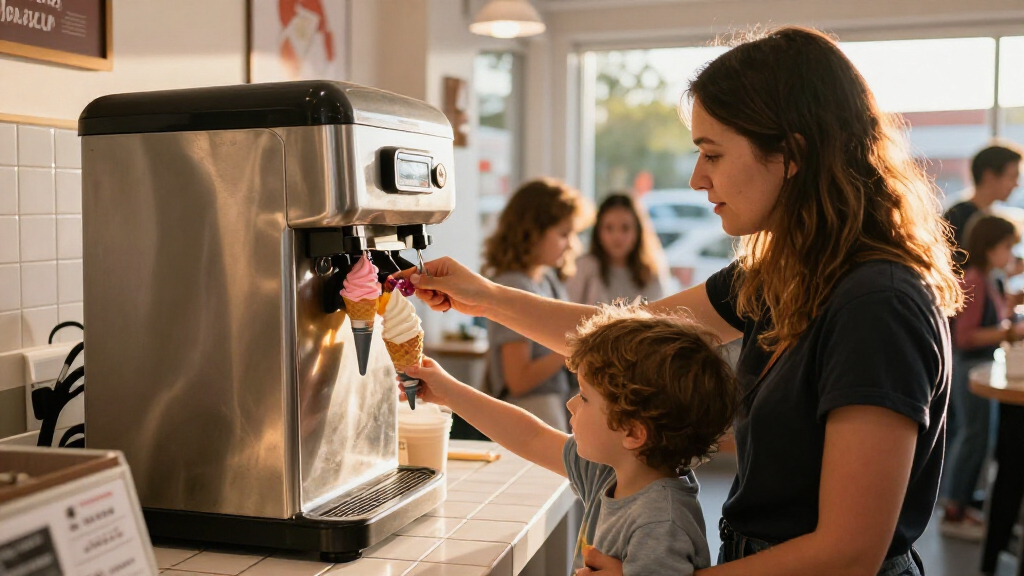
I ranked these machines by how well their listed features answer the day-to-day needs of a frozen yogurt business: usable output, flavor flexibility, hopper and cylinder capacity, controls, cleaning support, and footprint. I also gave weight to practical fit—whether a machine appears better suited to a compact counter, a shop with several flavor options, or a higher-volume service window. Since the product details supplied do not establish independent performance tests, I treat output claims as specifications, not verified serving rates.
The order favors a strong balance of capacity and operating convenience over a single standout specification. Models with three flavors and similar stated output are separated by details such as power, cleaning features, and available capacity information; models offering five or seven flavors rank higher for menu variety, not as automatic winners for every shop. I also account for missing information: when a listing provides limited details about service, electrical fit, or maintenance, I recommend confirming those points before purchase.
Factors to Consider When Choosing Commercial Frozen Yogurt Machine
A commercial frozen yogurt machine is a production tool as much as a menu feature. I’d start with your service pattern and operating constraints, then compare machines by the work they will do during a busy shift—not by the biggest number on a listing. These factors help separate a suitable machine from one that adds cost, complexity, or bottlenecks.
Match Rated Output to Your Rush, Not Your Daily Average
Estimate the number of servings you need during your busiest hour, then compare that demand with the machine’s stated production rate. A business with a steady stream of small orders may need consistent recovery between servings more than a high peak-output claim. Ask the seller how output is measured and what mix, temperature, and serving size assumptions apply. Rated gallons or liters per hour may not reflect real service when the machine is still freezing product or staff are switching flavors. A machine with excess capacity can take up space and draw more power without improving the customer experience. I’d choose enough headroom for rush periods, but avoid sizing from an unusually busy day alone.
Choose Flavor Count Around Menu Complexity
Three-flavor machines can provide two individual flavors plus a twist, a format that suits many straightforward menus. Five- and seven-flavor machines widen the menu, but each added option can mean more ingredients to manage, more cleaning work, and more staff decisions. Before paying for extra flavor outlets, check whether the machine’s layout supports the combinations your menu actually needs. A short menu with rotating specials may benefit more from reliable changeovers than permanent flavor variety. Also ask how flavor hoppers and dispensing paths are cleaned to prevent residue or flavor carryover. More choices are useful only when customers want them and the team can keep up with the added handling.
Verify Electrical Fit and Installation Requirements
Do not assume that a machine listed as 110V will suit every outlet or that a wattage figure tells the whole electrical story. Check the exact voltage, amperage, plug type, circuit requirements, and whether a dedicated circuit is needed. Have an electrician review the intended location before delivery, especially for higher-wattage countertop equipment. Measure the counter, doorways, and clearance around ventilation points; a machine that fits the worktop can still be difficult to install or cool properly. Confirm whether the listed dimensions include handles or other protruding parts. These checks can prevent a mismatch that no output rating can fix.
Treat Cleaning Claims as a Starting Point
Auto-clean functions may reduce repetitive work, but they do not necessarily replace disassembly, sanitizing, or the cleaning routine required by local food rules. Ask for the full cleaning procedure, including how often parts must be removed and whether special tools or cleaning agents are required. Check which components contact the mix and how easily staff can reach them. A machine that saves time during a rinse but takes longer to fully sanitize may not improve the shift overall. Include labor, water use, and downtime in your comparison, not just the presence of an auto-clean button. Training new staff is easier when steps are clear and documented.
Check Service, Parts, and Warranty Before Committing
Commercial equipment downtime can interrupt sales, so find out who handles service and where replacement parts come from before ordering. Ask about warranty coverage for the compressor, freezing cylinder, and labor, and confirm whether repairs require a local technician. A low purchase cost can become a poor value if parts are difficult to source or support is slow. Request written details on expected maintenance and any routine replacement items. Compare service availability in your area rather than assuming all countertop machines receive the same support. For a business that depends on frozen yogurt every day, dependable repair access can matter more than an extra flavor option.
Plan for Mix Handling and Food-Safety Workflow
Machine capacity is only one part of production; staff also need a safe, repeatable way to store, load, and rotate mix. Confirm whether the hopper arrangement and any pre-cooling feature fit your ingredient handling process, and follow the manufacturer’s temperature and storage instructions. A larger hopper may reduce refill interruptions, yet it can be a poor match for a low-volume shop that turns mix slowly. Build refill, temperature checks, and sanitation into the shift plan before choosing a capacity. Ask whether the machine supports the mixes and viscosity your menu uses, since recipes can affect dispensing and texture. A smaller, well-managed setup may be a better business fit than a larger machine with unused capacity.
Frequently Asked Questions
Can these soft-serve machines make frozen yogurt, or are they only for ice cream?
Many soft-serve machines can dispense frozen yogurt, but compatibility depends on the machine and the mix, so I would not assume every listing supports every recipe. Check the manufacturer’s guidance for mix type, viscosity, and operating temperature before ordering. A formulation that is too thick or otherwise outside the machine’s specifications may affect dispensing or product texture. Ask the seller to confirm support for the specific commercial frozen yogurt mix you plan to use. That answer is more useful than relying on a product title alone.
How much output do I need for a small cafe?
Start by estimating peak-hour servings, not total daily sales, and include time for refilling, cleaning, and product recovery. Then ask the seller how the listed hourly output was measured, since serving size and operating conditions can change the practical rate. A cafe with a short rush may prefer a machine that is easy to operate and recover between orders over a larger unit rated for continuous volume. Leave some capacity headroom, but avoid buying based only on a best-case production figure. If demand is uncertain, a manageable workflow may be more useful than extra capacity.
Is a three-flavor machine enough, or should I choose five or seven flavors?
Three flavors often cover two individual choices and a twist, which is enough for many cafes and snack bars. More flavor outlets make sense when variety is central to the menu and sales can support the added ingredients and cleaning workload. Before choosing a five- or seven-flavor layout, map the flavors customers can order and how often each will be replenished. Check whether all outlets can run the combinations you want rather than judging by the number in the product name. If you plan seasonal specials, a simpler machine with a clear changeover process may be a better fit.
Does an auto-clean feature mean the machine needs no manual cleaning?
No. Auto-clean generally describes a feature that assists with part of the cleaning process, not a promise that sanitation and disassembly are unnecessary. Get the written cleaning procedure and confirm which components staff must remove, wash, and sanitize. You should also check local food-safety requirements and the manufacturer’s schedule for cleaning and maintenance. Include the time and training needed for the full routine in your labor plan. If the seller cannot explain the steps clearly, treat that as a reason to ask more questions before purchase.
What should I verify before ordering a 110V or high-wattage countertop machine?
Confirm the exact voltage, amperage, plug, circuit requirement, and whether the machine needs a dedicated circuit. A 110V label alone does not confirm that the machine matches your outlet or that other equipment can share the circuit safely. Ask an electrician to review the installation, especially for a higher-wattage unit or a busy food-service space. Also check the machine’s dimensions, ventilation clearance, and delivery route to the counter. Getting these details in writing can prevent installation delays and avoidable operating problems.
Conclusion
For the broadest mix of capacity and convenience, my best overall choice is the 4L-hopper Commercial Soft Serve Ice Cream Machine with pre-cooling and auto clean. The best for a multi-flavor menu is the Kolice 5-Flavor Countertop, while the Kolice 7-Flavor model suits shops where maximum choice is a defining feature. For a buyer focused on stated throughput, compare the PioneerWorks and VEVOR 20–28 L/H models against your electrical and installation limits before choosing. The listings do not provide enough consistent evidence to name a clear best value or best premium pick, so I’d judge those roles by confirmed warranty, local service, parts access, and total operating fit rather than a headline feature. For beginners, the 4L-hopper model’s touch controls and cleaning assistance make it the clearest starting point—but only after confirming mix compatibility, power requirements, and the full sanitation routine.