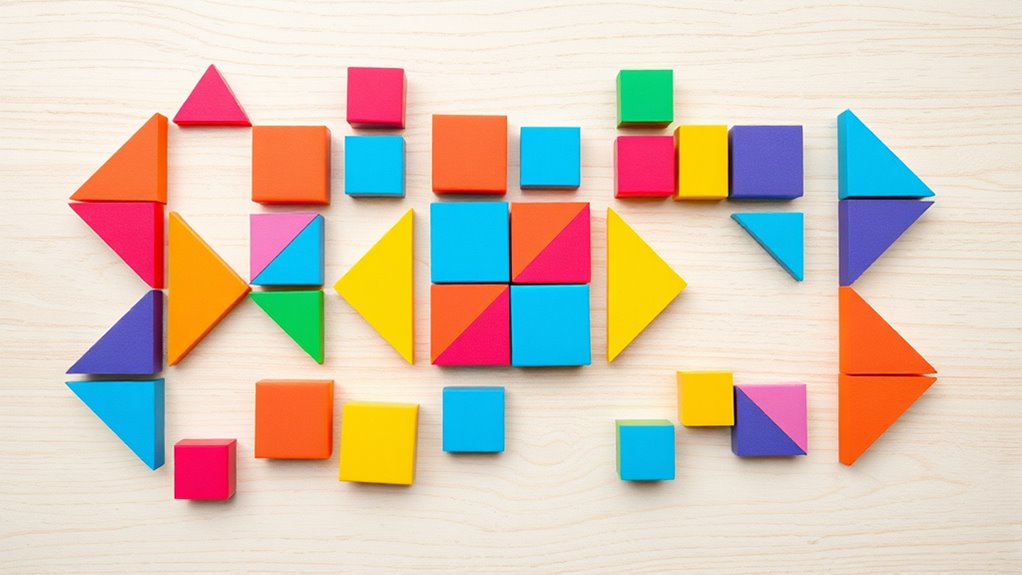

Using pattern blocks helps you explore symmetry and geometric relationships hands-on. As you arrange colorful shapes, you can create eye-catching, repeating designs that show symmetry through reflection or rotation. Color patterns add to the visual appeal and help you understand how symmetry balances a pattern. By rotating or reflecting shapes, you see how designs repeat seamlessly. Keep exploring—there’s much more to discover about how shape and color create harmonious patterns.
Key Takeaways
- Pattern blocks help explore symmetry through shape manipulation, including reflection and rotation.
- Arranging blocks by color and shape reveals repeating and rotational symmetry in patterns.
- Using pattern blocks enhances understanding of how symmetry creates balanced, aesthetically pleasing designs.
- Rotational symmetry occurs when arrangements look the same after rotating by 90°, 180°, or 360°.
- Hands-on exploration with pattern blocks fosters tactile learning of geometric and symmetry concepts.
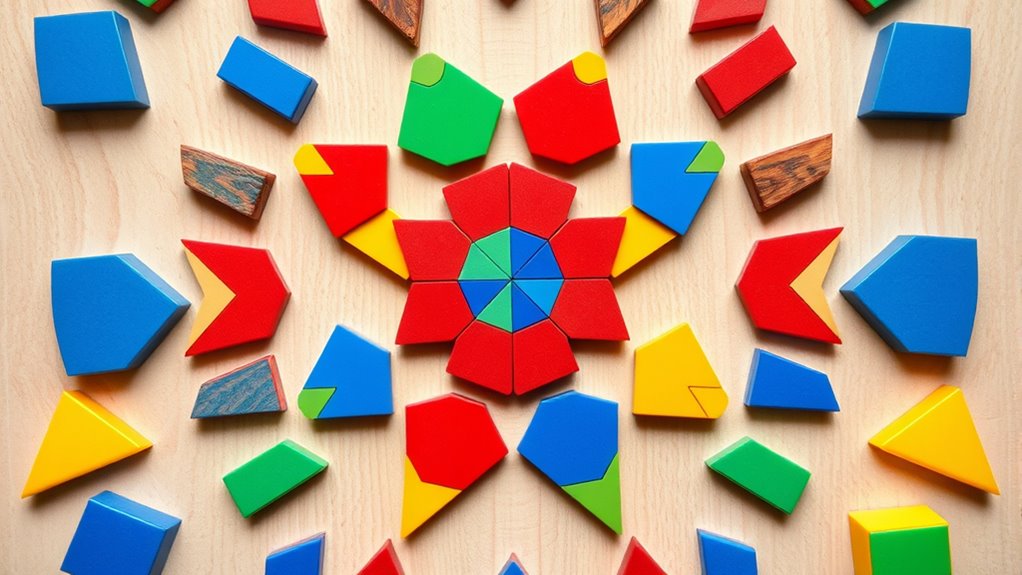
Pattern blocks are versatile tools that help you explore symmetry and geometric relationships. When you use these colorful shapes, you’ll notice how they can be arranged to create eye-catching designs that exhibit various patterns. One of the most fascinating aspects of working with pattern blocks is discovering how color patterns influence the overall look. By carefully placing the different colored pieces, you can develop repeating designs that are visually appealing and demonstrate consistent color arrangements. These color patterns often serve as a foundation for understanding how symmetry works in nature and art. As you experiment, you’ll see how the arrangement of colors can reinforce or enhance the symmetry of your design, making it more balanced and harmonious. Recognizing different types of symmetry, such as reflection and rotational symmetry, helps deepen your understanding of pattern structures. Rotational symmetry is a key concept you’ll encounter when working with pattern blocks. It occurs when a shape or pattern can be rotated around a central point and still look the same. As you manipulate the blocks, try rotating your arrangement by different angles—such as 90, 180, or 360 degrees—and observe whether the pattern appears unchanged. This active exploration helps you grasp the idea that some designs maintain their appearance despite rotation, which is the essence of rotational symmetry. When you align the blocks carefully, you’ll notice how certain patterns repeat seamlessly after rotation, creating a sense of unity and rhythm in your work. Recognizing rotational symmetry in your designs not only sharpens your understanding of geometric relationships but also enhances your ability to craft intricate and balanced patterns. Exploring celebrity transformations can inspire creative approaches to symmetry and design in your own artwork. Using pattern blocks to explore these concepts encourages hands-on learning. As you build and rearrange shapes, you develop a tactile understanding of symmetry principles. This approach makes abstract ideas more concrete and accessible, especially when you see how different arrangements produce symmetrical patterns. You can challenge yourself to create designs that incorporate multiple types of symmetry—such as reflection and rotation—by experimenting with different configurations. Over time, you’ll become more confident in identifying symmetrical features in both your patterns and the world around you. This active engagement with pattern blocks deepens your appreciation for the beauty of symmetry in everyday objects, from snowflakes to architectural details.

Melissa & Doug Pattern Blocks and Boards with 120 Multi-Colored Wooden Shape Tiles, 5 Double-Sided Puzzle Boards, Tangram Puzzles, Montessori Toys for Girls & Boys
Skill-Building Pattern Play: Kids sort & stack wooden shaped tiles, to fill 5 unique patterns allowing them to…
As an affiliate, we earn on qualifying purchases.
As an affiliate, we earn on qualifying purchases.
Frequently Asked Questions
How Can Pattern Blocks Improve Spatial Reasoning Skills?
Pattern blocks improve your spatial reasoning skills by enhancing spatial visualization and geometric understanding. As you manipulate the blocks, you actively explore how shapes fit together, which sharpens your ability to visualize spatial relationships. This hands-on approach encourages you to recognize patterns and geometric features, making it easier to solve complex puzzles and understand geometric concepts. Regular practice with pattern blocks boosts your confidence and skills in understanding space and shape.
Are Pattern Blocks Suitable for All Age Groups?
Yes, pattern blocks are suitable for all age groups, but you should consider age appropriateness and developmental stages. Younger children benefit from simple shapes to develop fine motor skills and basic recognition. Older kids and adults can explore complex patterns and problem-solving. Adjust activities to match their cognitive abilities, ensuring they stay challenged yet engaged. This way, pattern blocks support learning and growth across various ages effectively.
What Are Some Real-World Applications of Symmetry?
Imagine walking through a city where every building reflects perfect balance, like a mirror image. Symmetry plays a vital role in real-world applications such as analyzing fracture patterns in geology or designing stunning architectural structures. You see symmetry in nature’s butterfly wings and in the intricate patterns of snowflakes. It helps engineers create stable bridges and resilient materials, making your environment safer and more beautiful.
How Do Symmetry and Pattern Blocks Relate to Art?
You see that symmetry and pattern blocks influence art by helping you create balanced, harmonious designs. They connect to color theory, as artists use symmetry to develop appealing color arrangements, and cultural symbolism, where symmetrical patterns often hold cultural meanings. By exploring how pattern blocks form symmetrical shapes, you learn to craft visually engaging artwork that communicates deeper cultural messages and evokes emotional responses through balanced composition.
Can Pattern Blocks Be Used to Teach Advanced Mathematical Concepts?
Yes, you can use pattern block puzzles to teach advanced mathematical concepts. They facilitate algebraic exploration by helping you visualize and manipulate shapes to understand relationships, transformations, and symmetries. By engaging with these puzzles, you deepen your comprehension of geometric principles, develop problem-solving skills, and explore mathematical patterns in a hands-on way. This approach makes complex ideas more accessible and encourages active learning.
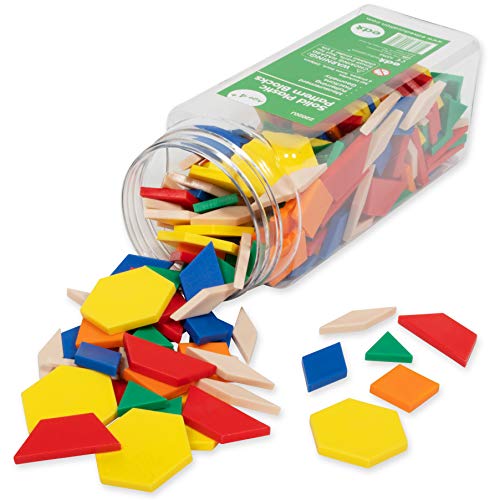
edxeducation Plastic Pattern Blocks | Set of 250 | Math Manipulative for Fractions, Symmetry, Patterning and Creativity | Math Supplies for Classroom
BULK 250-PIECE SET — This large set of standard pattern blocks includes 25 yellow hexagons, 25 orange squares,…
As an affiliate, we earn on qualifying purchases.
As an affiliate, we earn on qualifying purchases.
Conclusion
By exploring pattern blocks and symmetry, you discover how shapes repeat and balance beautifully. Did you know that symmetry appears in over 70% of natural objects, from butterflies to flowers? This shows nature’s incredible design and helps you see patterns everywhere. Keep experimenting with pattern blocks, and you’ll notice how symmetry makes everything more harmonious and interesting. So, next time you create, remember—you’re revealing the secrets of nature’s perfect balance!
edxeducation Plastic Pattern Blocks | Set of 250 | Math Manipulative for Fractions, Symmetry, Patterning and Creativity | Math Supplies for Classroom
BULK 250-PIECE SET — This large set of standard pattern blocks includes 25 yellow hexagons, 25 orange squares,…
As an affiliate, we earn on qualifying purchases.
As an affiliate, we earn on qualifying purchases.
edxeducation Plastic Pattern Blocks | Set of 250 | Math Manipulative for Fractions, Symmetry, Patterning and Creativity | Math Supplies for Classroom
BULK 250-PIECE SET — This large set of standard pattern blocks includes 25 yellow hexagons, 25 orange squares,…
As an affiliate, we earn on qualifying purchases.
As an affiliate, we earn on qualifying purchases.